
The “worst readers” are often the kids who read the most
 There are two kinds of reading comprehension questions.
The first has a right answer. You read a passage, you find the information, you match it to the option that fits. These are multiple choice questions. They test whether you can locate and recognize a correct answer inside a text. They reward pattern detection and results correlate strongly with IQ.
The second kind has no right answer. You read a passage and then someone asks: what do you think the author meant? How did the character feel? What was the theme? They test a kid’s ability to produce a coherent, contextual response to a question with no objective answer. These scores do not correlate with IQ.
Half of reading comprehension tests actually measure social skills
In fact, the open-ended questions are measuring something closer to a social skill. Have you ever watched someone with high systemizing intelligence freeze when someone asks “how are you?” They freeze because the question is genuinely unanswerable given how many possible true responses exist. Open-ended reading comprehension questions are hard for the same reason “how are you?” is hard.
We use these two types of reading comprehension tests interchangeably to assess how well children read. What we call reading comprehension is not a single ability. And that mistake is labeling the wrong kids as failures.
This idea unfolded a few years ago when I was doing research at Harvard’s School of Education. I ran a study of fifty autistic women, and I asked them whether they had reading comprehension problems. Most said yes. Then I asked whether those problems had held them back professionally. Most said no. Several of them hadn’t even known they had “reading comprehension deficits” until recently.
This finding reveals the core problem: reading tests don’t test reading.
These women were high IQ, strong decoders. Most loved words and language and they had spent their lives reading. Also, most were professionally successful. But they performed poorly on open-ended reading comprehension questions. The women did not reliably perform understanding in a socially fluent way.
The test did not locate a reading deficit but rather a particular cognitive style. The test couldn’t tell the difference.
Our reading skills crisis is that we can’t measure reading skills
Now there’s a national panic about kids not being able to read. Teachers are alarmed. Parents are alarmed. There are op-eds and documentaries and curriculum overhauls. But nobody is asking the first question: what exactly are we measuring when we say kids can’t read?
If we’re measuring multiple choice comprehension, we’re measuring IQ and pattern seeking.
If we’re measuring open-ended comprehension, we’re measuring verbal fluency and social cognition.
Often, if the reading comprehension test results are low, the next test will measure decoding. But measuring decoding is really measuring working memory, which is largely inherited neurological trait rather than a teachable skill.
Forget about trying to teach a kid to love to read. Reading for pleasure is a result of very early decoding. Some children, from infancy, attend intensely to language patterns rather than faces and social cues. That early focus produces precocious decoding, and decoding produces a neurological reward from the pattern-solving that other children don’t get. That reward becomes identity. You can’t generate reading love through instruction because by the time a child is in a classroom, the thing that produces it already happened.
So here’s how reading works; it has nothing to do with instruction
Here’s how reading actually develops. It has nothing to do with instruction.
Genetics and early neurological development → working memory capacity
Working memory capacity → early decoding ease
Early decoding ease → reading becomes a source of pleasure, not effort
Reading pleasure → a lifetime of voluntary reading
Voluntary reading → the vocabulary, background knowledge, and language exposure that produce strong test performance
By the time a teacher assigns a reading log, every arrow in that chain is already determined. The kids who will love reading are identifiable in infancy — not because of what their parents did, but because of how their brains developed. The open-ended comprehension score sits entirely outside this chain, measuring something else: whether a child can perform social fluency on demand. Which is why it doesn’t predict any of the outcomes the other arrows predict.
The panic over “kids today can’t read” comes from people who love reading, researchers who study literacy, policy wonks who experience the world through reading, teachers who manage a large group of students by telling them to sit down and read. So of course these people interpret declining scores as a crisis rather than a shift. Our reading crisis is actually a measurement system built around one cognitive style, applied universally, and mistaken for an objective truth about reading.
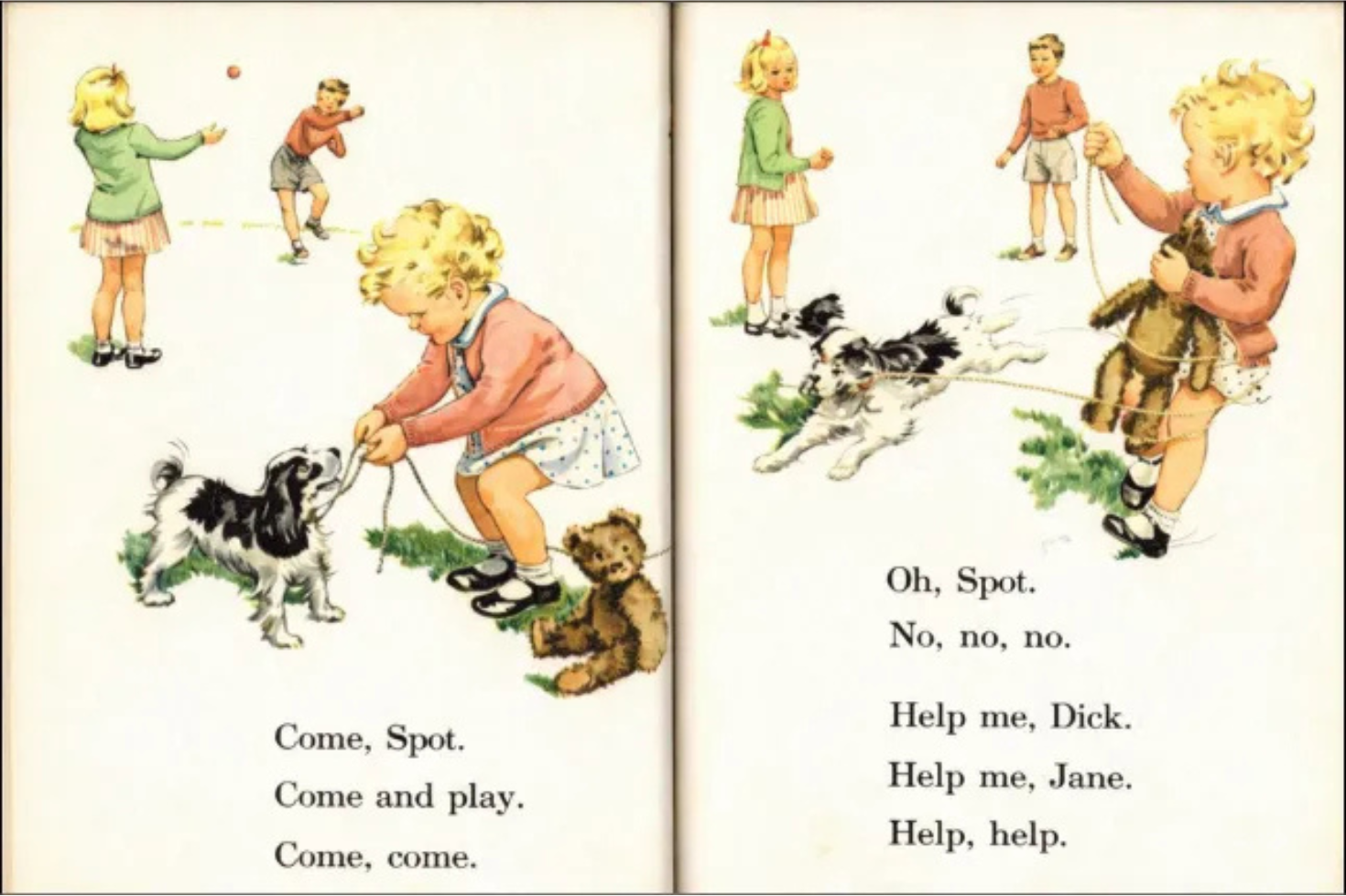
I taught myself to read when I was three (with Dick and Jane!) I have read constantly my entire life. I love words – the sound of them, the patterns, I even love diagramming a sentence.
In high school I was nationally ranked as a debater. I was also in remedial reading. I didn’t know that’s what it was until halfway through the semester. What I remember most is that the class focused on vocabulary and I loved it. Because even though I thought I was bad at reading, what I was actually bad at was one narrow format inside a much larger bundle of skills we’ve decided to call “reading.”
It took me a long time to understand that I’m smart. I accepted that intelligence is measured by who is in advanced English. I told myself I did well in debate because I’m a good speaker, not because I’m smart. If someone explained to me why I was in remedial English I could have made sense of who I am.
The problem for me wasn’t facing that I had a deficit — that was obvious to me in a range of ways. But people were scared to tell me I had a learning deficit and that made them unable to have a conversation with me about my learning strengths. Now that I understand, I have much more agency in my life. For example, I can’t fill out forms when there’s a blank line. I used to feel shame. Now I ask someone to help me because I know it doesn’t mean that I’m stupid. It means that I love to read.
Sources, further reading, and a note to the reader
I’ve been arguing with AI for the last 36 hours about this research. Every time I asked AI to check my logic it told me I was wrong and then couldn’t produce research to back it up. Finally, I asked it what I can do so that the next time we talk about this topic it starts out with the research it approved the last time we talked about the topic. And AI said I should have this section, which, I have to admit, AI wrote as a note to itself.
On the distinction between dyslexia and reading comprehension deficits: Snowling, Hayiou-Thomas, Nash & Hulme (2020) followed children from age 3½ through age 9 and found that children with dyslexia had severe decoding deficits but only mild reading comprehension problems, while children with Developmental Language Disorder had intact decoding and severe comprehension deficits — confirming these are separate neurological systems. Journal of Child Psychology and Psychiatry, 61(6), 672–680. https://pmc.ncbi.nlm.nih.gov/articles/PMC7317952/
On what different reading comprehension tests actually measure: Keenan, Betjemann & Olson (2008) showed that different reading comprehension tests vary substantially in whether they depend on decoding skill or oral language comprehension — meaning two tests called “reading comprehension” can be measuring largely different things. Scientific Studies of Reading, 12(3), 281–300. https://doi.org/10.1080/10888430802132279.
On the heritability of reading ability: Twin studies consistently find that 60–75% of variance in reading ability is genetic. Shared environment — including how many books are in the home and how often parents read aloud — accounts for a small and shrinking portion of variance as children age. Byrne, B., Olson, R.K., Samuelsson, S., Wadsworth, S., Corley, R., DeFries, J.C., & Willcutt, E. (2006). Genetic and environmental influences on early literacy. Journal of Research in Reading, 29(1), 33–49. https://doi.org/10.1111/j.1467-9817.2006.00291.x
On working memory and reading: Working memory contributes to decoding acquisition in early readers and to inferential comprehension in older readers. For a review of the mechanisms: Gathercole & Alloway (2008), Working Memory and Learning: A Practical Guide for Teachers. Sage Publications. https://www.scirp.org/reference/referencespapers?referenceid=2279894
On the Simple View of Reading: The foundational framework showing that reading comprehension is the product of decoding and language comprehension — and that deficits in either produce comprehension problems for different reasons: Gough, P. B., & Tunmer, W. E. (1986). Decoding, reading, and reading disability. RASE: Remedial & Special Education, 7(1), 6–10. https://doi.org/10.1177/074193258600700104
On whether you can train working memory to improve reading: Melby-Lervåg, Redick & Hulme (2016) analyzed 87 studies with 145 experimental comparisons and found no convincing evidence that working memory training transfers to word decoding, reading comprehension, or any other academic skill. Critically, the degree of improvement on working memory measures was unrelated to any reading gains — meaning even when the training “worked,” it did not help kids read. Psychological Science, 27(4), 512–522. https://pmc.ncbi.nlm.nih.gov/articles/PMC4968033/ This finding was replicated specifically in typically developing children by Sala & Gobet (2020), a multilevel meta-analysis of 41 studies showing that working memory training produces zero far-transfer effects on language and academic achievement when active controls are used. Psychonomic Bulletin & Review, 27, 423–434. https://doi.org/10.3758/s13423-019-01681-y
On inhibitory control and inferential comprehension: Pérez, Schmidt, Kourtzi & Tsimpli (2020) found that inhibitory control — specifically the ability to suppress competing interpretations — predicts whether readers can successfully revise their understanding when new information contradicts a previously generated inference. Readers with lower inhibitory control had difficulty suppressing outdated interpretations even after encountering correct information. This is the mechanism behind why some strong decoders struggle with open-ended comprehension questions: competing interpretations keep interfering when they try to generate a response. Neuropsychologia. https://doi.org/10.1016/j.neuropsychologia.2019.107313
On the Harvard study I reference in this post: The sample of autistic mothers we describe here stems from research conducted at the Harvard Graduate School of Education. The published methodology and sample characteristics appear in: Trunk, P., Choi, B., & Rowe, M.L. (2024). Surveying autistic mothers about their parenting practices related to children’s early language development. Autism in Adulthood. https://doi.org/10.1089/aut.2024.0138. The reading comprehension findings that I report in this post — that mothers who reported significant school-age comprehension deficits showed no corresponding professional impairment and were largely passionate readers — were collected in the course of that research but were not submitted for publication.
I love seeing your name on a scholarly article.
I was judged to have poor reading comprehension in school. You have let me see that it was not being able to decode the hidden things in the social interactions in stories.
The worst reading experience I had in school was _Wuthering Heights_. There was so much going on below the surface that I just couldn’t reach. There was active and engaged discussion in class about the book with the girls, mostly, talking about all they pulled out of the text and I’m sitting there thinking, “Where did you get all of this from? I don’t see it in there.”
I really like how clearly you separated recognition questions from generative interpretation questions. That distinction is very important.
I see that ‘reading comprehension’ scores are used as a tool by institutions. Reading comprehension functions as a composite or combined score. It blends decoding, language comprehension, inference, executive regulation, and discourse into one number. That number creates a rank order, which is useful. Schools use it to place students, assign groups, and, I think most critically, to divide resources.
When a bunch of different skills gets squeezed into one score, schools can sort kids quickly, but not always correctly. And if that number is going to shape a child’s path, it should actually reflect what they can and cannot do.
Unfortunately, because this ‘sorting tool’ is so accessible to teachers and schools, I don’t see it going away any time soon. I hope I’m wrong.
Megan, I love this comment. You say so clearly that the problem is school. School drives the need to test and that means there’s a huge budget to test, and academics create suspect ways to become experts in this field so they can make money.
Education is broken from kindergarten through to the professors. It’s all about money and that is making the people and institutions less and less productive.