
When people tell me they want to stay home with their kids and they can't afford it, I want to yell at them about how when I was trying to write freelance and take care of the kids I had a babysitter refuse to come to the house because we had no food in the house. We had no food in the house because we had no money. I bought food on a day-to-day basis. That was me, affording to stay home with my kids and not work.
I must also admit that I ended up in a mental ward. Maybe from postpartum depression, but probably from the stress of being the sole breadwinner and a stay-at-home mom.
I am having flashbacks. Because I'm homeschooling now – both boys. I never really believed I'd do this. When I launched my homeschooling blog I actually thought I was just exploring a trend. I thought I'd just write a little about how it's clear to me that there is about to be a homeschooling revolution.
But that's not what happened.
Because then I noticed how the US school system is really just the biggest babysitting institution in the world. My first clue, probably, was that I was dying to have my kids back in school so I could have my life back. What else can I do to get time alone? How else can I do some work? Work is very fun.
I love work. I love how people tell me how great I am when I am right. I love when I sell something and make a lot of money, when I create a great job for someone, when I give great career advice. Work is so rewarding. I get accolades and I get money. It's a toxic combination.
And kids at home without school is just impossible. There is no reward system. There is no announcement that the mom has done a good job. We don't even know what a good job is.
So in the middle of realizing that school is really just a babysitting service, I became militant. I realized that public school is like Social Security. There is no money to do what we are pretending we are aiming to do. We should just grow up and admit that we cannot have effective public schools for everyone. Just like we cannot have Social Security for everyone.
But parents in the middle class can have one parent working and one parent home with their kids.
I feel like I have no choice. Because while I was waiting for the kids to go back to school, I was reading. And, of course, now my homeschool site makes me a magnet for research about school. And the evidence is overwhelming that schools are not meeting the educational needs of children:
- Unstructured play is more important than everything else for young kids.
- Test scores are not important.
- The homeschool trend is huge among educated parents.
- Passion-based learning is an impossible goal with 30 kids and one teacher.
- Almost all serious talk of school reform is about redefining what school is.
I challenge you to read these links and tell me you don't think homeschool would be better for your kids. And this is why I tell myself that I have to make homeschooling work.
Believe me. There is absolutely no evidence that middle class kids from college-educated parents should be sitting in a classroom. Find me some. Really. Put it in the comments. Because if I could have found some, my kids would be in a classroom today.
But you know what? I can't figure out how to get my work done and do homeschool too. I can't figure out: Should I work more to pay for more childcare so I can work more? I know I don't want the pressure of trying to have a big job and be a mom. I want to be a mom and I want to have an interesting job. And, I guess, I want to figure out how much more I have to work in order to pay for somehow getting a break from the kids.
I feel so bad writing that. A break from the kids. But that's what sending kids to school is. Giving the parents a break. So I guess I'm still doing that. I'm still planning to get some sort of break. I'm just not calling it school.
Last week, all I could think of for my break was shopping at Forever 21. And I am hopeful that maybe it counted as homeschooling, too.

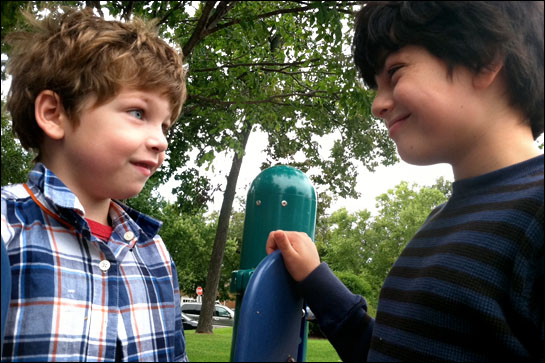
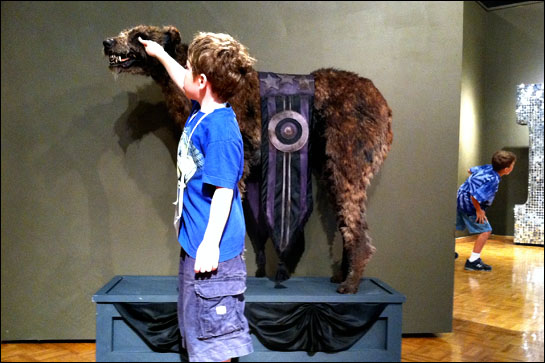


He he-that picture is hysterical. Educational, indeed.
Posted by Nessa on September 19, 2011 at 1:09 pm | permalink |
He he-that picture is hysterical. Educational, indeed.
Posted by Nessa on September 19, 2011 at 1:09 pm | permalink |
Our solution to this problem was for my husband to stay-at-home with the kids. I love my work, and he didn't love his, but homeschooling was non-negotiable for our family.
So with him taking care of a couple meals a day, the dishes and a lot of the cleaning, plus playing with and helping the kids while I work, I'm able to do both.
18 months in, and it's working for us!
Posted by Mandi @ Life...Your Way on September 19, 2011 at 1:13 pm | permalink |
Our solution to this problem was for my husband to stay-at-home with the kids. I love my work, and he didn't love his, but homeschooling was non-negotiable for our family.
So with him taking care of a couple meals a day, the dishes and a lot of the cleaning, plus playing with and helping the kids while I work, I'm able to do both.
18 months in, and it's working for us!
Posted by Mandi @ Life...Your Way on September 19, 2011 at 1:13 pm | permalink |
Are any of the leaders you admire public school graduates? I know plenty who are successful (measured in many ways) who are products of public school. Human beings are resilient.
One danger of the homeschooling trend is that it becomes just one more way that some women can hold ourselves to impossibly high standards. And unlike the way we do this at work, add to this one the pressure of making sure your kid turns out okay without any help.
I'd also say that the "middle class" as we once knew it is a currently a pretty difficult juggle for many two income families. I think that one parent staying home is more realistic for people at the way upper end of middle class, and beyond.
Posted by Anne on September 19, 2011 at 1:18 pm | permalink |
Public school does not get the credit for the success of people like me and others. Just because I endured the boredom and torture doesn't mean it lead to my success any more than the other abuses I've suffered.
We shouldn't send our kids to a place and give ourselves the excuse that humans are resilient. Some are. Others end up in mental wards, are victims of suicide ex.
Posted by Anonymous on September 19, 2011 at 1:54 pm | permalink |
Public schools are way more overcrowded and underfunded than they were 20, 30, 40 years ago. At least in my area. I have a toddler now but I'm soon looking at choosing between public schools surrounded by 10 foot fences and with full time staffs of multiple security guards (just as much to keep the kids in as to keep the riff raff out), as well some of the lowest scores and highest percentage of behaviorally challenged students requiring personal attention in the state, or private school I'm not sure we can afford, or homeschooling. Not much of a choice.
I am a product of public school and I turned out fine. And we are not wealthy by any definition at all. I would much rather work full time than homeschool. But not at my child's expense. We have to consider all of the factors involved.
Posted by RotterWrites on September 19, 2011 at 5:52 pm | permalink |
I challenge your math. Overall US per capita spending on education is up 190% over the last 20 years on an inflation-adjusted basis. I bet this is no different in your community. The US federally-funded education scheme has used more and more money for worse and worse results for decades. Seriously, NYC spends more than $11K/student/year and yet somehow I believe that if someone handed me 25 random 3rd graders and $275K I could get better results.
Posted by Anonymous on September 21, 2011 at 9:46 pm | permalink |
This post is exactly right. The only part that is not mentioned that I am weighing is the "shared experience" benefit of going to school. Public school in the United States started as a way to bring together an immigrant population with diverse backgrounds and provide the next generation with a common experience. I think there is still value in that…but maybe not enough.
Posted by Stacy on September 19, 2011 at 1:23 pm | permalink |
Stacy, first that is not at all why schools were started. Compulsory schooling was started 1) To keep more people out of the work force 2) To produce compliant workers who were good at sitting in rows and not questioning authority who would help an industrial age society prosper.
School does not group children with varied backgrounds. In school kids are grouped by date of manufacture, with those who share their geography, and are rarely culturally diverse. If you want to read more on this look up Jonathan Kozol and apartheid education. You can start with this article http://www.thenation.com/article/overcoming-apartheid
If you believe there is value in exposing children to others with diverse backgrounds, home education provides terrific opportunity to do just that. School does not.
Posted by Anonymous on September 19, 2011 at 2:06 pm | permalink |
you make the invention of schools look like a bog evil conspiracy. What is discussed here in terms of homeschooling is to some degree a luxury problem: middle lass educated parents are and will be in the future the largest group considering and doing home schooling. In many other countries to be able to attend a school is considered a privilege. That does not make all schools great, not by a far cry, but it allowed to educate a large percentage of the population which would never have been possible otherwise. Being able to individualize, or even wish to individualize every aspect of a childs learning is a luxury.
And about the art of teaching: you can only teach well a subject you fully comprehend. Good teaching of a subject is not simply achieved by looking at a textbook together. It requires much more in-depth knowledge, and probably not all teachers bring this to the table, but many try and even succeed.
Posted by redrock on September 19, 2011 at 4:18 pm | permalink |
you make the invention of schools look like a bog evil conspiracy. What is discussed here in terms of homeschooling is to some degree a luxury problem: middle lass educated parents are and will be in the future the largest group considering and doing home schooling. In many other countries to be able to attend a school is considered a privilege. That does not make all schools great, not by a far cry, but it allowed to educate a large percentage of the population which would never have been possible otherwise. Being able to individualize, or even wish to individualize every aspect of a childs learning is a luxury.
And about the art of teaching: you can only teach well a subject you fully comprehend. Good teaching of a subject is not simply achieved by looking at a textbook together. It requires much more in-depth knowledge, and probably not all teachers bring this to the table, but many try and even succeed.
Posted by redrock on September 19, 2011 at 4:18 pm | permalink |
Public school was started in colonial times for farmers' sons to learn the basics of calculation, reading, and writing (during the winter months) so that they could be more successful and the country could grow in prosperity. It was a politically driven social program mostly spearheaded by Benjamin Franklin.
Posted by Tingras on September 19, 2011 at 2:19 pm | permalink |
There are plenty of homeschoolers in college. They can often spot each other by their enthusiasm for learning and individuality. They have their own jokes about their shared experience of homeschooling and others' humorous questions of them.
Posted by Zellie on September 19, 2011 at 4:08 pm | permalink |
There are plenty of homeschoolers in college. They can often spot each other by their enthusiasm for learning and individuality. They have their own jokes about their shared experience of homeschooling and others' humorous questions of them.
Posted by Zellie on September 19, 2011 at 4:08 pm | permalink |
I'm so glad you wrote this. We're homeschooling. My husband runs a seasonal business and I work from home. It's beyond crazy, but we're trying to figure it all out. The ONLY reason I ever want to send the kids to school is for free babysitting.
But that's not really a good reason to institutionalize the kids.
By the way we're the should be middle class, but now lower class. You know the poor prople with iphones and dark chocolate. Though we're looking for my career to grow and hubby to stay home and manage the home/homeschool.
Posted by Hillary13 on September 19, 2011 at 1:29 pm | permalink |
I think what you're sacrificing by not sending your kids to school (apart from your time and mental health) is standardization. I agree homeschooling could get your kids to be more successful than others – for a number of reasons related to innovation and creativity, however, what are the future costs (cultural, social etc…) of not having your kids adhere to school system standards? Will the benefits be higher than such costs? It's important because your kids will be the ones to pay.
Posted by Alex Dogliotti on September 19, 2011 at 1:31 pm | permalink |
Wait! Why do we want learning that is standardized rather than customized to a child's passions, talents, interests and abilities? Parents who have chosen passion-driven learning over the dumbed down standardization and regurgitation fostered in schools have been thrilled with their adult children who grew up to be creative, entrepreneurial, critical thinkers, writers, movie makers etc.
If you want to read about what happens to kids who grew up without school, you can start with some that I've compiled here http://theinnovativeeducator.blogspot.com/2011/01/profiles-of-adults-who-were-passion.html
I have met numerous adults who grew up without traditional schooling and they are grateful that they were not the standardized widgets the system likes to spit out. These widgets today, btw are graduating college having a difficult time getting jobs because compliance and standardization aren't the ingredients for success in a post-industrial world.
Posted by Anonymous on September 19, 2011 at 2:13 pm | permalink |
Wait! Why do we want learning that is standardized rather than customized to a child's passions, talents, interests and abilities? Parents who have chosen passion-driven learning over the dumbed down standardization and regurgitation fostered in schools have been thrilled with their adult children who grew up to be creative, entrepreneurial, critical thinkers, writers, movie makers etc.
If you want to read about what happens to kids who grew up without school, you can start with some that I've compiled here http://theinnovativeeducator.blogspot.com/2011/01/profiles-of-adults-who-were-passion.html
I have met numerous adults who grew up without traditional schooling and they are grateful that they were not the standardized widgets the system likes to spit out. These widgets today, btw are graduating college having a difficult time getting jobs because compliance and standardization aren't the ingredients for success in a post-industrial world.
Posted by Anonymous on September 19, 2011 at 2:13 pm | permalink |
I am thrilled with my adult son. One of the benefits of home-schooling I think is that he wasn't exposed to the drive to fit in, be part of the 'in group', be 'popular'. He has an innate ability to interact with and value all people regardless of social status born out of his own strong identity or sense of self.
I home-schooled beginning after sixth grade using principals from the Sudbury Schools. 'Dumbing Us Down: The Hidden Curriculum of Compulsory Schooling' by New York State teacher of the year John Taylor Gatto was one of the books that convinced me that home-schooling was preferable to public education. For the person who asked how to teach everything…chemistry, math, etc. My son wanted to learn about auto mechanics and building a computer from scratch. For the subjects that I wasn't proficient in we found a class, a book, an online course, another adult. He learned a lot hanging out at my local Union Hall for example. Many community colleges accept home schoolers. You don't have to teach everything yourself. This also resolves the issue of isolation.
Posted by Susan Hall on September 19, 2011 at 3:20 pm | permalink |
I am thrilled with my adult son. One of the benefits of home-schooling I think is that he wasn't exposed to the drive to fit in, be part of the 'in group', be 'popular'. He has an innate ability to interact with and value all people regardless of social status born out of his own strong identity or sense of self.
I home-schooled beginning after sixth grade using principals from the Sudbury Schools. 'Dumbing Us Down: The Hidden Curriculum of Compulsory Schooling' by New York State teacher of the year John Taylor Gatto was one of the books that convinced me that home-schooling was preferable to public education. For the person who asked how to teach everything…chemistry, math, etc. My son wanted to learn about auto mechanics and building a computer from scratch. For the subjects that I wasn't proficient in we found a class, a book, an online course, another adult. He learned a lot hanging out at my local Union Hall for example. Many community colleges accept home schoolers. You don't have to teach everything yourself. This also resolves the issue of isolation.
Posted by Susan Hall on September 19, 2011 at 3:20 pm | permalink |
Susan, that makes a lot of sense. People unfamiliar with home ed think it means the parents teach everything. No! The parent may teach some things, as they do regardless, but the reality is that people can pursue learning if given the freedom to do so. It could be a formal face-to-face or online class. It could also be passionate people connecting on doing something of interest. It could be an apprenticeship and/or working some where. There are so many options once we think outside of old-school constructs.
The great thing about home ed kids is that they are free to do and engage with the world rather than being locked in a school building with children who just get to read about such things.
Posted by Anonymous on September 19, 2011 at 4:42 pm | permalink |
Alex - Curiosity here. can you tell me more? What are the "school system standards" the children won't know how to adhere to? And why are they important to you?
Posted by Elaine Hansen on September 19, 2011 at 2:59 pm | permalink |
homeschooling is *unstandardized* education â that's it's beauty.
Posted by Lori on September 23, 2011 at 6:33 pm | permalink |
Well, I don't know. How about if women who choose motherhood, stick to game plan, which ought to be 110% dedication to raising their kids, not any career at all. This is what is wrong with society today.
Everyone wants it all and our children are suffering because of this mentality. Women have lost focus. It's sad.
Yes, I agree that the US school system is utilized for "babysitting" and ought not to be.
Instead, women need to stay home to care for kids, while men go to work to support the family.
Because women "want it all," kids suffer, get babysat and wages are spread thin, which perpetuates the vicious cycle of kids raising themselves, badly. Thus putting mothers in the awful position to have to work, AND raise the kids, who become last on the list, after our accomplishments and income.
It's a shame and to blame for the desecration of our society.
No one can have it all, yet because we are selfish, it is what it is.
I'm sure to get a lot of flack for this comment. I am not saying women ought not to have careers, I am saying that women who want to be mothers, ought to consider the position they are putting their kids in by needing a "babysitter."
@gogorach
http://gogorach.com
Posted by Anonymous on September 19, 2011 at 1:39 pm | permalink |
Your point is well taken, that in our current day and age we often feel driven to "have it all." My only criticism is that you're focusing on "women" rather than "parents." PEOPLE want to have it all, not just women. And, it's not necessarily a matter of selfishness, it's a matter often of feeling trapped or not realizing what the alternatives are, which is why discussions like this are so important.
Marriage/partnership takes a good deal of time, committment, effort, and the willingness to grow. There's nothing guarenteed about it, and the conundrum that stay at home moms (or dads) often face is the dependence on someone else's income. What happens if the primary breadwinner becomes ill,or leaves the relationship?
If we can't depend on social systems as a safety net, then we have to rely on ourselves. What that means on an individual basis is going to vary.
Posted by Tingras on September 19, 2011 at 2:16 pm | permalink |
Well, I do blame women, in a sense, especially the ones who "want it all" because they are typically the ones in charge of paying the bills and the wallets. If this was managed better, women would be able to stay home. For example, anyone who buys a latte every day, or goes out for dinner regularly is making the choice to earn/spend those dollars instead of saving and preparing for motherhood. It has become a societal problem, sure, but it began with the third wave of feminism.
If it were up to me, I would set aside a fund for mothers and children who are left behind by dead beats. Also, people would be required to pass a test to prove that they are able and willing to manage the responsibility that is a child, before I'd allow them to procreate. I do not have children, by choice, because of my beliefs.
No worries. I won't ever be in charge, but I will be published and talking about this subject as often and loud as I can. All my best to you and yours! GGR
Posted by Anonymous on September 20, 2011 at 8:04 pm | permalink |
"I won't ever be in charge." Damn good thing, too…
Posted by Nessa on September 21, 2011 at 2:58 am | permalink |
Well, I do blame women, in a sense, especially the ones who "want it all" because they are typically the ones in charge of paying the bills and the wallets. If this was managed better, women would be able to stay home. For example, anyone who buys a latte every day, or goes out for dinner regularly is making the choice to earn/spend those dollars instead of saving and preparing for motherhood. It has become a societal problem, sure, but it began with the third wave of feminism.
If it were up to me, I would set aside a fund for mothers and children who are left behind by dead beats. Also, people would be required to pass a test to prove that they are able and willing to manage the responsibility that is a child, before I'd allow them to procreate. I do not have children, by choice, because of my beliefs.
No worries. I won't ever be in charge, but I will be published and talking about this subject as often and loud as I can. All my best to you and yours! GGR
Posted by Anonymous on September 20, 2011 at 8:04 pm | permalink |
Your point is well taken, that in our current day and age we often feel driven to "have it all." My only criticism is that you're focusing on "women" rather than "parents." PEOPLE want to have it all, not just women. And, it's not necessarily a matter of selfishness, it's a matter often of feeling trapped or not realizing what the alternatives are, which is why discussions like this are so important.
Marriage/partnership takes a good deal of time, committment, effort, and the willingness to grow. There's nothing guarenteed about it, and the conundrum that stay at home moms (or dads) often face is the dependence on someone else's income. What happens if the primary breadwinner becomes ill,or leaves the relationship?
If we can't depend on social systems as a safety net, then we have to rely on ourselves. What that means on an individual basis is going to vary.
Posted by Tingras on September 19, 2011 at 2:16 pm | permalink |
There are people who "want it all" on both ends of the gender divide. Don't make this a problem about women. The antifeminist crap is a bit out of place here.
Posted by Nessa on September 19, 2011 at 3:48 pm | permalink |
Well, actually, "the anti-feminist crap" is completely relevant because the home-schooling problem wouldn't exist to begin with, if it were not for Penelope's issue with managing her career and her kids, while making a decision whether to use the US School system for "babysitting."
Posted by Anonymous on September 20, 2011 at 7:57 pm | permalink |
Yes, however, the anti-feminist stance gives the impression that the issue of career/family balance is a problem created by women and thus belonging to women. This idea is antiquated and out of place.
Posted by Nessa on September 20, 2011 at 8:18 pm | permalink |
That's good if you pretend that men and women are the same and fathers and mothers are the same. They aren't. There are some fathers who are more nurturing than mothers and are better qualified to be primary caregivers. But these are the exceptions to a rule of human experience to the contrary. And the old-style feminist concept that men and women are the same sex is nonsense.
That does not mean this is a women's problem or a woman's failure if she can't make it work. These are joint challenges and responsibilities. But with few exceptions, pretending that there is no difference between moms and dads in child-rearing does not help anyone meet these challenges honestly and productively.
Posted by Ron Coleman on September 21, 2011 at 11:00 pm | permalink |
Feminists do not think men and women are the same sex. Just equally capable.
Feminism is about choice. Women taking the same lifestyle choices that have previously been offered only to men, rather arbitrarily. I say arbitrarily because, as you said, some men are more nurturing, and some women are better breadwinners. Who takes the position of breadwinner should not have anything to do with their gender. And if kids are suffering from a lack of balance, it is the responsibility of both parents to fix it. It is not a female problem.
But I'm honestly a little tired of defending women's choices today to a bunch of older men who wish we could go back to an older model. It's never gonna happen, and I'm personally grateful to live in a society where I can go to work at my intellectually stimulating job and my husband can enjoy taking care of our son, which he does. I'll be even more grateful when the whole world stops giving me grief about it. Women are not making any choices today that aren't perfectly acceptable for men to take.
Posted by Nessa on September 22, 2011 at 12:30 am | permalink |
Note that the public schools would still be sucking eggs and barely-acceptable as babysitting wards even without your liberated-women bogeyman.
I'm failing to see the relevance of your point to this discussion.
Posted by vixapphire on September 22, 2011 at 6:41 pm | permalink |
Well, actually, "the anti-feminist crap" is completely relevant because the home-schooling problem wouldn't exist to begin with, if it were not for Penelope's issue with managing her career and her kids, while making a decision whether to use the US School system for "babysitting."
Posted by Anonymous on September 20, 2011 at 7:57 pm | permalink |
Yes, those selfish, selfish women, going out to work, and causing the desecration of society. Shame on them.
Posted by Cathy0 on September 20, 2011 at 3:20 am | permalink |
I'm not saying it's selfish for women to work, I'm saying it is very selfish to want it all, when kids are the ones who suffer for consumerism and keeping up with the jones'.
The desire and expectation that a career and kids is possible is the desecration of our society. It's a tragedy.
Posted by Anonymous on September 20, 2011 at 8:06 pm | permalink |
I'm not saying it's selfish for women to work, I'm saying it is very selfish to want it all, when kids are the ones who suffer for consumerism and keeping up with the jones'.
The desire and expectation that a career and kids is possible is the desecration of our society. It's a tragedy.
Posted by Anonymous on September 20, 2011 at 8:06 pm | permalink |
Is it also selfish for fathers to want it all? A career and happy, healthy family?
Posted by Beth on September 20, 2011 at 10:24 pm | permalink |
Nothing as fine as a gent who blames all society's ills on the wimmenfolk. lol.
Posted by vixapphire on September 22, 2011 at 6:42 pm | permalink |
This is an antiquated idea that fits well into an agrarian society or maybe the 1950s, but denies the economic realities of the world today.
With the divorce rate so high, what you've proposed would put women in serious economic danger.
Posted by Chloe on September 22, 2011 at 1:58 am | permalink |
This cuts both ways, my friend. If you want adult humans to devote themselves to something, it needs to be something that other adult humans validate as necessary and worthy. We pay a lot of bullshit lip service to motherhood in American but people don't reliably open doors for me when I'm struggling with the double stroller. People love to yap about what women need to do but examine your own life. Do you go out of your way to support mothers in your community as mothers? Do you babysit so your sister can go to the dentist? Are you taking an older child to the park so that mom can get the nursing relationship established with her newborn? Do you treat women with children as people who are working, or do you treat them as people who have removed themselves from real life? People who work for pay embed themselves in a structure that validates them in millions of tiny ways that totally disappear when you stay home. Women go to work for all kinds of good reasons. It's not enough to just say "go home and raise your kids." You have to say "go home and raise your kids AND I WILL BE THERE FOR YOU." But it's so much easier to complain about other people's selfishness.
Posted by Karen on October 1, 2011 at 6:33 pm | permalink |
This cuts both ways, my friend. If you want adult humans to devote themselves to something, it needs to be something that other adult humans validate as necessary and worthy. We pay a lot of bullshit lip service to motherhood in American but people don't reliably open doors for me when I'm struggling with the double stroller. People love to yap about what women need to do but examine your own life. Do you go out of your way to support mothers in your community as mothers? Do you babysit so your sister can go to the dentist? Are you taking an older child to the park so that mom can get the nursing relationship established with her newborn? Do you treat women with children as people who are working, or do you treat them as people who have removed themselves from real life? People who work for pay embed themselves in a structure that validates them in millions of tiny ways that totally disappear when you stay home. Women go to work for all kinds of good reasons. It's not enough to just say "go home and raise your kids." You have to say "go home and raise your kids AND I WILL BE THERE FOR YOU." But it's so much easier to complain about other people's selfishness.
Posted by Karen on October 1, 2011 at 6:33 pm | permalink |
i do this. you have to invest some time in giving them that passion-based education you think is important. you have to help them figure out their interests and support them to become self-directed. you have to create an environment that allows them to be independent. once you've done that, they'll spend most of the day operating under their own steam and you'll have time to concentrate and work.
this requires more time on your part as you get things rolling, but once you're underway, you're good.
my husband and i envisioned hiring tutors and whatnot for our kids. we live 30 minutes from a university town; we figured we could hire a student for part of the day so we could work. it was totally unnecessary. once we figured out what the kids wanted to concentrate on and agreed on what else they needed, they quickly began to stay busy most of the day.
when they were younger, they interrupted more with questions, etc., but once they hit around age 8, they were mostly self-sufficient. we don't ignore them all day, but i can sit and concentrate for blocks of time and get my work done. we stack lessons and activities into a single day, which also helps. you can do it.
Posted by Lori on September 19, 2011 at 1:49 pm | permalink |
Lori,
I realize that things vary from family to family, but I for one would love to hear from you what a "typical" day looks like for your and your family. Hearing this from other families that are successfully homeschooling would be great too. I think one of the most difficult things for people is getting started, but if we could see how it goes, then maybe more people could envision themselves doing the same thing. Would you mind?
Posted by Tingras on September 19, 2011 at 2:21 pm | permalink |
no problem.
our sons have been hs'ed since they were very young. the bulk of their homeschooling is centered around self-chosen projects. they do math. we also sit down with them every year to talk about what area(s) we think they should learn more about â they usually choose these (e.g., one son said he thought he needed to learn more geography) but sometimes we tell them we think they need to study something in particular (for example, american history for one son who never covered it in his own reading).
the math + non-project work takes my younger son less than an hour a day. my middle-school-age son is doing higher-level math so his work takes him a bit longer. they have the rest of the day to devote to their projects (these have been everything from geology to roman history to cooking to robotics) and their hobbies (which are numerous). they manage their own work and their own schedules. they're allowed to watch tv/movies or play video games after 2 o'clock, but they usually spend most of their after-2:00 time doing other things. they're both big readers. if they feel like it, though, they can binge on screen time.
we bunch up music lessons & similar into a single weekday. that's the day we'll go to the library and run errands.
my husband and i both work at home. he tolerates interruptions better than i do so he helps the boys with their math when they have questions. i work all morning and for two or three hours after lunch, then i usually do things with the kids or hang out with them. i help them with whatever they need at lunch (we all have lunch together) or in the afternoons. we go hiking or swimming. they have friends over or go to a friend's house. during the school year, we mark all the "teacher institute days" on our calendar and make a point to see school-attending friends then.
the boys have summers "off" â they spend a lot of time outdoors and working on personal projects and hobbies. often, they choose something to focus on (for their self-chosen projects) based on something they did or learned about during the summer. we travel in the off-season, spring and fall. their summers are quite long. even so, both boys are way ahead of grade level.
that's our typical homeschooling/working life. as you can see, it's pretty relaxing.
Posted by Lori on September 20, 2011 at 12:32 am | permalink |
"I challenge you to read these links and tell me you don't think
homeschool would be better for your kids. And this is why I tell myself
that I have to make homeschooling work."
Fine. I don't think home schooling would be better for my kids.They need to be taught by educational *professionals*, not an amateur, which is what I am compared to almost all teachers. My parenthood does not not make me expert nor does it endow with their knowledge, experience, and training. Furthermore, I cannot possibly marshal the resources as affordably, efficiently, and effectively as my local school district can, does and will.
Do not confuse my acceptance with those realities for defending the status quo. I am stating the obvious: Public education is the most *affordable* and *realistic* option I have to give my children, both of whom have specials needs, a chance at some semblance of normality. And if you think that's aiming low, well, those of us who have been dealt that sh!tty hand know that you don't have a f_cking clue.
Posted by Anonymous on September 19, 2011 at 1:50 pm | permalink |
Ha ha ha ha….. You called the public school system efficient and effective…. Ha ha ha ha!!!
Posted by Mrscindeed on September 19, 2011 at 5:36 pm | permalink |
how were YOU educated?
Posted by Sabinal on September 21, 2011 at 9:49 pm | permalink |
how were YOU educated?
Posted by Sabinal on September 21, 2011 at 9:49 pm | permalink |
We all (most of us) went to public schools. That has nothing to do with where — or whether — we were "educated" there.
Posted by Ron Coleman on September 21, 2011 at 10:00 pm | permalink |
Excellent point, Ron. A teacher's union local president introduced me to the term "seat time." For Sabinal's benefit I'll point out the obvious: seat time is not education.
Posted by rightactions on September 22, 2011 at 7:03 am | permalink |
I was mostly public school educated. I truly learned when I got to college and beyond. I learn every day I home school my three children. I continue to learn and educate myself because I can, because I am thrilled by it, because I am pursuing my bliss and encourage my children to do so as well.
Posted by Moniquews on September 22, 2011 at 5:14 am | permalink |
how were YOU educated?
Posted by Sabinal on September 21, 2011 at 9:49 pm | permalink |
how were YOU educated?
Posted by Sabinal on September 21, 2011 at 9:49 pm | permalink |
how were YOU educated?
Posted by Sabinal on September 21, 2011 at 9:49 pm | permalink |
I don't know the hand you have been dealt, and I have confidence that you are making the best choices for your family. However, I must address one point: as a trained and professional educator, curriculum expert, and education writer myself, I can assure you that parents can be and often are just as good teachers as professionals. One of the best homeschool teachers I ever met was a woman who has dyslexia and was a very bad student herself. As a mom, she was energetic and caring and, while doing cool stuff with her kids, she got SO excited by things she'd never understood when she was a child, and books she'd never read back when she was doing poorly in school. Her sincere enthusiasm was infectious and didn't just inspire her own kids, it inspired many other kids who knew her!
People who know things, however they learned them, and even people who are open to learning new things, can be great teachers. Of course some of these people get teacher training and diplomas and credentials. But not all of them, not by a long shot.
Good luck with your challenges.
Posted by Cathy Earle on September 19, 2011 at 6:02 pm | permalink |
I hate to tell you this, but most of the teacher education training is about classroom management not actual teaching. It's a lot of meaningless hoops; that's why I dropped out of my college's teacher education program. Sometimes "professional" teachers don't know anymore about their subject than what their assigned textbook says (a problem school districts have found when they tried to switch textbooks or learning programs).
As long as I know my numbers and colors, I think I am fairly well qualified to teach them to my kids. The same thing goes for basic addition, subtraction, etc. I can read a history textbook to my kids as well as a teacher can, except I can take time to actually discuss what we read. And if I'm not sure of a concept I can read a teacher's manual as well as a "professional" can.
If your children both have special needs, and you feel that your school is handling their education well I am happy for you. However, I know lots of parents of special needs kids who turned to homeschooling specifically because the school was just babysitting instead of helping their kids overcome their special needs and get educated.
Posted by Barbara C. on September 21, 2011 at 7:41 pm | permalink |
I hear such pain in your words. Special needs of two children throw a whole new dynamic into the mix.
Posted by Gcweaver on September 22, 2011 at 6:37 am | permalink |
First, bravo, you are so right about this. I was lucky to find a school for my son that was all about passion-based learning, free time, everything I would have done if I had home-schooled him, but even better. It cost us a fortune (and I am not exaggerating; we well may be living in a trailer very soon.) He went on to a more traditional (private) high school which was okay, but not nearly as good as the first school. The end result is that he is now in college in a program of individualized study, reading Vergil with his advisor, becoming a poet and a historian. He is having a very non-traditional education, and he is turning out to be an really self-directed, creative and smart kid, and much of that I attribute to his early education in that "iffy" school. If I did not have that choice, I agree that homeschooling is a better option than the babysitting I see going on in public school.
Posted by Sally on September 19, 2011 at 1:50 pm | permalink |
Thank you for your candor and for sharing your experience, Penelope. I find myself contemplating the exact same situation that you are facing right now, only with the added bonus of being recently separated from a 20 year marriage. I have yet to check out your links but I look forward to seeing any new information they present. I'm an educational consultant, I specialize in 21st Century methodology which truly focuses on personalization with the use of technology. While I consider this to be a benefit that could be utilized by the school and her teachers in particular, I find that they feel threatened. It's sad. I'm battling with the decision of taking on the culture of teaching vs. educating in our failing K-12 school systems. There's a big difference and unfortunately, the majority of schools and TEACHERS in the schools are either unfamiliar or unsure of those differences…..here's what I mean:
Definitions:teach (tch)1. To impart knowledge or skill to: teaches children.2. To provide knowledge of; instruct in: teaches French.3. To condition to a certain action or frame of mind: teaching youngsters to be self-reliant.4. To cause to learn by example or experience: an accident that taught me a valuable lesson.5. To advocate or preach: teaches racial and religious tolerance.6. To carry on instruction on a regular basis in: taught high school for many years.
ed·u·cate (j-kt)1. To develop the innate capacities of, especially by schooling or instruction. 2. To provide with knowledge or training in a particular area or for a particular purpose3. To provide with information; inform: a campaign that educated the public about the dangers of smoking.4. To bring to an understanding or acceptance: hoped to educate the voters to the need for increased spending on public schools.5. To stimulate or develop the mental or moral growth of.6. To develop or refine (one's taste or appreciation, for example).
Such a significant difference and despite the vast amount of research our legislators, unions and other influencers are pouring more money into standardization. Rather than creating an environment where the emphasis is on asking questions, they're more comfortable with maintaining an environment where the focus is on memorizing answers to questions that have already been answered. Instead of a enriching, questioning, engaged student, they're creating an Industrial Age "widget" that can follow rules, maintain the status quo and stand in line with the others.
Forgive my rant, but this particular post really nailed a touchpoint for me. Just sent emails requesting meetings with the Principal and Teacher before responding! :)
And for what it's worth…..Penelope (aka Mom) you're doing a great job…and you're work is changing the lives of your children, as well as countless others. Thank you!
Posted by Angela P on September 19, 2011 at 1:50 pm | permalink |
Dear Penelope, it can be done – I know, because I'm doing it. It's taken me most of two years to figure out exactly how to do it, but it's working now. I'd say the biggest things I've learned are (1) school, like everything else, is not a function of seat time, it's a function of engagement and quality. So don't think you have to have 6 hours of school a day; and (2) you can't do work and school at the same time. It seems obvious, I know, but it's amazing how it took me two years to finally get it. When it's school time, it's not work time, and vice versa. My son is a night person, so we do school at night, and I do work during the day while he has his down time.
Oh and one more thing I already knew, which I know you know, but which is especially applicable in home schooling: reading is basically everything. Hit the reading heavily (including audio books if your kids are audio learners). It trains the will and teaches attention and those are much more important in life than knowing what a present participle is and how to do stuff a calculator will do for you. Hang in there – you are doing the right thing. Everything you wrote about public schools is right on, and I know because I used to be an education policy consultant (and I'm a mom, of course). If you don't already know about k-12.com, please look into it. They are actually a public school here in California and also in some other states. But even if they aren't public in your state, their curriculum is really well done and engaging, and it helps give structure to home schooling.
(People will criticize you and ask you when you're going to put your kids back in "regular school" and that really does not taper off. I'm still getting asked that 2 years later. But it's only because their kids are in "regular school," and if yours are doing something different because you don't think regular school is good enough, what does that say about their choices?)
Posted by Anonymous on September 19, 2011 at 1:51 pm | permalink |
"reading is basically everything. Hit the reading heavily (including audio books if your kids are audio learners). It trains the will and teaches attention and those are much more important in life than knowing what a present participle is and how to do stuff a calculator will do for you."
I respectfully disagree. Reading is important but math is just as important, if not more so. To classify it merely as "stuff a calculator will do for you" is just ignorant. Math is about analytical skills and problem-solving ability. It is what made this country one of the world's leaders in science and technology (a distinction we are rapidly losing as our math skills decline).
And posts like this summarize my whole problem with home schooling. Is it theoretically better? Perhaps. But most Americans I know are incapable of doing a long division problem, quake at the thought of a rate-time-distance problem, can't do algrebra to save their lives and wouldn't know a gerund if they tripped over it (and contra sterlingrose's post grammar is important because it teaches the structure of language, and once the structure of language is understood it makes it vastly easier to learn other languages).
And that's just grade school material. My friends are mostly upper middle-class profesionals but I'm pretty sure that not one of them is qualified to teach trigonometry, can do a proof in geometry, can balance a chemical equation, are confident of their ability to distinguish between a vertebrate and an invertebrate, or can teach even simple Newtonian physics. Reading is important, certainly, but it's not enough by itself and there's much more to an education than reading books. This American belief that amateur teachers are automatically the equivalent of, or superior to, professional teachers who have mastered the material they teach, smacks to me of narcissism
Posted by Blueshark on September 20, 2011 at 6:15 pm | permalink |
Today, while my homeschooled 16 year old high school junior was in her College Algebra class, I helped a group of public school graduate community college students do their math homework–on place value–which they found very confusing.
Homeschooling is not the one and only perfect option for education, but it can work.
Posted by Amy on September 20, 2011 at 9:59 pm | permalink |
Last year my wife took a few classes at the local community college, and it was a very eye opening experience. Not only is the public school system not producing graduates qualified to go on to college level work, requiring colleges to offer many remedial classes in math and English, but 90+% of the students were attending a college that is already heavily subsidized by the state (~ $20/unit) with the help of grants and student loans. The attitude of many "students" is to do the absolute minimum necessary to obtain the financial aid money. Result: only 52% get a two year certificate or transfer to a four year university program.
Posted by Anonymous on September 21, 2011 at 11:29 pm | permalink |
I used to file report cards at a university and that experience showed me that very few students are A students. The most common grade is a C.
Maybe the problem is deeper than a grade or graduation rate. People are not motivated to excel and/or can't, for whatever reason, improve performance.
I really think we need to develop a variety of education approaches for the wide variety of learning styles. This has not yet been done as far as I can see.
M
Posted by Michelle McCleod on September 22, 2011 at 8:46 pm | permalink |
and are most of these friends of your public school grads? ; )
Posted by Lindsey on September 20, 2011 at 10:36 pm | permalink |
Yes, as a matter of fact.
Posted by Blueshark on September 26, 2011 at 9:51 pm | permalink |
and are most of these friends of your public school grads? ; )
Posted by Lindsey on September 20, 2011 at 10:36 pm | permalink |
I agree that reading is the basis of everything, because once you can read and comprehend well then it opens the door for the study of science, mathematics, etc. I disagree that the "stuff a calculator will do for you" is not important, though. What are you going to do if you can't find a calculator? And what good is a calculator if you don't understand what equation you need to plug into it.
Sadly, that type of thinking is becoming pervasive in our public schools as I hear parents complaining about kids using calculators in elementary school. This goes hand in hand with schools refusing to teach spelling because "everything has spell-check now".
If your upper-middle class professional friend can't tell the difference between an invertebrate and vertebrate isn't that assumedly a failure of their education which was probably not in a homeschool environment? And are they so ignorant that they can't look up the difference in an encyclopedia and explain it to someone else?
Until you get to the high school level, most teachers don't have a subject specialization. Elementary teachers have been trained in classroom management techniques and some child psychology in order to teach large groups of students which is much more difficult than teaching one or two. And they have these things called "teachers manuals" that outline how to teach every subject step-by-step; I am certainly smart enough to do the same thing. But by the time many homeschoolers hit the high school level, where more specialized teachers can be an asset, homeschooling parents often start outsourcing those specific subjects that they don't feel up to handling…to colleges instead of high schools.
Posted by Barbara C. on September 21, 2011 at 8:52 pm | permalink |
The mere fact that people confuse math with arithmetic and yet hold forth in this debate is troubling.
Posted by Ron Coleman on September 21, 2011 at 10:27 pm | permalink |
Arithmetic is to mathematics as spelling is to writing.
Posted by MoniqueWS on September 22, 2011 at 5:32 am | permalink |
Interesting. I just started homeschooling this year and within the first month the grammar book for my 4th grader taught us what gerunds, participles and infinitives were. These were things that I had never learned as a public school student or a college grad. And I graduated as valedictorian of my class.
Posted by clb on September 22, 2011 at 11:56 pm | permalink |
It makes me feel so happy to read this! I've long been saying that the public school system is little more than a state subsidized babysitting service that masquerades as an educational institution. Public school teachers have all sorts of mechanisms by which they deflect the criticisms of anyone who calls the quality of their "education" in to question, but at the end of the day, you're right: They do just need to "grow up" and accept that lowest-common-denominator-style "education" doesn't actually educate!
Posted by Uj22222 on September 19, 2011 at 1:51 pm | permalink |
It makes me feel so happy to read this! I've long been saying that the public school system is little more than a state subsidized babysitting service that masquerades as an educational institution. Public school teachers have all sorts of mechanisms by which they deflect the criticisms of anyone who calls the quality of their "education" in to question, but at the end of the day, you're right: They do just need to "grow up" and accept that lowest-common-denominator-style "education" doesn't actually educate!
Posted by Uj22222 on September 19, 2011 at 1:51 pm | permalink |
I'm so glad I don't live in the US. Why don't you just raise your taxes so that you can pay for decent schools? Believe it or not, schools in other countries are good! It's just a US thing to underfund everything and then say "we can't afford it."
Also schools in other countries aren't obsessed about testing or textbooks. Unstructured, exploratory, and experimental learning is part of school programming where I live.
So the problem isn't school itself — it's the way your country treats schools (and kids). As a low priority. As a social problem that can be engineered away. As something for elected idiots to build their political careers on.
Instead of fixing the problem, your people are stuck muddling through it for themselves. The costs to each person individually (in lost income, lost careers, lost mental health, female impoverishment, and a poorly educated work force) are far higher than the taxes you could have paid in the first place.
Posted by Nancy on September 19, 2011 at 1:53 pm | permalink |
The US actually has a pretty hefty tax for schools. But, more interesting than that is that the recent edition the Economist has an article titled "The Great Schools Revolution" (p. 23 — their articles are never online) which compares schooling on an international basis.
The first finding is that the amount of money governments throw at schools does not necessarily affect the rankings of that country's school system.
The second finding is that the best schools are in Asian countries where parents are very focused on test scores — which is how governments measure school effectiveness.
So unless you are writing from China, South Korea or Singapore, I think you're throwing stones from a glass house.
Penelope
Posted by Penelope Trunk on September 19, 2011 at 2:00 pm | permalink |
Hi Penelope,
at least I can get to the article, http://www.economist.com/node/21529014.
In Finland we have been at the top of the PISA studies for a long time, but we're still not sure our schools are really that good. Homeschooling is definitely not a trend here, though. Yet?
Posted by Tommi on September 19, 2011 at 2:32 pm | permalink |
Finland is a great example of a country that does an excellent job of educating children, does not have standardized tests, and gives teachers an enormous amount of autonomy since they trust their teachers because it is a highly competitive job (only 10% of applicants are accepted into teaching programs, and it is a very high-paying job). Totally the opposite of how we do things here.
Penelope, I'm confused because you said in your post that test scores are not important, but now it sounds like you are praising countries that are pro-testing. Could you clarify?
Posted by Alicia Fessenden on September 19, 2011 at 8:33 pm | permalink |
Finland is a great example of a country that does an excellent job of educating children, does not have standardized tests, and gives teachers an enormous amount of autonomy since they trust their teachers because it is a highly competitive job (only 10% of applicants are accepted into teaching programs, and it is a very high-paying job). Totally the opposite of how we do things here.
Penelope, I'm confused because you said in your post that test scores are not important, but now it sounds like you are praising countries that are pro-testing. Could you clarify?
Posted by Alicia Fessenden on September 19, 2011 at 8:33 pm | permalink |
Test scores are how governments rate schools, and the issue in question is comparing schools on an international basis.
Penelope
Posted by Penelope Trunk on September 20, 2011 at 1:41 am | permalink |
Test scores are how governments rate schools, and the issue in question is comparing schools on an international basis.
Penelope
Posted by Penelope Trunk on September 20, 2011 at 1:41 am | permalink |
To be fair, Penelope, you can't just rate internationally by test scores without considering how much money each country throws down the rat-hole of education for each SAT point, or some such.
We Amerikans waste $12,000 per pupil/student in only 9 months with abominable SAT results. I'd like to see the figures for Finland or, especially, Hong Kong. Now I hear that every student in Armenia is taught chess. Hell, you can hardly find an Amerikan woman who can spell chess let alone play it.
Posted by Anonymous on September 22, 2011 at 3:03 am | permalink |
It all depends on who does the schooling — and this included homeschooling. It's all open to scrutiny, and there will be good and bad in both systems.
Posted by Skweekah on October 24, 2011 at 10:41 pm | permalink |
FWIW, I took her to mean it as an example of a faulty system/perspective: China has high tests scores and therefore the 'best' schools *because* they consider test results to be indicative of best schools. Anyone can learn what the teacher wants and regurgitate information, doesn't mean they've truly gained knowledge. But I may be entirely missing the point. ;>
Posted by Kimberely Arana on September 20, 2011 at 2:05 pm | permalink |
I teach college freshman writing, and without fail every Chinese student has an incredibly hard time learning to think or write with their own ideas rather than regurgitating and frequently accidentally plagiarizing what they've read. It's a huge cultural difference in thinking. And for what it's worth, the Chinese students are very aware of it and eager to learn to think critically for the first time.
Posted by Eng101 on September 20, 2011 at 6:25 pm | permalink |
I totally agree. That is such a fallacy to believe that the Asian school systems are the best.
Posted by Gcweaver on September 22, 2011 at 6:29 am | permalink |
I totally agree. That is such a fallacy to believe that the Asian school systems are the best.
Posted by Gcweaver on September 22, 2011 at 6:29 am | permalink |
Yeah, the system rewards people who have the best memories, not who have the most potential.
Posted by Skweekah on October 24, 2011 at 10:39 pm | permalink |
Hi Tommi, an article why schools in Finland are at the top in PISA scoring -
http://www.smithsonianmag.com/people-places/Why-Are-Finlands-Schools-Successful.html?c=y&story=fullstory
Posted by Mark Wiehenstroer on October 14, 2011 at 12:16 pm | permalink |
Hi Tommi, an article why schools in Finland are at the top in PISA scoring -
http://www.smithsonianmag.com/people-places/Why-Are-Finlands-Schools-Successful.html?c=y&story=fullstory
Posted by Mark Wiehenstroer on October 14, 2011 at 12:16 pm | permalink |
You are right. I grew up in Singapore and tutored kids who studied 12-14 hr a day. It was expected by their parents. I am not a Tiger Mother, nor do I agree, but the fact is, if one does anything for the vast majority of their life, they will either learn it or do mad trying.
Posted by hsmom on September 22, 2011 at 2:26 am | permalink |
China, South Korea, and Singapore do NOT have the best schools. Lived in Asia.
Posted by Gcweaver on September 22, 2011 at 6:28 am | permalink |
China, South Korea, and Singapore do NOT have the best schools. Lived in Asia.
Posted by Gcweaver on September 22, 2011 at 6:28 am | permalink |
I don't know how to define a "best school", all I know (as a native Asian) is, the Asian way is definitely not the best.
Asian put a lot (too much in fact) emphasis on test scores. As a results, most students become study machines. They can do well in school by memorizing everything.
Then you produce people who lacks creativity, imagination, and have difficulties solving problems in real life (because it was not taught in school!).
Posted by CY on November 16, 2011 at 11:51 pm | permalink |
Very well thought out response. You are saying what many people think. Throw some "super students" into real life and they cant cope. Ive seen many computer masters/honours students not know how to troubleshoot PC problems! They know the buzz words but have no practical ability — EEEK!!!!!!!!
Posted by Skweekah on November 16, 2011 at 11:57 pm | permalink |
http://www.economist.com/node/21529014 for the economist article I think it goes online for non subscibers after a time (?). The comments on that article are worth reading too for anyone interested.
Posted by Anonymous on September 28, 2011 at 8:07 pm | permalink |
Ha! What an American politician's reply. Raise taxes!
As most Americans will correctly tell you, that's rarely the right answer.
Posted by ResuMAYDAY on September 19, 2011 at 9:40 pm | permalink |
DC public schools spend more money per student than most schools in the country, with miserable results. There is an optimal level of money for schools, but the marginal return on more money isn't a sure thing.
Posted by Ginger on September 20, 2011 at 11:06 pm | permalink |
people forget that the number one factor in a good education is initiative. Whether you are in a DC public school or that private Sidwell School for Friends that the Obama girls go to, you have to "want" to learn. No thing and no one can force you to have that passion.
Think about it. I can guarantee 90% of you here on this board has a public education. Don't you feel that you are educated? And most of us comes from a time when computers were fancy machines only in the principal's office or NASA. But we learned about life, math, God (if you had relgion/philosophy class), music, etc. No homeschooling, no private schools
Posted by Sabinal on September 21, 2011 at 9:48 pm | permalink |
I agree.
Penelope, maybe next time you can model some of those wares?
Posted by Bill on September 19, 2011 at 11:18 pm | permalink |
Creeper.
Posted by Nessa on September 20, 2011 at 1:30 pm | permalink |
Nancy, not sure what country you live in but an observation I've made over the years is the numbers of children educated in the US compared to other countries. The US offers the same educational opportunities to all children, unlike many other countries who "qualify" children at an early age and place them in the tier of education suited to them. I feel if we structured out system more along those lines we would be more successful. The American dream is work hard and you can achieve success. Success has many definitions and they aren't all being a millionaire. Make our kids learn to work hard from the beginning to get where they want to be. Just my two cents worth.
Posted by Brian K. on September 20, 2011 at 9:36 pm | permalink |
"The US offers the same educational opportunities to all children…"
The biggest joke I've ever heard.
Posted by Nessa on September 21, 2011 at 2:52 am | permalink |
What a persuasive response.
/sarc
Posted by Aaron Moore on September 21, 2011 at 9:41 pm | permalink |
I would try to persuade you, but Jonathan Kozol already wrote that book. Savage Inequalities. Unless you came from one of these schools offering such great educational opportunities, and thus, don't read.
Posted by Nessa on September 22, 2011 at 12:22 am | permalink |
I have read Kozol, though not the particular book you mention. The goal is to teach all children the same stuff the same way so that they are equal on the back nine. It assumes that if everyone is provided the same opportunity they should all be successful but socioeconomic status crushes this notion. There isn't a snowballs chance that the kids in public schools in Princeton are dealing with the same circumstances that that the kids in Newark are. And those circumstances affect every aspect of the educational environment.
How do you fix the schools Kozol refers to?
I wrestle with disaffected students all the time. They just don't care sometimes for what I am teaching them.
Posted by teacherdude on September 22, 2011 at 11:50 pm | permalink |
What a persuasive response.
/sarc
Posted by Aaron Moore on September 21, 2011 at 9:41 pm | permalink |
I think what she means is that in the US we *try* to offer the same educational opportunities to all children. I think she's also saying that that's not always a good idea, and that we should make a stronger effort to channel under-performing kids into trade schools and such where they can learn something productive.
Instead, we keep (trying) to treat everyone as if they're all exactly the same, willfully blind to all the kids falling by the wayside with no where else to go.
If, in fact, that's what she's saying, I'm in full agreement. Equal opportunities will never lead to equal results. We need more productive avenues for kids who simply aren't (at this point in their lives) college material.
Posted by SK on September 22, 2011 at 1:51 am | permalink |
To say that we try to offer the same educational opportunities to all children is naive and simply untrue. Our education system allocates funds based on reward– more funding goes to kids in higher performing schools. High performing schools are last places that need that money. If there will ever be a semblance of equality in this system it will be because it started allocating funds to raise education standards and performance, not to reward people in the richest districts.
Posted by Nessa on September 22, 2011 at 8:18 pm | permalink |
Um…no. Higher performing schools do not get more funding. Extra funding is allocated for special education, esl, and economically disadvantaged students. Schools that have a high percentage of those students qualify for even more funding under Title I. There may be some grants available for teacher merit pay based on school performance, but those are nearly always determined by the amount of improvement in test Higher performing schools and teachers are having a very hard time these days showing much growth. They have already 'captured' most of the capable students who used to be underachieving on standardized tests and are not having as much success getting their special populations to meet their goals. Counterintuitively, Title I schools are typically doing much better at that because they have learned how to get their special populations to over perform since they couldn't simply ignore them like the high achieving schools could.
Posted by Renee on September 22, 2011 at 9:07 pm | permalink |
"The US offers the same educational opportunities to all children…"
The biggest joke I've ever heard.
Posted by Nessa on September 21, 2011 at 2:52 am | permalink |
Nancy, not sure what country you live in but an observation I've made over the years is the numbers of children educated in the US compared to other countries. The US offers the same educational opportunities to all children, unlike many other countries who "qualify" children at an early age and place them in the tier of education suited to them. I feel if we structured out system more along those lines we would be more successful. The American dream is work hard and you can achieve success. Success has many definitions and they aren't all being a millionaire. Make our kids learn to work hard from the beginning to get where they want to be. Just my two cents worth.
Posted by Brian K. on September 20, 2011 at 9:36 pm | permalink |
Watch The Cartel and Waiting for Superman.
thecartelmovie.com
Posted by hsmom on September 22, 2011 at 2:24 am | permalink |
Nancy,
Where do you get the idea that the US schools are "underfunded". The US spends more per student than any other country. And you know what? The private schools that spend half as much do a better job.
Posted by Greg F on September 22, 2011 at 3:16 am | permalink |
Private schools can choose their students and s-can problem children. Public schools are legally bound to keep criminals in the seat next to your child. It is a crime. It is a wast of money for sure and time as well. Throw the bums out. Period.
Posted by teacherdude on September 22, 2011 at 11:34 pm | permalink |
Kids aren't born criminals. Many behavior issues in school are the result of kids being bored, not corrupt.
Posted by concerned on September 23, 2011 at 7:35 pm | permalink |
Kids aren't born criminals. Many behavior issues in school are the result of kids being bored, not corrupt.
Posted by concerned on September 23, 2011 at 7:35 pm | permalink |
Private schools can choose their students and s-can problem children. Public schools are legally bound to keep criminals in the seat next to your child. It is a crime. It is a wast of money for sure and time as well. Throw the bums out. Period.
Posted by teacherdude on September 22, 2011 at 11:34 pm | permalink |
That picture is hilarious. And you are right in your article. I stay at home. My husband works. We are middle class. We are homeschooling our five year old. Partly because our public school is not good. Partly because our baby was diagnosed as deaf earlier in the year, and we can't afford everything she is going to need and private school. I never thought I would homeschool. But it has turned out to be the best thing for all of us. There is no rushing. No PTA. No going to Target every other day to pick up a bag of beans or whatever to send to school. We get to do what we enjoy doing. Our life is so much easier. Even though there is not much of a break. I give you that. That part can be hard.
Posted by Taylor@WiseFamilyLiving on September 19, 2011 at 1:55 pm | permalink |
Love the picture
We're a middle-class family w/a SAHD and 2 kids in public school, both of whom are doing great in that environment. We live in a college town with a school system that is COMMITTED to improving public education for ALL of our children (yes, they do exist!). Where public schools are strong, or even decent, I think the experience of collective education is important for kids to learn how to navigate "inside the box". The ones with a creative bent will also learn how to maneuver "outside the box", but they need to know how society as a whole works in order to be able to figure out things like how to get paid for their creative work. Organized education also helps kids learn self-control and self-discipline by requiring them to do things they don't enjoy – which I would argue is a necessary part of becoming an employable adult.
I would only homeschool my kids (or have hubby do so) if they were obviously NOT being well-served by the public school system.
Posted by Lauren on September 19, 2011 at 1:57 pm | permalink |
The problem is that society as a whole does not work how it does in schools. The only other time in your life that you will be lumped in with people your own age is when you get put in the nursing home. If you don't like your job, you do have the option of seeking other employment while kids in school are just stuck. Even in most jobs you don't have every minute of your day regulated by others with people telling you when you are allowed to eat or go to the bathroom…unless you are in prison.
You don't think my homeschooled kids don't still have to do things they don't enjoy. My 3rd-grader doesn't enjoy subtraction but she still has to do it. And self-discipline is even more important in the homeschool environment when you have television, internet, and the outdoors easily accessible at all times.
And do schools really teach self-control and self-discipline? In order to learn self-control don't you have to have opportunities to control yourself? It seems to me that all of the control in schools comes from outside of the kids. The same goes for discipline.
Posted by Barbara C. on September 21, 2011 at 7:52 pm | permalink |
The problem is that society as a whole does not work how it does in schools. The only other time in your life that you will be lumped in with people your own age is when you get put in the nursing home. If you don't like your job, you do have the option of seeking other employment while kids in school are just stuck. Even in most jobs you don't have every minute of your day regulated by others with people telling you when you are allowed to eat or go to the bathroom…unless you are in prison.
You don't think my homeschooled kids don't still have to do things they don't enjoy. My 3rd-grader doesn't enjoy subtraction but she still has to do it. And self-discipline is even more important in the homeschool environment when you have television, internet, and the outdoors easily accessible at all times.
And do schools really teach self-control and self-discipline? In order to learn self-control don't you have to have opportunities to control yourself? It seems to me that all of the control in schools comes from outside of the kids. The same goes for discipline.
Posted by Barbara C. on September 21, 2011 at 7:52 pm | permalink |
Have you considered a homeschooling co-op where parents pool resources and maybe 1-2 days per week (or something) another parent who is really good at math or Spanish (for example) works with the kids from the co-op? Maybe occaisionally have the working parent from the co-op take a day off and spend time with the kids?
Just a thought. Then the kids get something (time away from mom, time with peers, tutoring from and "expert") and you get time to yourself (to work or do housework or relax or whatever).
Posted by Curtis on September 19, 2011 at 2:11 pm | permalink |
collective education, great idea.
Posted by Lynnewhiteside on September 19, 2011 at 4:24 pm | permalink |
Students don't need experts in order to learn. Some of the most famous people in American history were self-taught. Once kids learn to read (phonics) and do a little math, it's all gravy. Truly. A language is a little different – granted. But am I as an adult not capable of learning a language that I want to also teach to my child?
Posted by Anonymous on September 22, 2011 at 1:15 am | permalink |
Students don't need experts in order to learn. Some of the most famous people in American history were self-taught. Once kids learn to read (phonics) and do a little math, it's all gravy. Truly. A language is a little different – granted. But am I as an adult not capable of learning a language that I want to also teach to my child?
Posted by Anonymous on September 22, 2011 at 1:15 am | permalink |
Have you considered a homeschooling co-op where parents pool resources and maybe 1-2 days per week (or something) another parent who is really good at math or Spanish (for example) works with the kids from the co-op? Maybe occaisionally have the working parent from the co-op take a day off and spend time with the kids?
Just a thought. Then the kids get something (time away from mom, time with peers, tutoring from and "expert") and you get time to yourself (to work or do housework or relax or whatever).
Posted by Curtis on September 19, 2011 at 2:11 pm | permalink |
My father was a one room school teacher in the 50's in North Dakota. He taught he older kids and the older kids taught the younger ones. It was simple and it worked. Have you seen the "tests" for an 8th grade graduation from that time period? Most PHD's couldn't pass them today.
I disagree that it is all about the MONEY. Public education as structured today will never have enough money. Facts are that the highest graduation rates and lowest per pupil funding are in states such as North Dakota & Utah, Lowest graduation rates and highest per pupil funding is Washington DC….
Posted by Rsbennett11 on September 19, 2011 at 2:12 pm | permalink |
My father was a one room school teacher in the 50's in North Dakota. He taught he older kids and the older kids taught the younger ones. It was simple and it worked. Have you seen the "tests" for an 8th grade graduation from that time period? Most PHD's couldn't pass them today.
I disagree that it is all about the MONEY. Public education as structured today will never have enough money. Facts are that the highest graduation rates and lowest per pupil funding are in states such as North Dakota & Utah, Lowest graduation rates and highest per pupil funding is Washington DC….
Posted by Rsbennett11 on September 19, 2011 at 2:12 pm | permalink |
My mother-in-law was schooled in Moorhead and often describes similar experiences with difficult expectations and tests.
Posted by Kreuter Heidi on September 19, 2011 at 6:48 pm | permalink |
School is not just about learning, it's about teaching kids to be social. Kids need to be with other kids and not spend all day with one adult.
Posted by Susanne on September 19, 2011 at 2:15 pm | permalink |
School is not just about learning, it's about teaching kids to be social. Kids need to be with other kids and not spend all day with one adult.
Posted by Susanne on September 19, 2011 at 2:15 pm | permalink |
This is a frequent critique of homeschooling by people who do not know what they are talking about.
Home schoolers frequently have siblings. They also have communities. In addition to the after school activities that most kids are involved in, there are various day time programs specifically for home schoolers.
They are not limited to the artificial social structure of school that involves interacting with other children their own age which may exacerbate certain problems such as bullying.
Posted by Sepideh on September 19, 2011 at 2:42 pm | permalink |
Children no more need school to learn how to learn than they do to learn how to be social. Babies learn everything they need to know without the "benefit" of formal schooling, including in the "social" department. I agree with Sepideh–this is a frequent thought by people who have no idea what they are talking about.
Posted by Michael Fontaine on September 19, 2011 at 2:55 pm | permalink |
No, I don't think so. Kids need to be taught manners, humans have always been social.
My son is extremely social but lacks most skills needed to interact with other children and form bonds. So, he does need some help learning those skills. He's going to need things slowed down from the pace of a school environment to practice and understand those skills. Kinda like job training,huh? I used to manage a coffee shop and we never threw a barista on the bar during a rush with all those intricate details before practicing in a quiet environment first.
My daughter is also social and in addition was born empathetic and gazing deep into people's eyes. She has no problem forming bonds.
I bring both kids to a singing circle where they have a blast and participate on their own level. My daughter comes home filled with energy for hours while my son is extremely tired. Both are happy, but one is an introvert and one an extrovert.
Posted by Heidi on September 19, 2011 at 6:55 pm | permalink |
No, I don't think so. Kids need to be taught manners, humans have always been social.
My son is extremely social but lacks most skills needed to interact with other children and form bonds. So, he does need some help learning those skills. He's going to need things slowed down from the pace of a school environment to practice and understand those skills. Kinda like job training,huh? I used to manage a coffee shop and we never threw a barista on the bar during a rush with all those intricate details before practicing in a quiet environment first.
My daughter is also social and in addition was born empathetic and gazing deep into people's eyes. She has no problem forming bonds.
I bring both kids to a singing circle where they have a blast and participate on their own level. My daughter comes home filled with energy for hours while my son is extremely tired. Both are happy, but one is an introvert and one an extrovert.
Posted by Heidi on September 19, 2011 at 6:55 pm | permalink |
"My son is extremely social but lacks most skills needed to interact with
other children and form bonds. So, he does need some help learning
those skills. He's going to need things slowed down from the pace of a school environment to practice and understand those skills."
my sons learned social skills homeschooling while taking classes, being on sports teams, participating in clubs, playing with friends, and so on, and so on. homeschooling offers abundant opportunities for socializing.
i'm surprised you would admit so readily that your child lacks social skills and you have no ability to help him acquire them. it isn't hard. yet .. many people must struggle with it, just like you, because we run into kids with no manners in every restaurant and kids who have no ability to play with others at every playground.
if you are hoping school will teach these things to your child, good luck. a good friend had to relocate her family to a new town because of the vicious teasing her 7th-grade daughter was receiving. the school did nothing. it wasn't the daughter's lack of social skills that was the problem â she immediately made friends at the new school. it was the poisonous atmosphere at the old school â which the administration and teachers, even though they were completely aware of it, couldn't control.
Posted by Lori on September 23, 2011 at 6:32 pm | permalink |
Regular kids will naturally learn social skills by being in society with adult guidance, but kids with Asperger's usually need specific help to learn. Heidi's saying her son needs a slower pace than the school would provide. I think she means that she IS able to help him learn.
Posted by Zellie on September 23, 2011 at 9:23 pm | permalink |
my apologies for misreading
Posted by Lori on September 24, 2011 at 8:20 pm | permalink |
I am a stay at home mom, and home school my 1st grader and Kindergartener. {they are in the other room doing math while I snatch a bit of computer time 8^}
We use the K12 curriculum, which fortunately for us, is free!
{cyber charter school, uses public school money -set aside for my kids- to fund their supplies} Each kid has their own computer {yeah, my 4 year old has a desktop with Windows 7 he has the best computer in the house!}, their own books and work books, science experiment and art supplies- everything!
I cannot say enough good things about K12's program.
They go as fast {or as slow} as they need or want to on any given subject.
{my kids are currently working one grade level ahead in math and language arts}
The curriculum is set for you, and your children have teachers.
Being able to afford me staying home, well yeah, it's hard! But as a family we decided what to value more. My husband works 2 jobs, we have one car, we don't eat out or go to movies or shop at the mall {sorry Forever 21, which on a total side note tangent, had many problems with sweat shop labor…. but I digress}
Would I love a break from them? Well, yeah…..
But the crap my 5 year old went through during his short lived school and school bus experience last year {he went to a brick and mortar school for 6 months} was heartbreaking!
I never expected, ever, that I would homeschool, but it is working out so well for us!
Posted by Diana PrettyCoolShops on September 19, 2011 at 2:26 pm | permalink |
Most parents can teach a young kid. What about high school level chemistry, physics, geometry, pre-calculus, foreign languages, etc?
Posted by Brad on September 19, 2011 at 2:31 pm | permalink |
What, you didn't take that stuff in high school? I mean, it's not rocket science. You get a book and you go through it together. Duh.
Posted by Doc on September 19, 2011 at 3:24 pm | permalink |
Uh huh. I'd like to see your average mom explain a proof of the Pythagorean theorem, even with a text book staring her in the face.
Posted by Brad on September 19, 2011 at 4:20 pm | permalink |
I feel a little insulted by that remark. When I was in high school, scheduling did not allow for me to get into a geometry class, so I studied independently from the text book as I sat in the back of an algebra class. I took tests at the same schedule as the geometry class. The teacher was available if I had questions, but the explanation is right on the page. Discovery makes for more exciting learning.
People who haven't a lot of success with self-teaching underestimate their and others' ability for meeting this kind of challenge. It boils down to self-confidence and determination. If a person believes it can be done and wants to do it, he can find a way to be successful.
Posted by Zellie on September 19, 2011 at 4:34 pm | permalink |
And I got a perfect 36 on my math ACT. But I'm not arrogant enough to assume I could have done that without qualified teachers. Or that I could effectively teach my kid the entire high school curriculum.
Posted by Brad on September 19, 2011 at 4:55 pm | permalink |
Tons of kids are learning math, science, and engineering through MITs free online classes and the open education resources movement. When a person is motivated to learn something they can usually do just fine if given the resources to learn. Additionally, with the wonder of the internet those who share a passion can connect, learn, and grow together. This is called a personal learning network and those of us who have one find it to be much more effective than traditional teaching as a way to learn.
Posted by Lisa Nielsen on September 19, 2011 at 8:24 pm | permalink |
Brad, my sons are incredibly proficient learners. They don't have to learn everything from me or my husband. If there's something they want to learn or need to learn that we can't manage together, we simply find a class, a tutor, an online resource, a friend .. well .. there are so many ways to learn what you need to know. It's a way of life. They'll always know how to learn what they need to learn; they're already so good at it.
Posted by Lori on September 20, 2011 at 1:00 am | permalink |
Brad, my sons are incredibly proficient learners. They don't have to learn everything from me or my husband. If there's something they want to learn or need to learn that we can't manage together, we simply find a class, a tutor, an online resource, a friend .. well .. there are so many ways to learn what you need to know. It's a way of life. They'll always know how to learn what they need to learn; they're already so good at it.
Posted by Lori on September 20, 2011 at 1:00 am | permalink |
No, dude, I beg to differ. As established by the tone of your remarks, you are definitely arrogant enough.
Posted by vixapphire on September 22, 2011 at 8:33 pm | permalink |
No, dude, I beg to differ. As established by the tone of your remarks, you are definitely arrogant enough.
Posted by vixapphire on September 22, 2011 at 8:33 pm | permalink |
And I got a perfect 36 on my math ACT. But I'm not arrogant enough to assume I could have done that without qualified teachers. Or that I could effectively teach my kid the entire high school curriculum.
Posted by Brad on September 19, 2011 at 4:55 pm | permalink |
Even college kids are having to learn Calculus on their own, via textbook & online info, Zellie. (http://www.collegiatetimes.com/stories/18231/functional-tiny-minority-of-students-take-intro-math-classes-with-teachers-as-thousands-learn-via-computers) There are some tutors available at the Empo, but most folks I've heard from just gripe about the online version of that class, and wish they were in a real one. However, determined individuals are likely to do well and be successful in either environment.
Posted by Guest on September 19, 2011 at 5:02 pm | permalink |
http://www.collegiatetimes.com/stories/18231/functional-tiny-minority-of-students-take-intro-math-classes-with-teachers-as-thousands-learn-via-computers
Posted by Working Link on September 19, 2011 at 5:03 pm | permalink |
does knowing the pythagorean theory make your life better?
Posted by Itsrtimedownhere on September 19, 2011 at 5:49 pm | permalink |
Yes. You don't think it does, because you don't know the pythagorean *theorem.*
Posted by Nessa on September 20, 2011 at 6:34 pm | permalink |
Hi Brad,
One common misconception of homeschooling is that the only resources available are mom and/or dad.
The reality of home schooling is quite different – especially for the educated parents that this blog post was directed at.
For instance, in my family, my husband is a linguist and is fluent in 13 languages including Latin and Ancient Greek. He also plays the piano at a level that prompted his piano teacher to encourage him to continue it professionally (which he decided not to do as he had other passions). My dad has a degree in Chemistry and is amazing at teaching math. His brother is a whiz at computer programming. My sister and her husband are trained actors that actually make money doing it. And me, well, I'm not a genius, but, I've derived the Pythagorean Theorem before (though years ago) and I know how to balance a checkbook and cook some amazing food and fly a single engine plane.
If there's anything that my kids want or need to learn that my husband and I can't cover, we've got extended family, friends and grad students looking to pick up additional money that will fill in the gaps.
Best,
Jessica
Posted by Jessica Rudder on September 19, 2011 at 7:44 pm | permalink |
Jessica,
These are great points. I'd like to add another idea to your list. I know the language of social media like which hashtags to use in Twitter about topics in which I have an interest. When I want to learn something I connect with the people using those hashtags. The thing I do next is ask if someone would like to skype with me or I ask a group if they'd like to connect with Google Hangout. This is tremendously effective and opens up the world as your learning space.
Posted by Lisa Nielsen on September 19, 2011 at 8:28 pm | permalink |
Jessica, I have no doubt that your kids are getting a terrific education. But I have to believe yours is WAY above the average home schooling situation, which is what I was commenting on.
Posted by Brad on September 19, 2011 at 9:45 pm | permalink |
I think a family like yours is so exceptional, Jessica, that it goes far beyond the bounds of "educated parents." Which is great for you guys! But not all that useful for most of us mere doctors, lawyers and Indian chiefs.
Posted by Ron Coleman on September 21, 2011 at 11:26 pm | permalink |
I think a family like yours is so exceptional, Jessica, that it goes far beyond the bounds of "educated parents." Which is great for you guys! But not all that useful for most of us mere doctors, lawyers and Indian chiefs.
Posted by Ron Coleman on September 21, 2011 at 11:26 pm | permalink |
If the parent took it in school and didn't get it, what makes you think teaching that way is effective?
Posted by Lisa Nielsen on September 19, 2011 at 8:21 pm | permalink |
Dude, there are tons of resources out there beyond the traditional classroom. Ever seen Khan Academy online? Or just Youtube'd Pythagorean theorem? Mom doesn't *have* to explain the proof of the Pythagorean theorem anymore.
Posted by Anonymous on September 20, 2011 at 5:14 am | permalink |
Dude, there are tons of resources out there beyond the traditional classroom. Ever seen Khan Academy online? Or just Youtube'd Pythagorean theorem? Mom doesn't *have* to explain the proof of the Pythagorean theorem anymore.
Posted by Anonymous on September 20, 2011 at 5:14 am | permalink |
Dude, there are tons of resources out there beyond the traditional classroom. Ever seen Khan Academy online? Or just Youtube'd Pythagorean theorem? Mom doesn't *have* to explain the proof of the Pythagorean theorem anymore.
Posted by Anonymous on September 20, 2011 at 5:14 am | permalink |
Dude, there are tons of resources out there beyond the traditional classroom. Ever seen Khan Academy online? Or just Youtube'd Pythagorean theorem? Mom doesn't *have* to explain the proof of the Pythagorean theorem anymore.
Posted by Anonymous on September 20, 2011 at 5:14 am | permalink |
uh… I don't know if I'm "your average mom" or not. I went to public and private school. I went to college, though I did not complete a degree program.
My last day in a "real" classroom was about 25 years ago.
I could explain the Pythagorean theorem AND the quadratic formula.
Now, I don't think I would have been able to really understand how or why one would use the quadratic formula if my patient and kind brother-in-law (who is an engineer and actually uses this formula) hadn't told me.
I do, however, know how to perform an internet search, watch a tutorial online, etc.
I know how to walk and drive, so a visit to the library to obtain information is also an option.
I'm in my 10th year of homeschooling, but I rarely have a textbook staring me in the face. At least not one with big, scary problems I'll never be able to solve like – gasp!- the PYTHAGOREAN THEOREM!!
Seriously?
Posted by HKEN on September 20, 2011 at 9:52 pm | permalink |
I love this!! Way to break down the scary, scary skills!
I know how to walk and drive, so a visit to the library to obtain information is also an option.
Posted by Heidi on September 20, 2011 at 11:44 pm | permalink |
I love this!! Way to break down the scary, scary skills!
I know how to walk and drive, so a visit to the library to obtain information is also an option.
Posted by Heidi on September 20, 2011 at 11:44 pm | permalink |
Driving to the library or asking your brother in law has nothing to do with "schooling." How can we presume to call ourselves teachers when we have to ask someone else why fundamental components of a basic math curriculum are even necessary?
Posted by Ron Coleman on September 21, 2011 at 11:24 pm | permalink |
It's not an issue of whether we deserve the title "teacher" but whether the child learns.
Posted by Zellie on September 22, 2011 at 12:03 pm | permalink |
i don't think teachers like to face the fact that hs'ers can hire their services a la carte. they, and anti-hs'ers in general, keep wanting to assert this idea that hs'ed children don't have real teachers and their parents can't possibly teach everything they need to know. that's not how it works. an adult who wants to learn something takes a class, hires a tutor, learns it on their own, finds a mentor or a knowledgeable friend .. hs'ing works the same way. *you still have teachers.* teachers aren't only available in public school.
Posted by Lori on September 23, 2011 at 6:14 pm | permalink |
i don't think teachers like to face the fact that hs'ers can hire their services a la carte. they, and anti-hs'ers in general, keep wanting to assert this idea that hs'ed children don't have real teachers and their parents can't possibly teach everything they need to know. that's not how it works. an adult who wants to learn something takes a class, hires a tutor, learns it on their own, finds a mentor or a knowledgeable friend .. hs'ing works the same way. *you still have teachers.* teachers aren't only available in public school.
Posted by Lori on September 23, 2011 at 6:14 pm | permalink |
Most teachers I know are all for homeschooling, and plenty of homeschoolers I know are also teachers! In fact, my partner is about to become a high school physics/chemistry/math teacher.
One of my public school teacher friends who is not homeschooling her own children told me she's glad that people are homeschooling because it means fewer students in her overloaded classrooms.
Posted by Joy on October 7, 2011 at 11:59 pm | permalink |
Driving to the library or asking your brother in law has nothing to do with "schooling." How can we presume to call ourselves teachers when we have to ask someone else why fundamental components of a basic math curriculum are even necessary?
Posted by Ron Coleman on September 21, 2011 at 11:24 pm | permalink |
The only problem with your argument is that if it is true then what about the part where the "average mom" probably went to public school. What does that tell you? You are arguing the regular parents' own education was so poor that they probably can't teach their children, but that we should continue to trust a system that couldn't teach us in the first place.
Posted by Chloe on September 20, 2011 at 11:03 pm | permalink |
Uh huh. I'd like to see your average mom explain a proof of the Pythagorean theorem, even with a text book staring her in the face.
Posted by Brad on September 19, 2011 at 4:20 pm | permalink |
What, you didn't take that stuff in high school? I mean, it's not rocket science. You get a book and you go through it together. Duh.
Posted by Doc on September 19, 2011 at 3:24 pm | permalink |
Deal with that when you get there. Kids can learn from text books themselves, parents can co-op to teach a group their specialty, courses can be taken at community college, tutors can be hired, adult friends can share expertise. Or as Doc says, do it together!
Posted by Zellie on September 19, 2011 at 4:03 pm | permalink |
This isn't as hard as you'd think. I purchased a terrific biology curriculum and a great microscope and you can order specimens to dissect. We even dissected a cat which is usually a college-level dissection. (I should add that biology was a personal strength so I felt very confident teaching it.)
The other stuff you can outsource. The tutors I found were either teachers looking for some extra income or professionals in their fields. My kids got terrific individualized attention. Also, community colleges will allow teenagers if they meet certain criteria. Most serious homeschool kids start attending college around 16.
Posted by Chloe on September 19, 2011 at 9:41 pm | permalink |
Yes, I remember the feelings you are describing so honestly, Penelope.
Whomever said that it takes a while to find your groove was correct. After a while, you ALL get used to this method and then it runs more smoothly.
I think you have to un-school before you can home school. Forget the sitting-still-in-the-desk pattern, the open-up-your-book pattern, the finish-the-worksheet pattern. Then you will evolve to developing and then following their passions.
I remember being lonely at times, the only adult. I wanted other adults to talk to. Every SAHM feels that way.
You must develop in yourself the ability to sit quietly (as in learning to meditate) and watch your sons for a while. Put out a tantalizing idea and see what they say about it. Then have them write (in a journal) about the idea and their own response; or have them illustrate the idea. Have them story-tell to their dad later today or on the weekend.
I use Discovery News online for many tantalizing ideas. There was an Irish zombie story just last week . . . As well, there is a satellite that is going to crash in a few days . . .
My kids liked to have The Lion, The Witch and the Wardrobe read to them at this age (7-8).
The New York Times has an education section, designed for home-schooling.
I purchased the SRA math education boxes/curriculum. But kitchen math, that is, measuring out ingredients in cooking/baking is very good as well–plus you get to eat in the end!
Good luck
Keep on keepin' on.
Your sons have one another for socialization purposes. Sometimes the "group" thing in school is negative socialization . . .
Chris Keller
Posted by Ckeller64 on September 19, 2011 at 2:37 pm | permalink |
You will be able to carve out time for yourself…..it will just take some planning. (And if all else fails, lock yourself in your room or put on a video for them.)
-Start out with down time/room time in the afternoon. 1 hour of free reading (or play) on their own beds. Work up to 2 hours. This is totally doable and reasonable for elementary age kids. You could let your younger son play for part of the time.(independently of course) this is a great time for everyone to recharge. When my sons were in junior high and hitting growth spurts, they napped during down time. If they slept I didn't make them "make-up" their reading time they had missed.-Work on finding curriculum that they can use independently. The most educated people are those who can teach themselves. With homeschooling, my goal was not to teach them everything but to teach them how to teach themselves. Reading is the primary way we learn as adults so that's a great place to start. We like Sonlight and Aleks math.
-Fill their time with independence. One way to do this is to teach them to do their own laundry. This shifts responsibility to them, makes your responsibilities less and fills some of their time with something they can feel good about. Kids feel great about themselves when they
-Go to the library. We met friends at the library every Friday. The moms chatted while the kids had to entertain themselves. If you don't like chatting with friends, do your computer work during this time. At first they won't know what to do with 1-2 hours a the library and then after a couple weeks when they know you are serious about staying, they will explore and find cool things to do.
-Give them packets of work at the start of the week or a daily checklist to complete. That puts the responsibility onto them to complete their work on their timeline. I told them I was available to help them during certain hours (you decide) and then after that they were responsible for figuring it out. That way schoolwork doesn't drag on all day. I know this may sound harsh but I had one who was a huge procrastinator and I din't want to be helping him at 8 o'clock at night.
Jana
Posted by Jana Bedley Miller on September 19, 2011 at 2:41 pm | permalink |
I don't know not one parent who needs some time to themselves. Thank you for your honesty-I feel the same way. Although I live with the approach of enjoying each day, I have one day per week just for mommy time. It gives me something to look forward to after most of the week homeschooling my daughter.
Posted by Dolores on September 19, 2011 at 2:45 pm | permalink |
I just had to point out the MAIN reason why I send my kids to public school: so they can learn how to make friends, be likable, & gain social skills, which as you've said yourself is the deciding factor in why people are hired and promoted. I just don't see those qualities in the kids I've met who are homeschooled. Not to mention, I think it's important for them to learn that not everybody shares the same viewpoint as their parents. I don't even agree with letting kids skip a grade – sure, get them extra tutoring on the side, but let them be "normal" kids and not ostracized like I see happen to "gifted & talented" kids!!!
Posted by Cindy on September 19, 2011 at 2:47 pm | permalink |
Cindy, I'm calling your bluff. I don't think you know many home educated people because I know hundreds and they know hundreds and they are amazingly likeable with great social skills. Kate Fridkis who guest posts here is one such person. Your statement is narrow-minded and offensive.
If you want to connect with and learn about people who had success without school, you can start with this post which features individuals who credit their success to home education http://theinnovativeeducator.blogspot.com/2011/01/profiles-of-adults-who-were-passion.html
I also don't think you really know what home education is Cindy. It sounds as though you think it's sitting in the house listening to your parents all day. It is not. It is living and learning in the world and being exposed to real-world viewpoints.
To another of your points, why is it that you believe children should be grouped by date of manufacture? They are not widgets. They do not develop at the same rate. They do not have the same passions and interests. There is an abundance of research showing the benefits of multi-aged learning.
Finally, for many of us who are exceptional, there is no virtue in being "normal." Many parents and individuals take great pride in their differences.
Posted by Anonymous on September 19, 2011 at 3:11 pm | permalink |
Cindy, I'm calling your bluff. I don't think you know many home educated people because I know hundreds and they know hundreds and they are amazingly likeable with great social skills. Kate Fridkis who guest posts here is one such person. Your statement is narrow-minded and offensive.
If you want to connect with and learn about people who had success without school, you can start with this post which features individuals who credit their success to home education http://theinnovativeeducator.blogspot.com/2011/01/profiles-of-adults-who-were-passion.html
I also don't think you really know what home education is Cindy. It sounds as though you think it's sitting in the house listening to your parents all day. It is not. It is living and learning in the world and being exposed to real-world viewpoints.
To another of your points, why is it that you believe children should be grouped by date of manufacture? They are not widgets. They do not develop at the same rate. They do not have the same passions and interests. There is an abundance of research showing the benefits of multi-aged learning.
Finally, for many of us who are exceptional, there is no virtue in being "normal." Many parents and individuals take great pride in their differences.
Posted by Anonymous on September 19, 2011 at 3:11 pm | permalink |
I am calling your bluff. There are people who are good at homeschooling, and people that aren't. People that are exceptional are called 'outliers' and can be treated as such, however that is a small segment of the population. Through my job I spend plenty of time with both home, and public, school kids and frankly they are no different. One set of parents feels superior to the others, but that is about it.
Posted by Illini2k on September 19, 2011 at 4:05 pm | permalink |
I agree that there are people who are good or not good at both. We know that generally it is the fault of adults whether teachers or parents when children suffer such personality flaws.
The bluff I am calling is that Cindy knows many home schoolers and that they are not likeable and don't have social skills as a result of that.
Posted by Anonymous on September 19, 2011 at 6:38 pm | permalink |
I am calling your bluff. There are people who are good at homeschooling, and people that aren't. People that are exceptional are called 'outliers' and can be treated as such, however that is a small segment of the population. Through my job I spend plenty of time with both home, and public, school kids and frankly they are no different. One set of parents feels superior to the others, but that is about it.
Posted by Illini2k on September 19, 2011 at 4:05 pm | permalink |
I apologize if my statement was offensive - but it could very well be narrow-minded, which goes back to my point about why I choose public school. I want my children exposed to many, many, many viewpoints and not just mine (which I realize you said is possible with home-schooling, but I haven't witnessed it in my small sample size!)
Posted by Cindy on September 26, 2011 at 5:48 pm | permalink |
To make friends, you can naturally socialize without sending your children to a public school. Children are 'forced' to socialize in a public school setting whereas children choosing who they would prefer to have as friends. Actually, homeschool are just as normal as so called brainwashed children in public schools. Children don't need to be surrounded by others who are bullies and staff who are cruel to our children. So, I find that you describe in your words, "let them be normal…" , what makes you think that homeschoolers/unschoolers are not normal?
Posted by Dolores on September 19, 2011 at 3:49 pm | permalink |
Dolores,
Your comment reminds me of a quote.
Socializing is fun. Being socialized is not.
What's ironic is that in school there are tremendous limits on students ability to socialize and it's often frown upon when done without explicit permission, at specific times. What's more likely to happen in school is that children are socialized to conform, not question authority, only speak when given permission and only learn what someone else thinks is important in the way they say.
Posted by Anonymous on September 19, 2011 at 6:40 pm | permalink |
I agree with others who have stated that **many** homeschooled kids are likable and "normal," whatever that means. There is a wide range of social skills seen in people who go to public schools, those who go to private schools, and homeschoolers, including unschoolers. This is in part because there are a wide variety of people who choose this sorts of educations, and they do so for a wide variety of reasons.
I wonder how many people you have met who homeschooled/unschooled, and you didn't know it. Unless you interview every shop clerk and waiter, every kid on your child's dance or baseball team, every banker and college professor and pastry chef and – well, you get the idea – as to whether they homeschooled, I don't think you really know how many homeschooled people you know, let alone how their social skills compare to people who went to schools.
Posted by Cathy Earle on September 19, 2011 at 6:15 pm | permalink |
There's nothing about homeschooling that indicates kids won't be likable, have social skills, or be able to make friends. Homeschooled kids actually have more time to socialize, mix with a more diverse group of children and adults, and do more activities that require collaboration and team-building. They'll be at the top of the hire heap.
Now, those über-fundamentalist kids who were chained to radiators, well, even the ones who are public-schooled are going to have a hard time. All that stress paste-eating…
Posted by Lori on September 20, 2011 at 12:36 am | permalink |
may wife and I are former public school teachers (I accepted a staff position at a regional university) and knew that public school was not going to prepare our kids for the life we wanted them to have. I took a cut in pay… my wife stayed home… it was a major sacrifice… a homeschooling Co-op helped. Homeschooling allows you a lot of flexibility once kids learn how to manage their time. Reading and reading well is the key. What is so cool about homeschooling is that you cover the material in half of the time and really maximize 5 fold your learning. How cool is that? Most importantly our kids didn't get into the catty- popular culture, clickish behavior, bullying, and slow–pace instruction – and the one size formula that that occurs in public schools. In defense of public schools, I will say this: As public schools take on more of the responsiblity of educating kids, parents relinquish that responsibility. A public school education is only part of the puzzle, parents still have to provide enrichment activities, trips to the library, museums, concens – meangingful activities that don't cost a lot of money… and instill and reinforce whatever values they deem important. The caveat is this: Do you want your kids at age 30 to still be living with you? Because they weren't prepared to make a life for themselves?
Posted by W Salazar on September 19, 2011 at 2:50 pm | permalink |
I have held down a full-time job and homeschooled my kids for the last ten years because the public schools in my city pretty much suck, and as a single mom, I can't afford private school. We're now doing high school work. Still at home. And the kids are thriving. My boys stay with my mother while I'm at the office, and I realize that not everyone has that possibility. But really, there are a lot of single parents who home school and hold down jobs.It takes discipline and structure. It takes planning. You have to be willing to spend more time at the outset, instructing and coaching. But once the kids get the hang of it, you should be more free. Reading is key. Don't be afraid of audiobooks (get the unabridged, non-dramatized versions if you can) — for my very active boys, they were a godsend. By age 12, they had "read" most of the classics (even Moby Dick!), without tears and fuss, and so non-stressfully that they have actually listened to them more than once. They have listened to The Jungle Books so often that they can quote huge stretches from memory! LOL!
Choose your curriculum carefully. Be ready to alter it if it doesn't fit your child. We've used a variety of approaches and curricula, including the reading-based and self-directed Robinson Curriculum, supplemented with a number of math, science, and foreign language materials.
It can seem overwhelming at first. But set your own personal work aside for about four hours and focus on teaching your kids, and then turn your kids loose to play on that wonderful farm. Your kids will reap tremendous benefits (as you already know) and you will find your relationship with them improving beautifully. (And you might even brush up your own education … I did!)
Posted by Wendy Griffin Anderson on September 19, 2011 at 2:58 pm | permalink |
We get audiobooks regularly now. I myself often read and listen to a book as both are enjoyable. I'm really excited after reading your post to look forward to longer audiobooks in a few years!
Posted by Heidi on September 19, 2011 at 6:58 pm | permalink |
I'm not a mom, but almost all my friends are, and I am a former teacher. Please, please don't feel bad about needing a break: "I feel so bad writing that. A break from the kids." Let's stop the madness! The idea that a good mom who loves her kids wouldn't need a break from them is INSANE! I agree with Anne: "One danger of the homeschooling trend is that it becomes just one more way that some women can hold ourselves to impossibly high standards." Penelope, please don't get sucked into that.
Posted by brooklynchick on September 19, 2011 at 3:02 pm | permalink |
Yeah. I totally agree. That's why I think it's important for me to sort of announce that I'm scaling back work. I don't want anyone to think for a second that I can homeschool without having to do that.
I think too often women do not want to talk about the compromises they make. It feels somehow like a failing to have to make compromises. But I think we need less talk of compromises in general, philosophical terms, and more talk of women giving stuff up in concrete terms. It's sort of like ending the airbrushing in print ads: The more clearly we see ourselves the better we feel about ourselves. Penelope
Posted by Penelope Trunk on September 20, 2011 at 1:50 am | permalink |
A little more on compromises…I see this primarily as a choice between putting your kids first or putting yourself first.
"I challenge you to read these links and tell me you don't think homeschool would be better for your kids. And this is why I tell myself that I have to make homeschooling work."
These two sentences don't logically follow. Homeschooling may be better for my kids. But it's not better for me.
Why do women feel they have to give up everything? Prioritise themselves last?
School needs only to be 'good enough' – and when combined with a home environment that supports education – the kids will be fine.
Posted by Cathy0 on September 20, 2011 at 2:57 am | permalink |
Well, yes and no. At the end of our story, if we haven't made ourselves a priority then our children will end up having to take care of us in our old, sick age and they may not feel like we were quite so selfless then.
Posted by Chloe on September 20, 2011 at 3:19 am | permalink |
Chloe, we agree. I am saying mums should put themselves first.
Posted by Cathy0 on September 21, 2011 at 1:08 am | permalink |
Oops. I think I misread you. Sorry. That's what comes from reading too fast.
We'll have an equal society when the needs of mothers and the needs of children aren't pitted against one another anymore. I don't think I'll see that day in my lifetime.
Posted by Chloe on September 21, 2011 at 5:15 pm | permalink |
Oops. I think I misread you. Sorry. That's what comes from reading too fast.
We'll have an equal society when the needs of mothers and the needs of children aren't pitted against one another anymore. I don't think I'll see that day in my lifetime.
Posted by Chloe on September 21, 2011 at 5:15 pm | permalink |
Oops. I think I misread you. Sorry. That's what comes from reading too fast.
We'll have an equal society when the needs of mothers and the needs of children aren't pitted against one another anymore. I don't think I'll see that day in my lifetime.
Posted by Chloe on September 21, 2011 at 5:15 pm | permalink |
Every year when I get my Social Security report I see 10 BLANK YEARS where I didn't make a penny. You can't get more concrete than that. Luckily my marriage stayed intact or I'd be totally screwed, wouldn't I? Even so, I'm feeling the pinch now as I look towards retirement and how many productive working years I have left.
I never thought that I was holding my sacrifices against my children until I threw them at my son.The worst thing I ever did as a mother was when I told him through hysterical tears, as he was heading off to live out his dream of living on the Haight, that I should have put him in daycare and went off and made money like all my friends did because then at least I'd have something to show for those ten years.Yep. I'm lucky he calls me at all.
Posted by Chloe on September 20, 2011 at 3:03 am | permalink |
Every year when I get my Social Security report I see 10 BLANK YEARS where I didn't make a penny. You can't get more concrete than that. Luckily my marriage stayed intact or I'd be totally screwed, wouldn't I? Even so, I'm feeling the pinch now as I look towards retirement and how many productive working years I have left.
I never thought that I was holding my sacrifices against my children until I threw them at my son.The worst thing I ever did as a mother was when I told him through hysterical tears, as he was heading off to live out his dream of living on the Haight, that I should have put him in daycare and went off and made money like all my friends did because then at least I'd have something to show for those ten years.Yep. I'm lucky he calls me at all.
Posted by Chloe on September 20, 2011 at 3:03 am | permalink |
100% agree, P. If more women discuss compromises in concrete terms rather than being so competitive and saying (or at least fronting) that they "can do it all – ALL of the time" it only hurts the collective. I have been searching for a champion to say, "it's okay if you give up something for this, I am doing it too."
Posted by Beth on September 20, 2011 at 10:09 pm | permalink |
Compromises have to be made. Make no mistake, it's either career or kids for lots of women. Most women I've known aren't careerists, they are workers. They work to support their families. Their career, as it were, is their family. But then I've never lived in NYC.
Posted by Chloe on September 22, 2011 at 1:40 am | permalink |
The picture is just perfect. After awhile of homeschooling, you will start rationalizing that getting them to scrub the toilets and take out the trash is also homeschooling. It's all homeschooling.
I graduated two children from homeschooling. Yes, my career was ruined, but mostly because I became so obsessed with homeschooling them "right" that there wasn't much left for me. Oh, and I was a religious nut. Being a religious nut takes a lot of energy and attention. Between homeschooling and being a religious nut, I didn't have time for much of a career.
But I'm not a nut anymore. Well, I'm not a religious nut anymore.
After my years of absolute dedication and devotion to homeschooling, my daughter went and got married six month after graduating, and my son ran away from home to live on the streets of San Francisco so he could be a tortured musician. Hmmm. These are hardly the dreams a hs mom has for her little prodigies.
Before I started homeschooling, I read that book about they guy with his four boys and their goat farm, and all his kids went to Harvard or Yale or something. How come I didn't get the same results?
BUT, four years later? They are now 21 and 22, and all I can say is that God works in mysterious ways.
My daughter and her husband are happy together. They started their own business and bought their first home last year. At 22! Who buys a home at 22 these days? She lives two miles away and she calls me everyday. She is grateful she's not stuck with the huge debt her peers have for college degrees they can't get jobs with. I still wish she'd gone to college so I could brag, but you can't argue with success.
My son decided that being homeless wasn't as romantic as he thought it would be (He realized this after we turned off his cellphone. Being homeless without a cellphone just isn't as cool I guess). Then he moved to San Diego, got a job at Starbucks, never asks for money, AND calls me twice a week .
Sorry to ramble on, Penelope. I think you're terrific and you do have an important career. Keeping me entertained and inspired has to be worth something.
Posted by Chloe on September 19, 2011 at 3:02 pm | permalink |
Maybe you can have a career now…your response to the post is VERY entertaining. And so honest. And it's well written…I usually can't concentrate long enough to read a long comment on a blog post, but I read yours and was completely engaged along the way. Congrats on your kids finding their way…and congrats to you for raising healthy children! It sounds to me you did splendidly with homeschooling!
Posted by GerriWithaG on September 19, 2011 at 7:12 pm | permalink |
Thank Gerri, I know it was too long. Thanks for reading it anyway. It's my life story. I really need to condense it down to a twitter version.
Posted by Chloe on September 19, 2011 at 7:46 pm | permalink |
Love your writing too! I read all the way through without the thought of it being too long. A writing carreer? Maybe? Think about it.
Posted by Gina on September 19, 2011 at 8:44 pm | permalink |
Thank you, Gina.
Posted by Chloe on September 20, 2011 at 2:57 am | permalink |
Same here! really enjoyed that comment and I rarely read lengthy ones.
Posted by Rebecca on September 20, 2011 at 12:09 am | permalink |
Thank you, Rebecca. It was hard to live through, but I can laugh about it now.
Posted by Chloe on September 20, 2011 at 2:58 am | permalink |
Chloe: How did you recover from religion? Religion scares the crap out of me.
Posted by Vicky on September 21, 2011 at 4:27 am | permalink |
The tough part was recovering from my religion without losing my faith altogether. Wounded people tend to become bitter people and lose their faith in everything. The real challenge of getting out of oppressive religious systems is keeping your sense of humor about it all and still trusting that somehow this is all good. And even if it isn't, I want to think that it is because that's what's best for me.
Posted by Chloe on September 21, 2011 at 5:06 pm | permalink |
religion always gets a bad rap because of people…if you don't want to go to church fine. But as a churchgoer myself, I like it very much, thank you.
No religions aren't perfect, but then neither are people.
Posted by Sabinal on September 21, 2011 at 9:43 pm | permalink |
Hmmmm. I'm not exactly sure where I said I don't go to church.
Posted by Chloe on September 22, 2011 at 1:36 am | permalink |
religion always gets a bad rap because of people…if you don't want to go to church fine. But as a churchgoer myself, I like it very much, thank you.
No religions aren't perfect, but then neither are people.
Posted by Sabinal on September 21, 2011 at 9:43 pm | permalink |
When I decided to rebel in High School and become a beat-you-silly-with-my-three-Bible-versions-all-of-which-I-can-quote-chaper-and-verse Baptist (I was living in a predominantly Muslim country at the time.) I told my wise and loving mother she was going to hell, because she was not "born again". She told me I would get over it. I said, "you never get over God"… to which she replied, "no, but you do get over being stupid about him." God, Brad Pitt, George Clooney etc. She was so right. You are not alone. I just began my home school journey. I hope I do as well as you.
My seven year old asked tonight, " you did say college was MY choice right?" PhD professor daddy…. " yes. now go to sleep."
Posted by hsmom on September 22, 2011 at 2:19 am | permalink |
roflol. "no, but you do get over being stupid…" roflol
Those moms. Sometimes they actually do know a thing or two, don't they?
Posted by Chloe on September 22, 2011 at 1:18 pm | permalink |
When I decided to rebel in High School and become a beat-you-silly-with-my-three-Bible-versions-all-of-which-I-can-quote-chaper-and-verse Baptist (I was living in a predominantly Muslim country at the time.) I told my wise and loving mother she was going to hell, because she was not "born again". She told me I would get over it. I said, "you never get over God"… to which she replied, "no, but you do get over being stupid about him." God, Brad Pitt, George Clooney etc. She was so right. You are not alone. I just began my home school journey. I hope I do as well as you.
My seven year old asked tonight, " you did say college was MY choice right?" PhD professor daddy…. " yes. now go to sleep."
Posted by hsmom on September 22, 2011 at 2:19 am | permalink |
"The real challenge of getting out of oppressive religious systems…"
Oh so true. The harshest words that Jesus spoke were against the religious leaders who turned God's word into an oppressive system.
Posted by John Higgins1990 on September 22, 2011 at 7:20 am | permalink |
yeppers.
Posted by Chloe on September 22, 2011 at 1:19 pm | permalink |
By doing your honest best at the time, as wacky as it may now seem in retrospect, you gave your children the gift of Character. Cheers to you and your family! I think you will be enjoying many unexpected rewards for your efforts for the rest of your life.
Posted by SK on September 22, 2011 at 1:42 am | permalink |
Thank you. I'd like to think so.
I did not raise workers for the machine. But there was an unexpected cost that I failed to count at the time: Insecurity.
The machine promises security (which it doesn't actually provide–it just promises the illusion of it) and to raise children to live outside the machine can be very scary for the mom who really deep down just wants her children to be safe.
Posted by Chloe on September 22, 2011 at 1:22 pm | permalink |
Also, this site might be helpful if the boys are computer-inclined: http://powermylearning.com/
Posted by brooklynchick on September 19, 2011 at 3:27 pm | permalink |
Also, this site might be helpful if the boys are computer-inclined: http://powermylearning.com/
Posted by brooklynchick on September 19, 2011 at 3:27 pm | permalink |
Great site!
Posted by Matt4 on September 21, 2011 at 4:34 pm | permalink |
You've been mentioning this for a while, and now you're fully doing it. I'm still surprised. Reading this, it's another thing for parents (especially moms) to feel guilty about. That I put my kids in public school while I go skipping off to work to enjoy my day, vs. staying at home with them to teach them to follow their passion (and everything else…).
My kids challenge me. They are can be defiant enough when I try to get them to do everyday tasks, I just can't imagine myself teaching them too.
I am ignorant when it comes to home schoolinbg — how you actually put together a curriculum (do you need to meet state requirements? How do they "graduate"?). For someone like me, I just can't even see this working, although now I'm filled with doubt that my kids are getting short-changed.
Posted by Erika on September 19, 2011 at 3:31 pm | permalink |
Ditto! I furiously researched what it would take to home school and if it was something I could pull off myself too. Now I am feeling guilty that I am shortchanging my daughter if I send her to public school and she's still a toddler!
Posted by Beth on September 20, 2011 at 10:14 pm | permalink |
check out Home School Legal Defense, they know every law by state and can help you get started homeschooling
http://www.hslda.org/
Posted by Becky on September 21, 2011 at 12:17 am | permalink |
You've been mentioning this for a while, and now you're fully doing it. I'm still surprised. Reading this, it's another thing for parents (especially moms) to feel guilty about. That I put my kids in public school while I go skipping off to work to enjoy my day, vs. staying at home with them to teach them to follow their passion (and everything else…).
My kids challenge me. They are can be defiant enough when I try to get them to do everyday tasks, I just can't imagine myself teaching them too.
I am ignorant when it comes to home schoolinbg — how you actually put together a curriculum (do you need to meet state requirements? How do they "graduate"?). For someone like me, I just can't even see this working, although now I'm filled with doubt that my kids are getting short-changed.
Posted by Erika on September 19, 2011 at 3:31 pm | permalink |
What about "learning to live withother, different people"? That's something you learn by doing in a school, and don't learn homeschooling…
Going to a school is not just about the contents of the class; it's about learning to live in a society where not everybody loves you!
Posted by Lucas Reis on September 19, 2011 at 3:36 pm | permalink |
Why do you think hs kids dont deal with people that dont like them?My kids figure skate, dont everyone likes them. They do ballet, basketball, science classes, church classes. They know we live in a world that bas bullies and mean people.Dont need to sit in a classroom for 8 hours a day to learn those things!!
Posted by Gleealee on September 19, 2011 at 5:54 pm | permalink |
Not everyone likes them I meant. typing faster than thinking!
Posted by Gleealee on September 19, 2011 at 5:56 pm | permalink |
Lucas Reis,
Home educated kids learn to live with other, different people all the time because the are living in the real world rather than that of a manufactured, artificial school setting that is generally cut off from the world.
Additionally, in real life you get to have choice and input in those with whom you surround yourself. The inability to do this in the school world is one of things that leads to bullying and is very unhealthy.
Posted by Lisa Nielsen on September 19, 2011 at 8:19 pm | permalink |
You might never have been bullied in school, but certainly you witnessed what happens to the "other, different people" who aren't loved by everybody. The schoolyard is hardly the zen-like Kumbaya setting where everybody is learning, "Can't we all just get along?"
Posted by Chloe on September 20, 2011 at 3:53 pm | permalink |
Yeah, I know it. And, because life is not a "kumbaya setting" that I think the kid will learn more to live in a society if he is at school.
In real life there's no mom around. There is bullying all the time. There's conflict. Of course an average homeschooled kid will know math and english more than an average kid in school, but you can't deny that the kid in school will know how to handle bullies and conflict better!
Posted by Lucas Reis on September 20, 2011 at 5:57 pm | permalink |
Oh, by the way, I loved the "kumbaya setting" expression!
Posted by Lucas Reis on September 20, 2011 at 5:58 pm | permalink |
Thanks. I like it too. I hope I get to use it again somewhere.
Posted by Chloe on September 20, 2011 at 6:37 pm | permalink |
Lucas, I'm sorry, but I can deny it. Some people never get over that stuff. I lived in San Diego when a kid who was being horribly bullied showed up at school with a shotgun and blew several students and teachers away. His parents and teachers knew about the bullying but did nothing to stop it. He took matters into his own hands.
My sister-in-law, to this day, has a horrible social anxiety disorder from being bullied in school. She's 48 and a SCHOOL TEACHER! Being in school hasn't cured her. The playground is not a panacea for social ills and social dysfunction. If it was, we'd all be cured by now.
Homeschooling can be a good thing or a bad thing, but I don't think it necessarily predicts social adeptness. My children are very well socialized, but they take after their father that way. They could have just as easily been like their aunt and no amount of public school would have changed that.
I'm guessing Penelope knows her kids best and understands their situation better than any of us. I admire her putting it out here for our scrutiny. She sure knows how to start a provocative conversation that runs and runs and runs. She's got wicked blogging skilz, doesn't she? And the skin of a rhino.
Posted by Chloe on September 20, 2011 at 6:37 pm | permalink |
Lucas,
In homeschooling groups it is common to have many children and their parents present. When conflicts come up, the parent is there to guide his own child's behavior if inappropriate as well as to help decide on appropriate problem-solving. These lessons stay with the child as he matures, and he is gradually better equipped to handle such situations as bullies.
Children are not mature enough to deal with these issues alone, and the number of adults in school is not large enough to help them. When someone is overwhelmed beyond his coping abilities, it is no longer a learning experience.
Posted by Zellie on September 20, 2011 at 7:36 pm | permalink |
I can agree that public schools are non-optimal, and I've noticed that educated parents are opting out, but home schooling is just one way they're doing so. Charter schools are as big a trend as homeschooling, and private schools get decent enrollment for a reason.
My problem with the idea of homeschooling (doing it myself, or recommending it to others) is that I just don't think that I'd be very good at it, and I think that most people are similar. It takes years of study and practice to become an effective educator!
Also: it seems like you should be talking more about the Montessori approach. It's not the right thing for all kids, but it's in line with some of the things that you discuss, and there's a whole infrastructure of educational materials that are the result of years of experience in what is most effective.
Posted by Anonymous on September 19, 2011 at 3:39 pm | permalink |
Sorry, don't buy the whole home-school deal. Great solution perhaps for kids living out in farm country away from public schools but that's about it. Don't get me started on the shortcomings of our public schools but most teachers are awesome and can do a much better job at teaching than I can. Homeschooling movement seems to be out me, me, me and my kid. If all the well meaning homeschooling moms would volunteer at their kid's school or scream at their local school board, then maybe we can make our schools better.
Posted by Scot on September 19, 2011 at 3:46 pm | permalink |
Yea Scot! Thank you for recognizing that teachers are usually trying their hardest given their limited resources. I am a public school teacher in a city where home-schooling is all the rage (tied to the large evangelical population…). Every year we get kids who spent the past 3-4 years in homeschooling. Forgive me for my blunt honesty, but usually these kids are strange birds: sullen, write at a 2nd grade level in high school, can't do math to save their lives, EXTREMELY needy and don't understand that they are no longer the center of the universe. I feel badly for homeschooled kids – just because a parent has been to college doesn't mean they know how/what to teach, plus their lack of social skills are going to hold them back in the adult world. The truth hurts, but the sooner home school crowd gets this, the better their kids will be. Please, save your kids from adult-centric, ego-boosting ideologies. Your kids need to live life, not be sheltered from the world!
Posted by Pattyboulder on September 19, 2011 at 11:27 pm | permalink |
I wonder how Penelope cherry picks to which comments she will respond. I think this thread is the most important listed. As an introvert living in an extroverts world, I would like to know what research exists evaluating the social education of home-schooled children. Excluding professional degrees that require verified educational certification (scientist, attorney, etc), I would argue that the 'soft skills' children learn through sustained interaction in a socially competitive environment better enable that child to succeed when they are thrust into those same environments later in life. Anyone who has worked in a company of at least 100 employees and especially a large company of 5000 or more can see how they are just an extension of a high-school environment. No matter your subject matter expertise, if you can't connect, influence, show tolerance, accept criticism, use power, manage conflict, demonstrate confidence, be likeable and show a host of other social skills, you will not progress. Anyone who thinks advancement in this world is based usually on merit is kidding themselves.
Despite Penelope's own experience, most people in this world are not entrepreneurs. You can't be a leader without followers, and most of the population is being educated to work for someone else some day.
Posted by flynn on September 20, 2011 at 4:25 am | permalink |
flynn, you make several good points, the main one being that most of the population is being educated to work for someone else some day…and at a high school level. Sadly, the current high school level is very dumbed-down from what it was fifty or sixty years ago. One of the main reasons that parents choose homeschooling is that they aren't content with their kids being another "cog" in the factory. They want their kids to discern a vocation, not just be able to get a job.
Most people in the world aren't entrepreneurs, but maybe that's because they've been so well-schooled. Many of the most notable statesman (think Founding Fathers), inventors, and entrepeneurs in a America either dropped/flunked out of school or were privately tutored/homeschooled for the majority of their education (Franklin, Edison, Bill Gates). I don't necessarily expect my kids to be in the history books some day, but I want to give them every opportunity to develop into the best people they can be.
As for research supporting homeschooling socially: http://www.washingtontimes.com/news/2009/dec/13/home-schooling-socialization-not-problem/ And if you read the work of Dr. Gordon Neufeld, one of his conclusions was that the less time that children spend with their peer group the better social skills and decision-making skills they have. I mean do you learn how to swim better by someone dumping you in the deep end or by having an instructor teach you how step by step? Kids in schools are effectively dumped in the deep end socially. They are not watching adults interact with each other regularly, and they are often being talked AT by one adult at a time rather than being talked with.
Posted by Barbara C. on September 21, 2011 at 8:26 pm | permalink |
That is a really good point, Barbara. Especially the last bit- "They are not watching adults interact with each other regularly, and they are often being talked AT by one adult at a time rather than being talked with." Love that.
Posted by Valerie on September 23, 2011 at 7:54 pm | permalink |
Barbara, I appreciate your response, but I'm not sure it invalidates anything I said. I did not suggest that being a follower = being a cog. Would you consider a Sr Vice President of a major corporation a follower; how about an Innovation Director; or a small business owner. There are probably millions of wonderful jobs in thousands of vocations that will not be held by entrepreneurs but wouldn't be considered a 'cog in a factory'. And you know who gets most of those jobs in this world, people with a mainstream (read high-school / college) education. If you choose to educate your children in a different environment, that's your family's decision. But what I find a lot in both this discussion forum and these kinds of stories in general is a significant inability of most folks to put themselves in someone else's shoes. Homeschooling might be right for one kind of family. Unschooling for another. Sudbury one. Public for another. If I had an extremely extroverted child, I would probably want them in an environment where they could learn to influence their peers. A self starter, perhaps Montessori. Who knows. But for every one of those awesome individuals you could mention who received an unconventional education and became a success, I could probably respond with a thousand who received a mainstream education and somehow became presidents, business leaders, inventors, etc. Having your kids in public schooling does not automatically mean they won't develop into the best people they can be.
Thanks for the research. Unfortunately, it seems to have much in common with Swiss cheese. For one, it's based out of Canada and both studies were commissioned by Homeschooling organizations. For two, where are socioeconomics cross-referenced? And being engaged in social activities is hardly a comparison to managing a socially competitive environment. It's that 'competitive' part that's key. If your child winds up working for a company of any size, they are going to need to socially compete to progress. Their brilliant conceptualizing and free thinking they learned in home school won't get them anywhere if the person they're competing with for a promotion is taking their boss out for a beer and a game on a Saturday night. Does that mean a homeschooler doesn't have these social skills? Absolutely not. But they sure better understand the majority of people who do have the educational and social background.
And by the way, I think this entire story is really an illusion anyway. For my own part, I'd say that a successful education is probably not at all what mainstream society thinks it is, is really a lifelong pursuit, isn't really a separate discipline but an element of our very nature that should enable other progress and is probably as diverse in learning style and interpretation as there are schools in the world.
Posted by flynn on September 24, 2011 at 3:30 am | permalink |
Barbara, I appreciate your response, but I'm not sure it invalidates anything I said. I did not suggest that being a follower = being a cog. Would you consider a Sr Vice President of a major corporation a follower; how about an Innovation Director; or a small business owner. There are probably millions of wonderful jobs in thousands of vocations that will not be held by entrepreneurs but wouldn't be considered a 'cog in a factory'. And you know who gets most of those jobs in this world, people with a mainstream (read high-school / college) education. If you choose to educate your children in a different environment, that's your family's decision. But what I find a lot in both this discussion forum and these kinds of stories in general is a significant inability of most folks to put themselves in someone else's shoes. Homeschooling might be right for one kind of family. Unschooling for another. Sudbury one. Public for another. If I had an extremely extroverted child, I would probably want them in an environment where they could learn to influence their peers. A self starter, perhaps Montessori. Who knows. But for every one of those awesome individuals you could mention who received an unconventional education and became a success, I could probably respond with a thousand who received a mainstream education and somehow became presidents, business leaders, inventors, etc. Having your kids in public schooling does not automatically mean they won't develop into the best people they can be.
Thanks for the research. Unfortunately, it seems to have much in common with Swiss cheese. For one, it's based out of Canada and both studies were commissioned by Homeschooling organizations. For two, where are socioeconomics cross-referenced? And being engaged in social activities is hardly a comparison to managing a socially competitive environment. It's that 'competitive' part that's key. If your child winds up working for a company of any size, they are going to need to socially compete to progress. Their brilliant conceptualizing and free thinking they learned in home school won't get them anywhere if the person they're competing with for a promotion is taking their boss out for a beer and a game on a Saturday night. Does that mean a homeschooler doesn't have these social skills? Absolutely not. But they sure better understand the majority of people who do have the educational and social background.
And by the way, I think this entire story is really an illusion anyway. For my own part, I'd say that a successful education is probably not at all what mainstream society thinks it is, is really a lifelong pursuit, isn't really a separate discipline but an element of our very nature that should enable other progress and is probably as diverse in learning style and interpretation as there are schools in the world.
Posted by flynn on September 24, 2011 at 3:30 am | permalink |
Both my home schooled children are in senior supervisory positions as a result of the social skills they were required to develop. Instead of being locked in with age group peers they were interacting with people of all age levels. Socialization occurs when you teach children how to interact with all age levels. Tossing them in with peers is no guarantee of anything.
Posted by Anonymous on September 21, 2011 at 11:44 pm | permalink |
And you know who else is in senior supervisory positions, about a gazillion other people who did develop their social skills in a non-home schooled environment. Apparently being locked in with age group peers has turned out kind of well for millions of people leaders in this country. I won't touch the notion that public school children are only socialized with their peers and not teachers, counselors, coaches, mentors, etc. And not tossing them in with peers is also no guarantee of anything. Maybe, just maybe, your home schooled children aren't going to be any more successful (success meaning some ridiculous contemporary American version of consumption, happiness, status and income) than if they had been educated in a public school. But maybe you're happier they weren't. But this doesn't invalidate my points – success, as described above, will generally in this country involve significant socially *competitive* skills and most people, the overwhelming majority, will work for someone else. When they do, they better have the appropriate skill set.
Posted by flynn on September 24, 2011 at 3:47 am | permalink |
I wonder how Penelope cherry picks to which comments she will respond. I think this thread is the most important listed. As an introvert living in an extroverts world, I would like to know what research exists evaluating the social education of home-schooled children. Excluding professional degrees that require verified educational certification (scientist, attorney, etc), I would argue that the 'soft skills' children learn through sustained interaction in a socially competitive environment better enable that child to succeed when they are thrust into those same environments later in life. Anyone who has worked in a company of at least 100 employees and especially a large company of 5000 or more can see how they are just an extension of a high-school environment. No matter your subject matter expertise, if you can't connect, influence, show tolerance, accept criticism, use power, manage conflict, demonstrate confidence, be likeable and show a host of other social skills, you will not progress. Anyone who thinks advancement in this world is based usually on merit is kidding themselves.
Despite Penelope's own experience, most people in this world are not entrepreneurs. You can't be a leader without followers, and most of the population is being educated to work for someone else some day.
Posted by flynn on September 20, 2011 at 4:25 am | permalink |
It is not fair to judge all homeschoolers by the ones you have described above. Most successful homeschoolers would never consider enrolling their children in pubic school.
Posted by bookworm on September 20, 2011 at 10:57 pm | permalink |
Well, if the kids have to dodge bullets or encounter other crime, of course you wouldn't want to put them in public schools. Most schools are not that bad…give your kid a chance to experience diversity, communication…all that stuff flynn said! Don't mean to judge…just sharing my personal experience with MANY homeschooled kids.
Posted by Pattyboulder on September 21, 2011 at 12:01 am | permalink |
My kids are IN the adult world and don't need to be warehoused 6+ hours each day to learn how to be leaders, treat others well and make a positive difference in the lives of others. They (at the tender ages of 11 & 6) volunteer, team captain and help the planning committee of our local cancer walk each year. They are politically aware, compassionate and rather smart assets to our community. We live in a diverse community to the extreme that we look odd here, they don't need to be anywhere else to learn about other people groups.
I started teaching them soon after they were born: how do get along in a new environment, how to talk, walk, perservere, be kind, work hard and more. And frankly, teaching calculus to my 11yo at this point is really easy.
My girls will be IN the world, making it a better place while all those highschoolers you speak so highly of are still being rude to each others and adults, cheating, and slacking their way through to graduation.
Posted by Brenda Ray Borchert on September 21, 2011 at 1:21 am | permalink |
Snicker…you just sound bossy and controlling. Like you want to mold your kids in the image of YOU and what YOU think is important…not letting them be themselves. How are they going to learn to deal with rude people if they are busy thriving in the "perfect" world you've set up for them?
Posted by Pattyboulder on September 21, 2011 at 3:11 pm | permalink |
Well, duh, that's what parents do. They pass on the things they think are important. All parents who care about their kids want to guide them and mold them. Or are only "professional" teachers allowed to guide and mold young minds? Scary.
If anything homeschoolers let their kids be themselves more than schools do. I can tailor my kids education to their strengths, weaknesses, interests, personalities, and special needs better than a teacher in a classroom of 25 kids can. Homeschooling parents of ADHD children have found methods of educating their kids without having to drug them into acting like zombies.
And guess what, my kids have still had to deal with rude people in their "sheltered" life…like the public schooled kids they play with that called them "gay" or the girl at gymnastics who kept saying mean things behind my oldest daughter's back or the older kid at the play-ground who dumped sand on my five-year-old's head. There is no shortage of rude people in the world for my kids to encounter, but they aren't stuck with the same rude people day after day and year after year with very little direct adult supervision or assistance. Not to mention all of the conflict resolution my kids have to learn just to get along with each other every day.
Posted by Barbara C. on September 21, 2011 at 8:09 pm | permalink |
I guess if you're teaching your kids calculus that's a good retort to my earlier comment on math and science in home schooling. On the other hand if he's learning it at 11, home school or not, chances are he and his mom have a pretty good think going in terms of inborn talent.
Plenty to be said for your approach, Brenda, given how well it seems to have worked for your family — especially how you've avoided having them ground down by the leveling effect of mass schooling. This is probably not a prescription for most people, however.
Posted by Ron Coleman on September 21, 2011 at 10:10 pm | permalink |
My kids are IN the adult world and don't need to be warehoused 6+ hours each day to learn how to be leaders, treat others well and make a positive difference in the lives of others. They (at the tender ages of 11 & 6) volunteer, team captain and help the planning committee of our local cancer walk each year. They are politically aware, compassionate and rather smart assets to our community. We live in a diverse community to the extreme that we look odd here, they don't need to be anywhere else to learn about other people groups.
I started teaching them soon after they were born: how do get along in a new environment, how to talk, walk, perservere, be kind, work hard and more. And frankly, teaching calculus to my 11yo at this point is really easy.
My girls will be IN the world, making it a better place while all those highschoolers you speak so highly of are still being rude to each others and adults, cheating, and slacking their way through to graduation.
Posted by Brenda Ray Borchert on September 21, 2011 at 1:21 am | permalink |
My kids are IN the adult world and don't need to be warehoused 6+ hours each day to learn how to be leaders, treat others well and make a positive difference in the lives of others. They (at the tender ages of 11 & 6) volunteer, team captain and help the planning committee of our local cancer walk each year. They are politically aware, compassionate and rather smart assets to our community. We live in a diverse community to the extreme that we look odd here, they don't need to be anywhere else to learn about other people groups.
I started teaching them soon after they were born: how do get along in a new environment, how to talk, walk, perservere, be kind, work hard and more. And frankly, teaching calculus to my 11yo at this point is really easy.
My girls will be IN the world, making it a better place while all those highschoolers you speak so highly of are still being rude to each others and adults, cheating, and slacking their way through to graduation.
Posted by Brenda Ray Borchert on September 21, 2011 at 1:21 am | permalink |
I homeschool my children. It is the best decision for our family. Last year, we sent the kids to school to try it out. Both kids made plenty of friends, made the honor roll, and had fun. However, my son started asking to come home before Thanksgiving, and my daughter asked to come home in February. Both kids enjoyed their experience at school, but they both preferred being home. And I missed them.
While we we didn't have a bad experience with the schools, there were definitely shortcomings. My son was right on track with reading and writing, but light years ahead in math and science. My daughter was the opposite. They both spent a significant amount of the day bored. The public school system can't accommodate for children ahead in one or two subjects. With them at home, I can let them work at their own speed.
The other thing I noticed is actually about socialization. I agree that children need to be exposed to diverse situations and to conflict. They need to know how to handle peer pressure and bullying. But you don't teach a child to swim by throwing them into the middle of a lake and telling them to get to shore. How do we expect our children to resolve conflict by throwing them into it and telling them to deal with it??? With homeschooling, I get the privilege of being around when their friends are with them. When a conflict arises, I can help walk them through conflict resolution in a healthy way, rather than leaving them to figure it out (most likely in the wrong way) themselves.
True, there are home schoolers who want to isolate themselves from the world. However, that is not the case with the majority. For example, we actually don't have a single day of the week where we are home all day. We are constantly interacting with others through sports, music, our home school group, church, and volunteering. My children are exposed to people from all walks of life, not just their peers. They are able to interact with people their own age, people older and people younger. This is a valuable lesson at any age.
Being a military family, home schooling is a great way to provide continuity in the kids' education and a way that we can offer them some amount of stability. It also helps them to make the transition a bit more smoothly, because they're not thrown into a classroom with 20 new people all at the same time.
I don't think home schooling is right for everyone. The wonderful thing about our educational system here in America is the right to choose how our children are educated. As parents, we should evaluate our family's needs and goals each year before deciding what course is best for us. We have the freedom to choose. We should make that choice only after carefully considering all the options with an open mind, and we should remember that this decision is a very personal one, and just because somebody else arrives at a different decision than you do, that doesn't make them wrong.
Posted by Ryandkris on September 21, 2011 at 7:40 am | permalink |
I'm a public school teacher, too, and I see the home school failures. However, I wouldn't judge homeschooling based on them any more than I would judge the public school system solely based on its failures. Most of the formerly home schooled students in my school are yo-yo homeschoolers. They start out in the public system. Some time in elementary school when the parents have been called in for yet another conference either for their child's disruptive behavior or lack of achievement, the parents yank them out of school, convinced they can do better. After a couple of years, boom, they're back in the public system and have very little academic growth to show for their time away.
As others have said, the home school successes don't usually show up in the public school system. Colleges are plenty happy to enroll them, though.
Posted by Renee on September 21, 2011 at 2:45 am | permalink |
It's hard not to agree with this. You can ask a lot of questions about whether the social and socializing benefits of mass schooling are a good or a bad training for life, but the hard fact is that it is virtually inconceivable that anything like a majority of parents who are in a position to do the home schooling have the skills and resources to teach math or science — which are the "hard part" of school (unless, per the comment further up there, you're dealing with Asian kids, etc., who have challenges with English and thinking outside the box, or both).
Posted by Ron Coleman on September 21, 2011 at 10:04 pm | permalink |
Ron my husband and I are engineers. We both learned science and math in high school (public) and even better in college. We both help teach other home schooled kids. I also had the privilege to re-learn chemistry from a home school parent while my eldest learned. Woo boy! She knew her stuff because she was passionate about it NOT because of her traditional education. Anyone with the interest and drive can learn and share with others.
Posted by Moniquews on September 22, 2011 at 5:25 am | permalink |
"Homeschooling" does not mean that children are taught only by their parents. I live in the outskirts of the Twin Cities– not NYC or Chicago, and,off the top of my head, I can think of 4 or 5 different options for hiring out the teaching of high school math and science, despite the fact that I haven't done any research yet (my kids are still elementary aged). Based on my experience with other subjects, there are probably 5 times that number of options. (For the record, these options are not Creationist "science" either).
Homeschooling is often a kind a la carte schooling. Families do some subjects on their own, others in casual groups, and some in formal out-of-the-home settings. The main difference is that parents have control– there's no negotiating with the school to get your kids what you believe they need. Oh, and you almost always have to pay for what you want.
Posted by Ellen Volk Crain on September 22, 2011 at 12:37 pm | permalink |
HAHAHAHAHH I love this one. Sorry, no. I didn't fuck up the schools, it's not my job to make them better.
It's not mom's job to fix everyone's problems and clean up everyone's mess. The idea that mothers of young children should be engaged in social activism and ALSO raising children and ALSO having a career? You come and clean my house and maybe I'll think about it.
Posted by Karen on September 26, 2011 at 6:05 am | permalink |
Query: If you are dedicated enough to attempt to homeschool, it would stand to reason that you are dedicated enough to provide an enriching home life to your children when they are done with school for the day/week (assuming that the school is a safe place for them to be).
Posted by RRA on September 19, 2011 at 3:49 pm | permalink |
Why waste my kids time? How many years does it take learn to add and read? Why create burnout in children? Do you want to do more work after you put your 40? Plus kids already get a ton of homework.
Since only 65% of graduates of High School are functional literates. It stands to reason they are not the same.
Posted by Someitguy on September 19, 2011 at 4:25 pm | permalink |
OMG Best post ever.
Posted by Brooke on September 19, 2011 at 3:51 pm | permalink |
Penelope, I don't have the exact reference, but didn't you cite Harvard research a while ago, indicating that sending kids to day care was better than staying home. And this is because of their exposure to social situations? So wouldn't the opposite be true in the case of home school?
Sure the public schools are less than they could be, but isn't every public institution, by it's very definition, ultimately going to result in mediocrity at best? Unless there is a dangerous situation for your child, home school is really just an opportunity for parents to control the environment around their children so that they can win. And maybe breeding 100% winners yields a fearless type of leadership that we need today. I don't know, but you are kidding yourself if you think the home school movement is about the kids, it's about a subconscious move away from the 2 income family that has devastated our society and economy the past 30 years. 1 parent can stay home without the risk of being 'unproductive'.
Posted by Illini2k on September 19, 2011 at 3:54 pm | permalink |
The research I cited was the exact opposite. Look up Wikipedia – attachment theory. There is an insane amount of research to show that daycare is bad for kids under two. It's just really unpopular to publish, so I guess it's only on Wikipedia, and academic papers… and my blog
Penelope
Posted by Penelope Trunk on September 20, 2011 at 1:54 am | permalink |
"Reactive attachment disorder". This is also a major issue when considering adoptions, especially from Eastern Europe or Russia.
Posted by John Higgins1990 on September 23, 2011 at 6:46 pm | permalink |
"sole breadwinner" — not true. get your facts straight.
Posted by Nino on September 19, 2011 at 3:58 pm | permalink |
My 9th and 12th graders are taking pre-calculus, multivariable calculus, AP Spanish Literature, Research & Experimentation (building a trebuchet), Chemistry, Computer Programming, and Latin, among other subjects.
I have a PhD in Biophysics but the only one I could conceivably teach of these subjects is Computer Programming, and that too, probably not very well. Is the talk about homeschooling meant for elementary school-aged kids? Or is the point that you just don't think kids need to learn all the stuff I listed above? But what if they love it, as mine do?
Posted by Susan on September 19, 2011 at 4:12 pm | permalink |
Susan,
Home school does not mean that mom teaches you everything. At the high school level, many home schooled teens I know are taking classes in college either online or face-to-face if that is their interest. Others are doing the stuff many kids in school are just reading about by doing things like apprenticeships or part time jobs. Some are writing for real and becoming published authors. Others are using their creative skills to make and sell products. One home educated young man I know was able to begin a successful music career. Additionally, in many states home ed students can participate in some school if that works for them.
The thing for people like me is that the school curriculum and the way schools think people learn didn't work. I retained nothing that I learned from memorization and regurgitation. So much of school is about meaningless assignments and tests. I haven't had to take a test in my real life in nearly 20 years.
Home education is about following your passions and having the freedom to learn what you want in the way that works best for you. If you are interested in learning how to do this, I wrote a free guide that you can download at http://www.scribd.com/doc/55366959/The-Teenagers-Guide-to-Opting-Out-Not-Dropping-Out-of-School
Posted by Lisa Nielsen on September 19, 2011 at 8:15 pm | permalink |
My 9th and 12th graders are taking pre-calculus, multivariable calculus, AP Spanish Literature, Research & Experimentation (building a trebuchet), Chemistry, Computer Programming, and Latin, among other subjects.
I have a PhD in Biophysics but the only one I could conceivably teach of these subjects is Computer Programming, and that too, probably not very well. Is the talk about homeschooling meant for elementary school-aged kids? Or is the point that you just don't think kids need to learn all the stuff I listed above? But what if they love it, as mine do?
Posted by Susan on September 19, 2011 at 4:12 pm | permalink |
I'd contemplated homeschooling when we had our first – and in fact had set up a freelance network to be ready to do that. I'd been an educational assistant in an elementary school and seen some of the down side, and thought I had the expertise and drive to do it.
When he was almost 2, I realized I was going crazy. I missed building something with a team and not just getting brought on here and there. I missed the social aspects of work. I missed…me.
At the same time a posting came up for a dream job. I got it, and then I freaked out – all my plans were flying out the window where family was concerned.
We found a Montessori daycare/up to kindergarten school and I have to say I was absolutely humbled. Here's what I've come to believe, and I just say it in case you reach this point. The difference, in part, is MASTERY. Teachers have mastered teaching, in such a way that they make decisions without consciously running through all the choices; when they're breaking a problem down, they already have in their minds what way to try next if the first way doesn't work. They know what's coming. They know what fits together. They have tried to explain things badly 30 times before getting it right. They've put their hours in. A teacher with 5 years of experience has taught over 100 kids.
As a parent, even with toddler it was burning me out to try to figure out what to do/try/introduce/explain/buy/etc. next. It was partly a personality thing, but also just a learning curve. And when we got into a school with excellent staff, my son did so many things I would never – even reading Montessori books or whatever – have thought of.
He also learned from watching other kids learn, every day. Sure, homeschoolers can provide that with coops and soccer teams and all that. It's just a lot of work, setting all that up, and takes money, and depending on driving time you may be sacrificing quality of life to commuting to all the homeschool things.
Yes, at a school – any school; my son's in public this year – there is wasted time and opportunity, a certain amount of shuffling around, etc. In homeschooling there is too – the amount of wrangling emotionally you and the kids do because you're the parent, not the teacher, the chores, the having to "learn together", the blind spots no one's aware of and so on. The school is there to teach more or less to the middle, and it's not as individualized, but there is a strength in that too. In some sense we all just pick our poison.
My husband and I committed to public school this year, but we know it has limits, so we also committed to spending other family time and money on passions. We're letting the school do some of the heavy lifting and then going deep on extra curriculars. That's an alternative too, especially if you live where you can do that (4H there I guess; for us it's music and a math club).
Most importantly, maybe, our family functions this way. I don't think it would function well homeschooling. If I'd wanted to be a teacher, I'd've become one. I love being a parent. Being the parent, the ultimate responsibility for education is mine, but I choose to outsource it to people who love to slowly plod through the steps of beginning algebra. I don't. And that is okay; it is not my job to provide a PERFECT life for my kids, just a GOOD one.
Posted by Shandra on September 19, 2011 at 4:34 pm | permalink |
Good post. Thank you for taking the time for a reasoned approach.
Posted by Irengland on September 19, 2011 at 7:10 pm | permalink |
Speaking as someone who's opted to homeschool, I really appreciate your post. You've got to do what works for you and your family — what brings happiness and strengthens bonds. It sounds like you've put a lot of thought into your path and are reaping the benefits.
Posted by Penina S. Finger on September 20, 2011 at 3:24 pm | permalink |
This is a great post and shows how we must all try and fail before finding what works for our unique units of existence.
Posted by Christina on September 20, 2011 at 4:01 pm | permalink |
I have struggled with the question of the necessity of having a master teacher, and that's why I joined a group that teaches moms and kids at the same time. My child learned the English language just by being at home with me – I have confidence that I can learn alongside him or her. If I can teach my child how to learn (I use the Trivium method), then I feel I have taught him everything he needs to know.
Posted by Anonymous on September 22, 2011 at 1:05 am | permalink |
I have struggled with the question of the necessity of having a master teacher, and that's why I joined a group that teaches moms and kids at the same time. My child learned the English language just by being at home with me – I have confidence that I can learn alongside him or her. If I can teach my child how to learn (I use the Trivium method), then I feel I have taught him everything he needs to know.
Posted by Anonymous on September 22, 2011 at 1:05 am | permalink |
I just keep thinking that the only people I know who homeschool (which inevitably makes me biased) are those who are afraid of letting their kids be exposed to other people's value systems. I know my kids would be better served in a homeschool environment, but I also know that the education piece is not the only reason I send them to school. So I send them to school for 6 hours a day, go to work, then the rest of the the time – work with them on values and "real" learning. It's the only possible way I can maintain my own sanity, feed the family, and educate the kids to understand life from outside of my own limited perspective.
Posted by Amanda on September 19, 2011 at 4:39 pm | permalink |
This is a very, very important comment.
Although there are people who homeschool for other reasons — (Penelope, for example) — there are plenty of people "who are afraid of letting their kids be exposed to other people's value systems."
Perfectly said.
Posted by guest on September 19, 2011 at 10:59 pm | permalink |
This is a very, very important comment.
Although there are people who homeschool for other reasons — (Penelope, for example) — there are plenty of people "who are afraid of letting their kids be exposed to other people's value systems."
Perfectly said.
Posted by guest on September 19, 2011 at 10:59 pm | permalink |
This is a very, very important comment.
Although there are people who homeschool for other reasons — (Penelope, for example) — there are plenty of people "who are afraid of letting their kids be exposed to other people's value systems."
Perfectly said.
Posted by guest on September 19, 2011 at 10:59 pm | permalink |
It's well said but it doesn't say anything. Is it inherently evil to be afraid of exposing your kids to "other people's value systems"? Is it inherently meritorious not to be?
It's too bad Chloe keeps distancing herself here from her former "religious nut" identity so no one thinks for a second God forbid that she's still politically incorrect like that. But the fact is that people who have religious beliefs, and many others who have certain non-negotiable principles by which they intend to raise their children, do and ought to have a lot of concern over what is regarded as not only permissible but mandatory "exposure" that public schools scoop out from the trough — or sewer — of "other people's value systems."
That's not to say that your kids can or should be protected from the big bad world forever. But there are a lot of choices about about when, where and how that the public school system makes today, often due to agendas that are political and not educational, that a very reasonable concerned parent could conclude are not worth the price of "free" schooling.
Posted by Ron Coleman on September 21, 2011 at 10:46 pm | permalink |
I wrote a reply to this with some good links, but maybe the links weren't too popular or something.
I'll just say that there are religious nuts and there are people who love God and try to be moral and upstanding. I'm afraid that my boat tipped too far to the right for awhile.
Posted by Chloe on September 24, 2011 at 9:43 pm | permalink |
I wrote a reply to this with some good links, but maybe the links weren't too popular or something.
I'll just say that there are religious nuts and there are people who love God and try to be moral and upstanding. I'm afraid that my boat tipped too far to the right for awhile.
Posted by Chloe on September 24, 2011 at 9:43 pm | permalink |
Today only 38% of homeschool families say they do it for religious reasons.
And, frankly, you could make the argument that you expose kids to a wider range of ideas by educating them outside the school district. I mean, a school district is, by definition, a community organization and communities generally comprise a bunch of people who think the same way. Penelope
Posted by Penelope Trunk on September 20, 2011 at 1:46 am | permalink |
Today only 38% of homeschool families say they do it for religious reasons.
And, frankly, you could make the argument that you expose kids to a wider range of ideas by educating them outside the school district. I mean, a school district is, by definition, a community organization and communities generally comprise a bunch of people who think the same way. Penelope
Posted by Penelope Trunk on September 20, 2011 at 1:46 am | permalink |
Even though I was a religious nut (note: was) I didn't homeschool for religious reasons. I agree with you that there are people at the fringes who attempt to shield their children from everything trying to keep them holy. I think this is a misreading of the Bible, but anyway, most homeschooling families I knew were doing it for the educational reasons.
Posted by Chloe on September 20, 2011 at 3:16 am | permalink |
"I realized that public school is like Social Security. There is no money to do what we are pretending we are aiming to do."
Contrary to popular myth, Social Security is in good shape. Based on pretty conservative budget estimates, SS will continue paying 100% of benefits through 2040 or so, and 75-80% of benefits after that, with no changes to current laws or taxes. Minor changes would allow it to pay 100% of promised benefits indefinitely.
http://krugman.blogs.nytimes.com/2008/03/28/about-the-social-security-trust-fund/
Posted by howie on September 19, 2011 at 4:42 pm | permalink |
Home schooling gets my blood boiling. As the product of public education (my kids too) and the child and sister of teachers I completely and totally disagree with home schooling: 1) Teachers are trained to educate in ways that parents are not. So being a parent untrained in education means that children who are home schooled are not educated. They might read interesting books and go on interesting field trips to the mall (things they can do while in school too) but they are not educated according to any curriculum or against any particular standards. A parent loves their kids but it is very hard to separate yourself from the kid and focus on what needs to be learned and the best way to teach so the child actually learns something. 2) There is no way that a parent understands all the subjects a child needs to learn. No way. It is not possible. If it were possible, 1 room schools would still be around. And exposing the child to occasional trips to the science museum is just not the same. 3) Public education (which is what home schooling is trying to kill) is a community effort. Parents need to be involved to enforce and reinforce the teaching done in the classroom. This is the parent's role. But if parents withdraw from the public education process, all the children lose – the children who sit at home with well intentioned parents who cannot teach and the children who might benefit from sharing a classroom with those children sitting at home. The whole concept of education falls apart. 4) There is absolutely no proof that students home schooled compete with students educated in the community. In my state and in most others, home schooled and charter educated students don't take the same tests so there is no way to prove that the children are learning at the same level. Yet the common wisdom reflected in this blog entry says that public schools are crappy? Right.
You are overwhelmed by having the children around all day in the summer because you don't have any system for education because you don't understand about a system for education. So while your kids are at school learning and you are at home working everyone in society is gaining because specialists are focusing on what they do best – teachers teach and you write. Little pods of children wasting time with their parents are not learning, not working with other people who are different from them, and most important are not exposed to ideas that might be different from the little world created by their parents so they are not learning critical thinking. And the concept of public education for the good of society is dying away. A very bad outcome for society all together. I am very disappointed in your point of view, Penelope. Very short sighted.
Posted by Kbrleads on September 19, 2011 at 4:48 pm | permalink |
I think you are the shortsighted one. Most of what you write is completely false. Homeschool parents do follow a curriculum. Some of the public schools in this country are simply wastelands where the staff is simply trying to get difficult children with no family support through to the next level, even minimally. You think that's better than an educated person following a state-supported curriculum at home? You must live in a community where the schools haven't been shredded by budget cuts. My local middle school now has at least 35 kids per "trained" teacher. What happens? The teacher helps the ones who need the most help. The brighter kids have little or no opportunity to keep moving forward at an appropriate pace. THIS is how the whole concept of education falls apart. Wake up. "Must be a community effort" is a pipe dream. Go tell that to the inner city parents who have a tv in every room and toss their kids a bag of chips every day for a snack instead of a bunch of grapes. We are dealing with a cultural breakdown in the education of our children. As soon as you figure out a way to get those parents to help with homework, I'll get on board with your theory. In the meantime, I'll focus on getting my child an education.
Posted by RotterWrites on September 19, 2011 at 6:04 pm | permalink |
Can you clarify?
3) Public education (which is what home schooling is trying to kill) is a
community effort. Parents need to be involved to enforce and reinforce
the teaching done in the classroom. This is the parent's role. But if
parents withdraw from the public education process, all the children
lose – the children who sit at home with well intentioned parents who
cannot teach and the children who might benefit from sharing a classroom
with those children sitting at home. The whole concept of education
falls apart.
It sounds like you are saying that the public school system is so weak that if a minority of students are kept out of it failure ensues.
Posted by Heidi on September 19, 2011 at 7:06 pm | permalink |
Can you clarify?
3) Public education (which is what home schooling is trying to kill) is a
community effort. Parents need to be involved to enforce and reinforce
the teaching done in the classroom. This is the parent's role. But if
parents withdraw from the public education process, all the children
lose – the children who sit at home with well intentioned parents who
cannot teach and the children who might benefit from sharing a classroom
with those children sitting at home. The whole concept of education
falls apart.
It sounds like you are saying that the public school system is so weak that if a minority of students are kept out of it failure ensues.
Posted by Heidi on September 19, 2011 at 7:06 pm | permalink |
You are operating on so many assumptions. Many of which are inaccurate. No wonder your blood is boiling!
I do agree that teaching is not natural and no one should assume that by virtue of being parents, one is at all qualified to teach. Luckily, it is irrelevant. Learning is natural, and children learn "despite" teachers or parents for that matter.
If I could offer you proof that the universe does not revolve around the Earth, would you consider another perspective of reality is possible?
Posted by Christeil Figueroa Gota on September 19, 2011 at 7:49 pm | permalink |
There is nothing "natural" about learning quadratic equations or chemistry for 90% of the population.
Posted by Ron Coleman on September 21, 2011 at 10:55 pm | permalink |
Are you saying *every* school is better than *every* homeschool situation? Do you even know what you're saying?
"There is no way that a parent understands all the subjects a child needs to learn. No way. It is not possible. If it were possible, 1 room schools would still be around." Do you know how one-room schools worked? Kids learned on their own and helped teach younger children while the teacher supervised and mentored. That's basically homeschooling. I don't have to know every subject my kids need to learn; how ridiculous. My sons teach themselves things all the time. They take classes, too. Where are you getting your narrow, incorrect views of homeschooling? Are you aware that hs'ed kids do better on standardized tests than public-schooled kids? From a purely educational standpoint, homeschool wins.
Posted by Lori on September 20, 2011 at 12:53 am | permalink |
Yooze so right. them homeskoolin parens prolly just use like the bak of a cirel box or sumin to teach them kids thar numbers and stuff like that and think that's edumakatin em. And I bet Penelope is one of em crackpots who just pull out the ole famly Bible for readin lesons or sumin.
Posted by Chloe on September 20, 2011 at 3:38 pm | permalink |
I was homeschooled in an isolated family. I had no social skills until I was forced to get some in college. To this day, I still wrestle with the subtle social aptitude that my peers have that I have yet to find. However, I did excel in college and kick butt in the work world… alone. So my solution has been to have my child in public school, know the teacher, encourage an educational environment at home and hope my son figures out how to get a long with people his own age far better than I have ever figured it out.
As we all know from your writings, networking is key.
I am fortunate though to live in a rural area and have my son is in a school with low student/teacher ratios and I have rapport with both the principal and the teacher. What is vital is to teach kids how to learn, because that is really what it boils down too – knowing where to go dig in when you are presented with a problem you have never worked with before.
Engineers must have this skill and apply it proficiently! :)
Posted by Brianna Chambers on September 19, 2011 at 5:25 pm | permalink |
Couldn't a parent just do 1-2 hours of extended enrichment at home to expand upon what they're already learning at school, instead of ditching the whole thing? I just don't buy that the majority of schools are SO terrible that ONE person with little subject matter expertise can do a superior job of teaching all those subjects for all those years than someone who has honed their skills at teaching students at a particular developmental level and undergone extensive training.
I'm sure there's an elite 1% that can do a phenomenal job. However. Over my years working in schools, my observation was that was that the least capable parents elect to homeschool their children…usually because of a conflict with the school system or a behavioral problem. Many of those kids are not getting any kind of "schooling" at home.
If all of these parents can do a better job, why don't they BECOME teachers and work to improve the school system instead of worrying only about their child? I've never been a teacher, wouldn't want to, couldn't do it…equating it to a giant babysitting system akin to social security is purely ridiculous to me. Volunteer in a classroom for one week and I guarantee you'll be in awe of all one teacher can accomplish.
How could a child possibly have the same stimulation, discussion, diversity…any of it…at home with just mom or dad? What about all the years of social skills lost?
Posted by down from the ledge on September 19, 2011 at 5:31 pm | permalink |
The idea that parents can do 1-2 hrs of enrichment on TOP of a regular school day AND homework is just fallacy. Typical kids are in extracurricular activities like soccer, swim team, dance, gymnastics, scouts. Evenings are insane with dinner preparation, homework, bedtime rituals, etc. Some people spend half of Sunday at church. When is this enrichment going to occur? Can it be authentic? Is it just another thing forced onto an over-scheduled kid that they wish would just go away so they can play pokemon on their DS?
It's silly to think homeschooled kids are always at home with mom and dad. Wake up. They're taking lessons and classes; they belong to co-ops. They go to scouts and 4-H. They participate on every kind of athletic team, and they belong to robotics clubs, chess clubs, sewing clubs… Most hs'ing families I know spend most of their time *away* from home. And hs'ing offers MUCH more diversity than public school if you live in my area â the kids at school are clones. Drive 20 minutes and you're in a university town with tremendous diversity in the mixed-age homeschool activities. They develop superior social skills from doing more collaborative activities with a more diverse group of kids and adults.
Your suggestion that parents should become teachers if they think they can do a better job cracks me up. Can I do a better job with my class of two? I sure can. Does that mean I should give up my career and teach public school? No thanks. Those parents can worry about their kids. I already took care of mine.
Posted by Lori on September 20, 2011 at 12:48 am | permalink |
Great response
Posted by Becky on September 21, 2011 at 12:16 am | permalink |
The public schools are broken because the system itself is ill-conceived. It is not just a matter of 2 students per teacher being better that 30 (although, in most situations, this is true) or that there aren't enough computers in schools. The main problems with the school system include that it is compulsory – and true learning withers under coercion – and it is based on a factory model of sorting kids by date of manufacture and then filling their heads with pre-established ingredients/curricula – whereas true learning is learner-based and requires choice, intent, and action on the part of the learner. A huge problem with the system is that a lot of time and effort is spent ranking kids and labeling kids — kids as numbers or scores on achievement tests, winners and losers, As and Fs and Cs — whereas true learning starts wherever the learner is and goes forward from there. True learning can evaporate from the scalding heat of "objective" evaluation, testing, scoring, grading – and it is stunted even by certain sorts of praise and reward.
Many people who homeschool treat life and learning in a completely different way than the school assignments, reports, tests, and grades. We unschoolers have had decades of success in raising creative problem solvers, critical thinkers, scientists and artists and service workers and entrepreneurs. And we parents who have proven our success with our own kids cannot go into the public school system and replicate it there, because the system itself is huge and lethargic and nearly immoveable – and almost exactly the opposite of the conditions necessary for true learning.
Posted by Cathy Earle on September 21, 2011 at 8:44 pm | permalink |
Great post, P.
Posted by Jason on September 19, 2011 at 5:32 pm | permalink |
Goodness. I didn't realize homeschooling was still such a contentious subject. As a former homeschooled student (2nd grade all the way through high school) I'd openly admit that homeschooling isn't perfect and it isn't always easy. There is a great deal of fear that comes with leaving the system, even when it is broken. My mother was afraid, despite her conviction that she was doing the right thing for me and my brothers. We stuck it out, and I'm still grateful for my formative education at home.
After my experience (I'm now 22, graduated from college, and working) I have learned that in America, we often look at education the wrong way. Education is not a process of feeding bits of information into children, so that eventually they learn everything they are "supposed" to know and spit it back out on a test. Education is the process of teaching children and young adults how to teach themselves. At home I was free to follow my natural sense of curiosity, and I learned how to
find out what I needed to know. There were no artificial boxes around
different subjects, so I learned to make important connections between the information I consumed. In high school, during the difficult subjects, I engaged in collaborative problem solving with my parents or other mentors. Because my days were not structured for me, I learned to manage time on my own. All of these things are common to the other homeschoolers I've known. This approach better prepared me for college level academics.
Deciding to homeschool is a hard decision, and it may not be right for every family (although I believe it can be good for every child). As a former homeschooled student, I think you're doing a good thing, Penelope.
Posted by Ivy on September 19, 2011 at 5:35 pm | permalink |
Those are all interesting points but I think one of the more overlooked benefits of public schools or even private schools is the social aspect. Business, regardless of what industry is about interacting with your peers and being able to communicate to a diverse group of people. My opinion is that by homeschooling children, regardless of how great your instruction might be, will hurt them socially and possibly negating any benefit of the greater education.
Posted by David Starkweather on September 19, 2011 at 6:04 pm | permalink |
At most jobs the employees vary in age. In public school kids are all grouped together by the same age. But my homeschool kids are around all ages, infants all the way up to seniors. My 8 year old regularly talks with our 86 year old neighbor, is great with his 1 year old cousin, and plays with kids his general age range without problem. So my kids have a greater advantage because they are spending time with many ages groups and doing well interacting with them.
And a lot of the socialization I remember in school was kids being cruel, spreading rumors, and generally negative, including the bully in my class that repeatly beat the students of any other nationality than her (and I am only 31.) Having a postive self esteem surely will go a long way in life. Some of us (me included) took years to overcome the insecurities developed in elemantry and middle school, because of the teasing and socialization.
Posted by Becky on September 21, 2011 at 12:09 am | permalink |
I want to show you where my kids, and I, went to school. One of the earlier Progressive schools. I think you'll like the pictures. http://www.peninsulaschool.org/
Posted by Amid Privilege on September 19, 2011 at 6:18 pm | permalink |
hi Penelope, I think home schooling can be great. But I'm wondering if this means you're giving up on running businesses for a while that require board meetings and soliciting investors.
I'm also a little confused. Don't both your sons have special needs? I thought they were autistic. I think home schooling special needs kids would both suspend any career momentum with your business ventures and pose additional hurdles to having their needs met. But maybe I missed a diagnosis update.
The thing that kids can get from school that will be harder in home schooling I think would be social skills. If you have Asperger's and they have autism and they're not socialized in a school setting and one of their major extracurricular activities has been solo instruments, it seems like social skills with peers is something they'll have to pick up somewhere else.
I wish you and them all the best and hope I've somehow missed a piece of the puzzle.
Posted by Gib Wallis on September 19, 2011 at 6:20 pm | permalink |
This is a great post, Penelope! Thank you for your honesty. I was in your boat 4 years ago when I started home ed for 2 of my boys. I sacrificed a career that I was top of my game at and just getting started too. I still have twinges of regret sometimes. My son would get physically ill when he had to go to school, so our choice to home educate was sort of the last resort for us.
However, I'm so glad that we went through with it. It was not easy and my husband and I had to go through quite of "deschooling" of ourselves. So don't be so hard on yourself. You love your kids and that is why you have misgivings about school and what it lacks to nurture the minds of your children. Totally understandable too is your economic situation. I think you are in the perfect position to employ BOTH standard schooling and home schooling with your kids.
Of course, I endorse and support that you return to home education if you can, but in the meantime, you can use all you learned and are learning about the virtures of home ed, like "learner-directed learning", "passion-driven learning," etc. Hopefully you can find that doable balance between the freedom of home education and the arbitrary rigors of school. Remember, it's ok to think that school sucks, because it does. Homework sucks, because it does! Work the system – don't let the system work you. If you use love as your guide – which it looks like you do – then you and your kids will be fine.
Posted by Christeil Figueroa Gota on September 19, 2011 at 6:23 pm | permalink |
Amanda, I appreciate the way you worded that – you are self-aware and, as you said, aware of your own bias. My kids were homeschooled and, like most families who homeschool, we sought out a homeschooling group. Our group was far more varied and also more open about discussing values and differences than most school communities. We had a family in which the mom was a Quaker and the dad was preparing to become a Buddhist monk, a Mormon family, a Catholic family, several atheist and freethinker families, some Pagans, and two Bah'ai families. We had vocal conservatives and liberals and everything between. We had amazing discussions about books, philosophy, history, and politics – informal kids-only discussions, adult discussions that kids sometimes listened to or chimed in on, and a few intentional, set-up discussions with adult "facilitators" and mostly kid participants. We had families considered black, Asian, Jewish, Hispanic, white… There were families who had ten times the financial assets of other families. A big old mix of people – and we came to each know each other because we were a minority in a way that was very important to us: we wanted our kids to grow up and learn in freedom. (Not to mention the very important fact that our family, like all other homeschool families I know, also interacted with a variety of other people through Scouts, sports, art classes, science museum classes, etc.)
Posted by Cathy Earle on September 19, 2011 at 6:27 pm | permalink |
I've been homeschooling my 5 and 3 year old for 6 weeks now and LOVE IT! I didn't work so this is just the challenge I have needed as my children have gotten a bit older and we settle into a modern house filled with time-saving devices. Yeah!
I never wanted to homeschool but looked into it after finding out all kindergartens in our area were full day. FULL DAY=NO WAY in my goals. I've read the local paper for 2 years and seen weekly reports on how the children's day is filled. No, thanks. Its back to basics here so that my children learn to write decently.
Its a very individual choice that is great for us. Here's a few reasons, as I'm not willing to follow dogma in any choice.
1. My son turned 5 in August, he could definitely use more free play and maturing.
2. My son has Asperger tendencies and I'm perfectly fine with helping him learn more about himself in his home environment before exposing him to human cruelty.
3. My son and daughter get to continue forming their awesome sibling relationship.
4. I get to see struggles with activities as they happen and try something else or think on it for a day. I don't have to wait to ask a teacher or find out at a conference.
5. I get to follow a handy-dandy schedule I bought for a mere $60 to simplify my prep.
6. My son has been teaching himself to read for at least a year now. He needs my presence and a bit of direction, but I've yet to have to teach him anything.
I just love being an adult in a free country and getting to make decisions.
Heidi
Posted by Kreuter Heidi on September 19, 2011 at 6:45 pm | permalink |
"I just love being an adult in a free country and getting to make decisions."
You say that now. Wait until your kids grow up and become adults and start making their own decisions. You might feel a little differently. I'm white-knuckling it.
Posted by Chloe on September 19, 2011 at 7:49 pm | permalink |
I think, anymore, even if you send your kid to Public School, you still have to homeschool to close the gaps. We will probably send our kid to school, and have some kind of program at home as well.
M
Posted by Michelle McCleod on September 19, 2011 at 6:46 pm | permalink |
see above re: "The idea that parents can do 1-2 hrs of enrichment on TOP of a regular school day AND homework is just fallacy."
Posted by Lori on September 23, 2011 at 4:39 pm | permalink |
see above re: "The idea that parents can do 1-2 hrs of enrichment on TOP of a regular school day AND homework is just fallacy."
Posted by Lori on September 23, 2011 at 4:39 pm | permalink |
I didn't say anything about 1-2 hours of enrichment on top of school and homework. You're putting words in my mouth. Frankly, 1-2 hours of daily enrichment is inappropriate for the elementary school level. And who said we would do homework?
M
Posted by Michelle McCleod on September 23, 2011 at 6:33 pm | permalink |
I am a third generation teacher who had a spotty, tangled, revolving educational experience growing up. Never longer than two years at any school, by eight years old, I hid the secret that that I couldn't read by being smart and verbal.
One year of home schooling by the teacher-parents while traveling through Europe in the early 1960's on a sailboat, taught me to read, love history and realize that the USA is NOT the best place in the world. Seven years of US secondary school taught me how to survive in the shallow shark pool of popular culture – a great lesson for adulthood in America.
There are all kinds of educational experiences in life – it's ultimately up to the individual to bring meaning and relevance to the journey.
Posted by Artfully on September 19, 2011 at 6:57 pm | permalink |
What a fabulous experience! Sailboat in the 60's. How cool is that?
Posted by Gcweaver on September 22, 2011 at 6:41 am | permalink |
I am a third generation teacher who had a spotty, tangled, revolving educational experience growing up. Never longer than two years at any school, by eight years old, I hid the secret that that I couldn't read by being smart and verbal.
One year of home schooling by the teacher-parents while traveling through Europe in the early 1960's on a sailboat, taught me to read, love history and realize that the USA is NOT the best place in the world. Seven years of US secondary school taught me how to survive in the shallow shark pool of popular culture – a great lesson for adulthood in America.
There are all kinds of educational experiences in life – it's ultimately up to the individual to bring meaning and relevance to the journey.
Posted by Artfully on September 19, 2011 at 6:57 pm | permalink |
It seems to me that if every mother did this (homeschooled her children), we would be back in the 1950s where women didn't work and all the social implications that has. Even your title says it: it's ruining your career. There are lots of people whose careers offer very little flexibility in terms of where and when they can work. Not sure how this would work at the macro level…
If that makes school just one big babysitting factory, so? Millions of kids are in day care and they are fine. Millions of kids stay home with mom (sometimes dad) and are also fine. So you're kid is being babysat at school and is also learning – maybe not the exact, perfect, tailored way of learning that *might* be possible but again, so? I think a lot of this boils down to the fact that parents, especially mothers, feel the need to provide perfection for their kids. And I think that, in and of itself, isn't good.
Posted by Nicole on September 19, 2011 at 7:23 pm | permalink |
Yes, this. Exactly.
Posted by Cathy0 on September 20, 2011 at 3:10 am | permalink |
Define "fine". All the daycare, public schooled adults I know aren't "fine", including me.
Posted by mumsince2007 on September 20, 2011 at 4:06 am | permalink |
As in, no one who went to day care or public school is fine, or just not 100% of them?
Posted by Nicole on October 20, 2011 at 10:59 am | permalink |
The dirty secret–that parents can't emotionally handle providing 100% all of the support, guidance, leadership, and discipline their children need 24×7–has a flipside: Kids need time away from their parents as much as parents need time away from their kids.
My children push boundaries like crazy at home, but get rave reviews for attention and discipline in the classroom. We've found that the stuff we have to beg/plead/demand/threaten/bribe to get our children to do at home–like focus on the task at hand–they happily do without prodding at school.
School is a microcosm of work. The goal is to prepare children to become productive members of our economy and society. I agree that public school, at our government's behest, has taken the eye off the ball: now the goal is to A) do well on standardized tests, and B) "get into college."
This is how we have millions of kids entering college without any idea why they're there, and without the tools they'll need to perform. Besides, in the working world, performance reviews aren't done with standardized tests.
A refocusing of school resources is absolutely needed, but homeschooling means worlds of unnecessary stress for parent and child–and likely slowing the development of the child's ability to work for or with anyone not like the parent.
Posted by Ty on September 19, 2011 at 7:41 pm | permalink |
"School is a microcosm of work."
Yes, this! I spent so much time in high school thinking the adult world would be so different, but you run into the same social structure over and over again–not just in work but in nearly any organization you join as an adult.
Posted by ama on September 19, 2011 at 7:55 pm | permalink |
Exactly! You have different "bosses" (teachers), "coworkers" (classmates), "working environments" (classrooms and class rules), and "workloads" in school. You'll also find cliques, bullies, gossipers, teacher's pets, and tattletales in adult life.
Posted by Ty on September 20, 2011 at 4:53 pm | permalink |
"School is a microcosm of work."
Yes, this! I spent so much time in high school thinking the adult world would be so different, but you run into the same social structure over and over again–not just in work but in nearly any organization you join as an adult.
Posted by ama on September 19, 2011 at 7:55 pm | permalink |
"This is how we have millions of kids entering college without any idea why they're there, and without the tools they'll need to perform. Besides, in the working world, performance reviews aren't done with standardized tests."
I realize that my family is only one of 1 or 2 million families homeschooling in the US. My two oldest children have graduated high school and are students at a state university. They are both successful both in academics and in extra-curricular/social activities. This is not unusual among the homeschool families that I know.
Posted by Amy on September 20, 2011 at 10:16 pm | permalink |
You're right that parents alone can't emotionally handle everything. You do need to have a larger "village", but that doesn't have to be a school. In fact up, until a hundred years ago school wasn't even mandatory and many educated people didn't go to school. That village can be extended family, church, and homeschooling groups.
I agree that my kids do need to be able to learn from others besides myself. But they can learn that in their extra-curricular activities (gymnastics, guitar, art, dance, softball). Their grandmother has been teaching them how to sew. My oldest learned how to ride her bike without training wheels from the kid next door. And my kids are all constantly teaching each other things (good and bad) in ways different than I would. But I forgot, homeschooled kids are just trapped in their houses all day with no interaction with anyone but their parents and only someone with a teaching degree has the intelligence to pass on basic knowledge.
As for disciplinary issues, there are many people who can put on a good face at school or work but then treat their family like crap. If my kids can follow disciplinary instructions from someone else, then why would they be incapable of taking instruction from me? That makes no sense. Obviously, they are capable. It's just a matter if as the parent I am willing to put in the time to discipline them correctly.
I would actually find it more stressful to send my kids to school…having to be up early to get everyone ready for the bus, dealing with all of the fundraisers and volunteering, keeping an eye on what the kids are actually being taught, and having to supervise an hour to an hour and a half of homework every night. In the time that most parents spend supervising homework, they could just teach their kids themselves and enjoy the rest of their time together.
Posted by Barbara C. on September 21, 2011 at 9:19 pm | permalink |
This is a great point, especially because parent-child dynamics are not necessarily as ideal in a given family and even the best of circumstances, just because of people being people, as the presumption of many of those commenting here seems to be. Few parents are able to see or admit this; as for the kids, seldom can they do so until it is way too late.
Posted by Ron Coleman on September 21, 2011 at 10:30 pm | permalink |
As others have mentioned, home schooling is not one parent locked in a room with one kid all day. It's cutting edge in education. Schools are trying to mimic the unschooling movement because in a traditional classroom students received minutes, not hours, but minutes of instruction that is aimed at their instructional level and even that may or may not be in a form that is conducive to their learning style. I've been a teacher for over 15 years, but that's not my opinion. That's what the research shows.
That is because the vast majority of class time is taken up with classroom management and addressing the needs of a wide range of students. A class with just two or three different ability levels is a luxury that is rarely seen in my school. Try teaching a middle school Language Arts class with students ranging from a 3rd grade to a 9th grade reading level. Sure the kids reading on a high school level is content to finish their work in 5-10 minutes and spend the rest of the time reading, but why should they have to spend their youth that way? For years I ran myself ragged creating extension activities for these students, in addition to differentiated lessons for 2-3 different levels of ESL students and perhaps 4-8 special ed students each with different educational requirements. The research is now clear. Self-selected reading is far and away the best use of class time.
A far better use of these kids' time would be to spend a couple hours with a LA program and a math program on the computer at home, a couple hours reading outside, and the rest of her time pursing hobbies, working on projects, and exploring career options through apprenticeships.
Penelope is right. These students are being warehoused, not educated, and no, not socialized, either. The 'socialized' kids are the ones who have involved parents and outside interests. The kids who don't have that support system operate in a Lord of the Flies environment that is extremely detrimental to their future educational and employment prospects.
Posted by Renee on September 21, 2011 at 11:34 pm | permalink |
Your point is valid. As I mention later below, there seems to be a real misapprehension among many, including me, of the meaning of word "homeschooling."
Posted by Ron Coleman on September 21, 2011 at 11:39 pm | permalink |
That word comes with a lot of baggage. It probably needs to be replaced. It's really an individualized educational plan with the parents directing their child's education rather than the school.
Sorry for the poor editing in my previous comment. After a day teaching, my mental faculties are exhausted.
Posted by Renee on September 21, 2011 at 11:59 pm | permalink |
As others have mentioned, home schooling is not one parent locked in a room with one kid all day. It's cutting edge in education. Schools are trying to mimic the unschooling movement because in a traditional classroom students received minutes, not hours, but minutes of instruction that is aimed at their instructional level and even that may or may not be in a form that is conducive to their learning style. I've been a teacher for over 15 years, but that's not my opinion. That's what the research shows.
That is because the vast majority of class time is taken up with classroom management and addressing the needs of a wide range of students. A class with just two or three different ability levels is a luxury that is rarely seen in my school. Try teaching a middle school Language Arts class with students ranging from a 3rd grade to a 9th grade reading level. Sure the kids reading on a high school level is content to finish their work in 5-10 minutes and spend the rest of the time reading, but why should they have to spend their youth that way? For years I ran myself ragged creating extension activities for these students, in addition to differentiated lessons for 2-3 different levels of ESL students and perhaps 4-8 special ed students each with different educational requirements. The research is now clear. Self-selected reading is far and away the best use of class time.
A far better use of these kids' time would be to spend a couple hours with a LA program and a math program on the computer at home, a couple hours reading outside, and the rest of her time pursing hobbies, working on projects, and exploring career options through apprenticeships.
Penelope is right. These students are being warehoused, not educated, and no, not socialized, either. The 'socialized' kids are the ones who have involved parents and outside interests. The kids who don't have that support system operate in a Lord of the Flies environment that is extremely detrimental to their future educational and employment prospects.
Posted by Renee on September 21, 2011 at 11:34 pm | permalink |
one could also easily argue that the pittance we pay our teachers in relation to the job they perform is part of the cause for schools "not meeting the educational needs of our children."
and i would also argue that the private voucher concept is also utter nonsense. the education may be better, but if it is also primarily religious based, how is that endorsement any better?
Posted by icfantv on September 19, 2011 at 8:01 pm | permalink |
"one could also easily argue that the pittance we pay our teachers in relation to the job they perform is part of the cause for schools "not meeting the educational needs of our children."
But you haven't made that argument. It's not a very good one even if you do make it, but you can't expect a lot of deference to your merely repeating a slogan.
Posted by Ron Coleman on September 21, 2011 at 11:20 pm | permalink |
one could also easily argue that the pittance we pay our teachers in relation to the job they perform is part of the cause for schools "not meeting the educational needs of our children."
and i would also argue that the private voucher concept is also utter nonsense. the education may be better, but if it is also primarily religious based, how is that endorsement any better?
Posted by icfantv on September 19, 2011 at 8:01 pm | permalink |
one could also easily argue that the pittance we pay our teachers in relation to the job they perform is part of the cause for schools "not meeting the educational needs of our children."
and i would also argue that the private voucher concept is also utter nonsense. the education may be better, but if it is also primarily religious based, how is that endorsement any better?
Posted by icfantv on September 19, 2011 at 8:01 pm | permalink |
P–As a child of the public schools,, a first generation college graduate, a former high school English teacher and mother of three, I couldn't agree more that public education in the U.S. is broken. Penelope, I have read your foray into homeschooling with great interest–and I appreciate your introduction of Lisa Nielson's Innovative Educator website–which I now follow as well. But here's the thing: while we agree that the public school system fails, we disagree on the remedy.
You have become an advocate for (and practioner of) DIY Education (homeschooling, unschooling) and it seems you would close all public schools, kindergarten through universities. Or at least it seems you would tolerate an educational system of continued decline in which people with means (the haves) are to drop out (and force women to drop out of the workforce) to build rich educational experiences for their children on their own–while other people, the "have nots", are to subject their children to dead end schools of declining quality (as more people drop out), who face futures of dead end opportunities.
I have always had a very different dream: to allow all public schools in the land to be the kind of schools we know are possible: schools filled with empowered educators who inspire, challenge and engage all kids. Schools (both K-12 and university level) filled with exciting programs designed to nurture creativity, curiosity and individual gifts–to support self directed learners, all the while building real skills and knowledge.
I couldn't agree more that our industrialized schools filled with mind-numbing hours of standardized instruction delivered by educators locked in a system that clips their professional wings in no way fulfills this dream; the whole system is a disservice to our children and our country, a system that fails to truly educate or build skills that matter. And I get that when people like you feel that their only choices are failing schools or home education, they choose home.
HOWEVER, I believe that the answer is not to drop out–but to re-create schools! Not reform, but complete revolution. There are amazing schools around the country re-imagining school and innovative educators – like Nielson – who know how! (I also strongly recommend Tony Wagner's book, The Global Achievement Gap.) It's just not happening enough.
As the monolith of institutionalized public schools continues to lumber on, it's easy to get discouraged, to drop out in the face of a hard-line system that refuses innovation. But we live in exciting times and what would happen if we decided to work together to revolutionize our schools for all children rather than abandon them in our own self interests?
P, I know you're good at foreseeing the future trends. Can you find a way to a larger vision?
Posted by Denise Herman on September 19, 2011 at 8:08 pm | permalink |
I am completely confused. YOU were not homeschooled: you are a product of the public education system. Yet you feel the same public school system is not good enough for your children. But you're fine. Why do you think they will not be at least as fine as you are? Moreover, you have spared them the sexual abuse you underwent in your upbringing. Why will they not be happier than you without homeschooling?
Posted by Dan on September 19, 2011 at 8:21 pm | permalink |
I could not homeschool my very social only-child, she would be miserable and I am honest enough to admit so would I. And I would rather stick needles in my eyes then give her over to the mediocrity that inhabits our local school district. She is now in her third year of a traditional Montessori School and we are very sad that after kindergarten we will have to once again change speed and move onto a different type of private education. A well run Montessori program is one of the few places that children find discovery within structure, extremely passionate child focused learning, very little "learning for the test" and where 30 children and one (although usually there will be two) teachers can really make it work. I only wish there were more of these schools around.
Posted by Joanne J-K on September 19, 2011 at 8:22 pm | permalink |
I'm all for a new way of educating my children, and I believe in the idea of passion-based education. Here's what worries me about home-schooling. 1. Not all parents are great teachers. I'm not sure I'd be a great teacher. I think my expectations of my child would get in the way of allowing him to develop on his own schedule. 2. I like the idea of my children meeting and developing healthy, mentoring relationships with other adults. 3. I like the idea of my children socializing with other children at school, both positive and negative, and learning how to work in a group towards achieving a goal.
I stay in touch with their teachers, learn what they love, and help them pursue their interests as much as I can. We read together, we write together, do art, explore the world. My boys are doing OK so far. I feel good about my choice, and I feel a little worried, I'll admit it, for parents who homeschool their children JUST because they want to protect the child from "other experiences."
Posted by Elizabeth on September 19, 2011 at 8:30 pm | permalink |
Finally got to follow one of the links. Being from the District & suburbs, I am not surprised that parents there are choosing to homeschool. But not every public district has the same issues as DC.
Posted by Elizabeth on September 19, 2011 at 8:32 pm | permalink |
Next comment. Unstructured play is great for young children, but does this argument lose validity as the child reaches middle school and high school? Does your opinion of homeschooling change at a certain age?
Posted by Elizabeth on September 19, 2011 at 8:33 pm | permalink |
The big thing is MS and HS right now is self-selected reading. Research shows that kids reading what they want when they want is four times for effective than the best reading instruction. Combine that with project based and/or inquiry based learning and you can see what comes after unstructured play.
Posted by Reneejones1 on September 20, 2011 at 8:49 pm | permalink |
The big thing is MS and HS right now is self-selected reading. Research shows that kids reading what they want when they want is four times for effective than the best reading instruction. Combine that with project based and/or inquiry based learning and you can see what comes after unstructured play.
Posted by Reneejones1 on September 20, 2011 at 8:49 pm | permalink |
As children get older they naturally move toward structured play- making up games with rules, playing team sports.
Beyond what we consider play, children will think of ways to pass the time and make up projects. This feels like play to them but will end up being observation and research and practice. Growth moves them along naturally. My son once asked me when he would be too old to play with toys and I told him you're never too old until it isn't fun any more.
Posted by Zellie on September 21, 2011 at 2:41 am | permalink |
unstructured play is great for older kids as well. read mihály csikszentmihályi's "flow" or dr. ken robinson's "the element".
Posted by Lori on September 23, 2011 at 6:27 pm | permalink |
Not only is unstructured time important for middle schoolers, it's important for EVERYONE. Kids play, adults make art. It is the same.
Posted by Karen on October 1, 2011 at 7:01 pm | permalink |
From Marjorie Bekaert ThomasPresident, Ivanhoe Broadcast News: I attended a panel discussion with retired Supreme Court Justice Sandra Day O'Connor, who is very concerned about the current lack of civics education in the school system as well as the kids' lack of understanding the importance of an independent judiciary. She highly recommends a website for children which has various games to teach the civics lessons they no longer get in school. Click here to check it out www.icivics.org/ .
Posted by Kyle on September 19, 2011 at 9:07 pm | permalink |
From Marjorie Bekaert ThomasPresident, Ivanhoe Broadcast News: I attended a panel discussion with retired Supreme Court Justice Sandra Day O'Connor, who is very concerned about the current lack of civics education in the school system as well as the kids' lack of understanding the importance of an independent judiciary. She highly recommends a website for children which has various games to teach the civics lessons they no longer get in school. Click here to check it out www.icivics.org/ .
Posted by Kyle on September 19, 2011 at 9:07 pm | permalink |
Penelope, I think that what you really need is to hire a tutor to teach your kids at home so you can work. Kind of like the household manager you hired a hike back.
Maybe an institutional learning environment is not great for your kids. That doesn't mean you need to be the one to teach them, or that you're a bad mom got wanting to spend time away for them. We are not all cut out to be with our kids 24/7. No shame
Posted by Carla Hinkle on September 19, 2011 at 9:19 pm | permalink |
I agree with Carla. There must be some middle ground to explore in between public (or even private) school and homeschool, surely?
Posted by Phoebe on September 20, 2011 at 3:03 am | permalink |
We have found a very good middle ground. I teach academics at home, and three afternoons a week, dd7 goes to a charter school for the afternoon, where she gets recess, the chance to make playground blunders and play with friends, and have Spanish, music/drama, PE, and art, along with a little history and science "investigation". A child of her age doesn't need to be in a school setting for 35 hours each week. Finland–the apparent educational leader of the globe–doesn't even start regular academic schoolwork until age 7, and they have shorter school days for the younger grades. If one can find a cooperative school district/principal, I highly recommend the partial-enrollment route for the younger grades at least.
Posted by CT on September 21, 2011 at 10:04 pm | permalink |
I agree with Carla. There must be some middle ground to explore in between public (or even private) school and homeschool, surely?
Posted by Phoebe on September 20, 2011 at 3:03 am | permalink |
Thank God homeschooling was non-existent in our community when I was a kid. My mom was too freaked out to teach me about my period and my dad didn't last 15 minutes trying to teach me how to drive stick shift before the car dealer had to take over. Math? History?? English??? They would have given up quickly and I would be a 41-year old with a 2nd grade education. I get a bit jealous when I read/hear about other parents who want to be so involved. Kinda cool.
Posted by ResuMAYDAY on September 19, 2011 at 9:32 pm | permalink |
You
should outsource half of your kids' learning time — hire someone (like me)
with a social work and tutoring background to teach your kids math (my
strongest subject) and whatever else you aren't strong in for 20 hours/week
(2.5 days), and use the time they're working to work too. And then teach them yourself the subjects/areas
you prefer.
I think public
schools could be effective, but I agree that it requires much more one-on-one
attention and curriculum differentiation, essentially changing the school
concept from a factory model to an environment representative of the workplace
in 2010s (something you're particularly knowledgeable about).
Posted by Jeanwroberts on September 19, 2011 at 10:18 pm | permalink |
i hold a masters degree in reading and critical thinking. my husband holds a phd in rhetoric. we are both educators. we did not send our children to public school to learn content. today's world allows us to access information, so we need to teach children the process of inquiry motivated by curiosity. how to evaluate credibility of sources, AND HOW TO RELATE TO OTHERS, OTHERS WHO MAY NOT BE MIDDLE CLASS.
read First democracy by paul woodruff and you will learn that literacy and criitical thinking are essential for a democracy to survive. public schools offer the skills and the practice lab.we sent our children to public school to experience recess–unstructured play without an adult telling children what to do.stand up for public schools. put your children in spanish immersion, like we did.people who complain about their child's lack of achievement don't realize that parents who participate in their child's learning are the most powerful factor for success.stop complaining and volunteer to assist your child's teacher a few hours each week.
linda
Posted by Clark1841 on September 19, 2011 at 10:41 pm | permalink |
I have no idea what a "masters degree in reading and critical thinking" is but it evidently does not include capitalization.
Posted by Ron Coleman on September 21, 2011 at 11:17 pm | permalink |
lol that public school teaches critical thinking and allows a process of inquiry motivated by curiosity.
Posted by Lori on September 23, 2011 at 4:43 pm | permalink |
lol that public school teaches critical thinking and allows a process of inquiry motivated by curiosity.
Posted by Lori on September 23, 2011 at 4:43 pm | permalink |
"There is absolutely no evidence that middle class kids from college educated parents should be sitting in a classroom. Find me some. Really. Put it in the comments."
I really wish the anti-homeschooling people would respond to this, instead of just stating opinions. But if nobody else is going to try, then I'll have a crack at it (even though I think I might end up homeschooling my kids).
The best argument against homeschooling I've heard comes from twin adoption studies. Check out Bryan Caplan's "Selfish Reason's to Have More Children" for a pop science summary
http://www.amazon.com/dp/046501867X/?tag=brazecaree-20
Basically, the twin studies indicate that nurture has only a very small effect on a child's development outcomes (including IQ, academic achievement, future income, health etc) compared with genetic inheritance.
My argument against homeschooling, assuming the twin studies are valid, is that we all become who we are are and there is very little parents can do about it. So why should parents bother giving up work?
Please note again, I'm playing devil's advocate.
Posted by InfiniteGuest on September 19, 2011 at 10:50 pm | permalink |
This. I'm surprised that someone as research-oriented and Internet-proficient as Penelope has not mentioned the enormous evidence of nature being the main factor in defining someone's future. Her children will be what they are meant to be (based on genes and prenatal environment) regardless of the education method, so why torture herself looking for perfection?
@Penelope: I have read all those articles on attachment theory you have linked to, and I'm sorry but they sound like psychobabble and not nearly as reliable as the tons of science backing up that an adult's emotional openness, stability,… will be determined mostly by his genes.
Posted by Mariana on September 21, 2011 at 7:09 pm | permalink |
I tried homeschooling over 30 years ago. At that time though it was not as accepted as it is today and social services came to my house and told me I had better get those kids in school. Pronto.
I am so glad they did. I could never have possibly given my kids what they needed at home. What they needed were other kids. They were much happier and so was I. I realize that we have many problems with our schools but in the end, kids need it. And so do parents. Just my opinion………
Posted by Roberta on September 19, 2011 at 11:52 pm | permalink |
Wow. Interesting.
Check this out.http://www.mywirelesshomesecurityalarmsystems.com/
Posted by John on September 20, 2011 at 12:16 am | permalink |
Public schools aren't a babysitting service. Parents have far more flexibility with their babysitters. Public schools are prisons. You have to completely divorce yourself from public schools to get that flexibility.
Posted by Becon on September 20, 2011 at 12:35 am | permalink |
I found this to be true. And the time my child spent in the cell everyday at school wasn't sufficient for them. They wanted to take up my children's entire day with school work (I volunteered and saw that it was mostly crowd control, not the great educational experience people say it is) and then take up all our evenings with the most inane, purposeless "homework."
If you want your children to think "systemically" then put them in the system. If you want your children to think for themselves then you might have to look at alternatives in education. But count the cost. There are consequences to teaching your child to think for themselves. They just might.
Posted by Chloe on September 20, 2011 at 3:43 pm | permalink |
I love your honesty, and as an author on doing what we love and blissful stay-at-home parenting, I love how you put proven facts into your posts.
I believe this dilemma is for all stay-at-home parents. We love our kids, we want the best for them, offer them – and that can put some strain on our career and our life. But I agree like you that homeschool is best, and being a stay-at-home parent too because of the attachment bond that can't be made best elsewhere.
I guess the best deal would be to be able to make a full income part time while having them being on their own/ with another significant person while we're doing this – but not all of us can do it quite now, it's hard work to get there to say the least. Studies show that both women that try to be superparent full time working or staying-at-home tend to be have problems, so we need our work/passion. It's just hard to keep balance sometimes and a break from working with our kids, because it is work really.
I agree with you wholeheartedly, it's my case too these days. But I'll keep going on this way because I believe it's best and I'm getting where I want. I just hope our society would recognize our role and there would be more support for our great work. You're an inspiration, I'm glad you have this mission too, keep on the good work!
Posted by Anonymous on September 20, 2011 at 1:17 am | permalink |
I'm realistic when I say I could never home school. After I gave birth and was finally able to get back to my desk at work I was so relieved! I love my kids but I would lose my mind if I was at home 24 hours a day. Why do you think those housewives of the 50s wanted OUT of the home. Yes it's good for the kids, blah, blah, blah, but if the mom is having a mental breakdown in the kitchen, how good can it be?
Posted by Vicky on September 20, 2011 at 2:12 am | permalink |
I'm also not sure we're talking about the same middle-class. I don't know any middle class couples where one can afford to stay home full-time. Two incomes are needed. When one stays home, they are really in the higher classes now. If they are in the middle class and one stays home, they are scratching out a hand to mouth existence.
Posted by Vicky on September 20, 2011 at 2:23 am | permalink |
Maybe it's just where you live? I know plenty of lower middle-class families that do OK on just one income. Have you read up on the two-income trap? By the time one takes higher tax brackets, commuting expenses, take-out meals, childcare expenses, etc. into account, one of the spouses' income is often nearly consumed. With one spouse at home, a family can sometimes get by with just one car and saves money in many other ways; since a penny saved is actually better than a taxed penny earned, many one-income families manage just fine. Obviously, they're not extravagant spenders, though.
Posted by CT on September 21, 2011 at 10:16 pm | permalink |
Maybe it's just where you live? I know plenty of lower middle-class families that do OK on just one income. Have you read up on the two-income trap? By the time one takes higher tax brackets, commuting expenses, take-out meals, childcare expenses, etc. into account, one of the spouses' income is often nearly consumed. With one spouse at home, a family can sometimes get by with just one car and saves money in many other ways; since a penny saved is actually better than a taxed penny earned, many one-income families manage just fine. Obviously, they're not extravagant spenders, though.
Posted by CT on September 21, 2011 at 10:16 pm | permalink |
Vicky, I am the sole provider in my family. My wife is a stay-at-home mom to our three boys. We just bought our first home, and though not flush with cash, we live comfortably. There are sacrifices required for her to be a mom full-time, but we are not remotely living "hand to mouth".
Posted by Free-range Oyster on September 21, 2011 at 11:08 pm | permalink |
Well I made the choice to homeschool my kids because I myself was homeschooled. It was the best thing my mom could have done for me due to my learning style and level of intelligence. However its become very difficult for me lately because right in the middle of it all I became a single mom. I'm supporting & raising my kids 100% alone and just had a new baby. But will I send my kids to a free babysitter just to make my life easier? Not a chance.
I work from home when they are sleeping and do all I can to teach them well. My daughter is three years ahead on math and two in reading. Socially, shes even more advanced. In a school setting, she wouldn't get the attention she needs and she would not flourish as she has. I'm proud to be a homeschooling mom NOT from a middle class two parent home and doing it well!
Posted by Loriroses on September 20, 2011 at 3:48 am | permalink |
I am also a homeschooling mom. http://strivingtoliveeachdayhisway.blogspot.com/ I blog about our life
Posted by Becky on September 21, 2011 at 12:13 am | permalink |
Public schooling takes the responsibility of parenting away from the parents. We are homeschooling (technically unschooling) because it is our job. We are certainly not upper class by any means. I babysit part time for extra income, grow our own food and preserve it, cloth diaper, and many other wallet and eco-friendly things. My children aren't 'sheltered' by any means. We visit the public libraries, participate in homeschool groups and field trips, and get to spend more time with extended family and friends because we live life according to *our* schedule (with the exception of my husband's work schedule), not an institution's schedule. My kids are learning at their own pace with my guidance. My 4 year old is reading and spelling. Both boys love books, nature, learning, cooking, music, and people. They are well-rounded, intelligent, social, confident, secure, and most importantly – HAPPY! I wasn't homeschooled and wouldn't have wanted to be. I don't come from a good family, but my children know family comes first before everything else. They already garden, can/preserve, cook, etc. They are wonderful people. Until we learn to respect and trust children instead of treating them like they are stupid and need to be treated as such, our 'education' system will never serve our future well.
Posted by mumsince2007 on September 20, 2011 at 3:54 am | permalink |
just send them to school and stop being so hard on yourself…of course school is mostly a waste of time scholastically, but they are socialising the whole time which as you have pointed out countless times is as or more important.
smart kids will cruise through the work and spend time reading novels or thinking about something that interests them
Posted by C8to on September 20, 2011 at 6:11 am | permalink |
Nice post there is. Home schooling is a new trend of education. We should learn about the courses as they help us in earning as ca cpt coaching classes & more.
Posted by THE CPS on September 20, 2011 at 7:09 am | permalink |
NIce post there is i like that. Every educative site as http://www.thecps.in.in/ has something good information that helps the peoples.
Posted by THE CPS on September 20, 2011 at 7:13 am | permalink |
There seems to be a general sentiment that people who went to school are becoming always and without doubt standardized adults. And those homeschooled become creative self-motivated people. I really would like to challenge this view. Kids in school do not act in lockstep every minute of the day, they form little subgroups, the nerds, the creative artsy kids etc. Many kids find their little universe of friends. Yes, homeschooling can have added value, if (and only if) you are able to supply a high quality stimulating education which is well rounded. A well rounded education equips a kid, young adult to go out into the world and be creative. And, maybe as a last comment here, creativity is based on many hours of labor, learning, studying, it does not emerge out of empty space but is based on an incredible amount of knowledge. Only then is the brain able to come up with new ideas how to apply this knowledge. Creativity does not exist without a good grasp of the basics. For example, take one of these super-creative designers making fabulous gowns which hug the body just right. They have an incredible knowledge about fabric, the use of fabric and how to cut it. Without learning at least the basics of tailoring, none of these gowns would work.
Posted by redrock on September 20, 2011 at 8:46 am | permalink |
That's the classical education perspective. First, fill children's minds with basics, as their brains mature they will use that material to create.
Posted by Heidi on September 20, 2011 at 11:47 pm | permalink |
actually this has nothing to do with a classical education perspective, only with the fact that creativity has to stand on something, otherwise it is just reinvention of the wheel.
Posted by redrock on September 21, 2011 at 9:48 am | permalink |
actually this has nothing to do with a classical education perspective, only with the fact that creativity has to stand on something, otherwise it is just reinvention of the wheel.
Posted by redrock on September 21, 2011 at 9:48 am | permalink |
P, your kids are living on a farm in the middle of BF Wisconsin (sorry Darlington); other than you & The Farmer (and cello lessons two hours away), they have no other real peer interaction, no?
So, why not send the kids to school for the socialization/exposure to the world & work with them on the weekends/at night to further hone their skills like reading or multiplication tables or geography or farm chores & whatever else you'd like to help them with.
Public school isnt perfect by any means – especially for kids like your oldest son (trust me, I know). But as another reader said: is it worth it to make yourself miserable in the process?
Posted by alley on September 20, 2011 at 12:27 pm | permalink |
Excellent blog post. Winding up our h.s. with our son. At 14.5 y/o he's on a more structured agenda. Regarding college, could not agree more. It's become more of a glorified, imperfect baby sitting service. Nothing in college prepared a young person to start their own business, be resourceful, be independent, or, for that matter, be a good citizen.
Your comments on no food in the house gripped me. The economy is so rough now, and I refuse to get food stamps, even full time employed sales people are having a struggle. When the cubbord is bare, it does 'change you'.
Posted by Scsbuckley on September 20, 2011 at 3:01 pm | permalink |
I'm a single, working parent, and my son and I are homeschooling. It's hard, but it was harder to focus on work when I knew he was miserable in school (among other things — trying to be quick here).
I've developed tactics to make it work, such as building strong relationships for myself and my son so he has quality places to go that don't all involve paid childcare. I do creative side projects (I'm a designer, gotta design), so I've got a bit of what I'd call a Life. Oh, and I've got a happy, confident, motivated 12yo who is driving me nuts and inspiring me (at the same time).
It's definitely not all perfect, but my only regret is that I didn't trust my instincts about homeschooling from the beginning.
Posted by Penina S. Finger on September 20, 2011 at 3:20 pm | permalink |
Penelope, I woke up and had a thought for you to consider. With all the cutbacks there might be teachers, including Special Ed, out there looking for extra income. You might consider outsourcing some of your day-to-day schooling so you can get some work done.
Posted by Chloe on September 20, 2011 at 3:58 pm | permalink |
Is it still career advice if the advice is to not have a career?
Posted by Anna on September 20, 2011 at 4:48 pm | permalink |
Is it still career advice if the advice is to not have a career?
Posted by Anna on September 20, 2011 at 4:48 pm | permalink |
I think home schooling is a great option for parents who are deeply committed to it, who can build the support system they need and who find this calling fulfilling. I am not one of them.
Back when our kids were young, we fully expected they'd attend the local public school. We actually move to our suburb because of its schools' excellent reputations. So you can imagine my dismay when, upon visiting, I realized the school's pedagogy was totally wrong for my very active, distractible eldest son. I knew he would hate it, feel like a failure and perhaps never develop a love of learning.
In a panic, I briefly considered homeschooling. Quickly, however, I realized I didn't have the patience, experience and love of teaching to make it work. We ended up sending our kids to a Waldorf school and another progressive independent school. It was a huge stretch for us financially, but we made sacrifices and I don't regret any of the privations.
I wonder if there a progressive school near you. One with a philosophy you can embrace? If so, why not take a look at it? Independent school are often flexible with financing, bartering services and financial aid.
I don't think you should sacrifice your career or your sanity to provide a wonderful, rich education for your kids–and I don't think you have to.
Posted by Lorraine on September 20, 2011 at 5:13 pm | permalink |
I think home schooling is a great option for parents who are deeply committed to it, who can build the support system they need and who find this calling fulfilling. I am not one of them.
Back when our kids were young, we fully expected they'd attend the local public school. We actually move to our suburb because of its schools' excellent reputations. So you can imagine my dismay when, upon visiting, I realized the school's pedagogy was totally wrong for my very active, distractible eldest son. I knew he would hate it, feel like a failure and perhaps never develop a love of learning.
In a panic, I briefly considered homeschooling. Quickly, however, I realized I didn't have the patience, experience and love of teaching to make it work. We ended up sending our kids to a Waldorf school and another progressive independent school. It was a huge stretch for us financially, but we made sacrifices and I don't regret any of the privations.
I wonder if there a progressive school near you. One with a philosophy you can embrace? If so, why not take a look at it? Independent school are often flexible with financing, bartering services and financial aid.
I don't think you should sacrifice your career or your sanity to provide a wonderful, rich education for your kids–and I don't think you have to.
Posted by Lorraine on September 20, 2011 at 5:13 pm | permalink |
Penelope- You always talk about how starting a business is the best education. In other words, doing non-routine creative work is the best education. So why not help your kids start their own businesses and/or have them help you with yours? Kids have great out-of-the-box ideas and with a little help could probably help you solve business problems. Even better, why not ask your kids to come up with solutions for how you use your time? All this "work" is education and is better than sitting at a desk all day in school.
Posted by Bryan on September 20, 2011 at 6:12 pm | permalink |
You might want to open a Waldorf School, but your location probably wouldn't support it so you would have to relocate…
Posted by Acorn on September 20, 2011 at 6:31 pm | permalink |
The post is interesting that education is not taken with dueimportance, it should, and more these days
Posted by luis on September 20, 2011 at 7:43 pm | permalink |
The post is interesting that education is not taken with dueimportance, it should, and more these days
Posted by luis on September 20, 2011 at 7:43 pm | permalink |
I think it would be nice if public schools were 3 or 4 days a week or half the amount of hours. Then we could get the free babysitting and adult time and then spend a couple hours a day concentrating on fostering the kids' passions…or just hanging out and having fun.
Posted by Colleen on September 20, 2011 at 8:35 pm | permalink |
We are doing public school at home through a website called k12.com! He gets the best of both worlds! He gets to get the one on one with me and he has a real teacher and field trips and all the things he'd get in a typical school. Best decision I ever made!
Posted by Leonards on September 20, 2011 at 9:32 pm | permalink |
This is nice to read. I'm considering this option for my daughter when she starts school next year, as it is an option in my state (WA). I like the self-pacing aspect of this option, as well as the lack of institutionalization, which is one of my beefs with public education (not to mention the poor performing schools in my urban district).
Posted by Anonymous on September 21, 2011 at 5:26 am | permalink |
We are doing public school at home through a website called k12.com! He gets the best of both worlds! He gets to get the one on one with me and he has a real teacher and field trips and all the things he'd get in a typical school. Best decision I ever made!
Posted by Leonards on September 20, 2011 at 9:32 pm | permalink |
When I was in high school, I dated a homeschooler for 1 year. That relationship ended because he had a complete inability to do the following:
1) Meet deadlines
2) Prioritize his time
3) Take initiative within a system
I personally feel that the reason I am successful (while he is still in an entry-level IT job, where he will probably stay for the rest of his life) is because I learned how to succeed within an institutional environment.
I'm an entrepreneur, but I need to tell the wishful-thinking commenters, small-busiess owners still need to work within institutions (banks, government organizations for various reasons, legal, etc.) To justify home-schooling (and excluding your children from top-tier universities and jobs) on the grounds that your child will have the skills needed to succeed as an entrepreneur is plain wishful thinking.
I had the opportunity to start multiple organizations at my high-school. I personally raised over $20,000 for charity by the time I graduated (from a low-income neighborhood). I created a legacy for myself and I'm so thankful that I had mentors and teachers encouraging me every step of the way.
The fact is, in life, the real world will not always accommodate your needs. Rather than being mollycoddled by a homeschooling parent, I learned at a young age how to satisfy my needs within institutional constraints. My ex-boyfriend, on the other hand, learned that he could only participate in jobs that would satisfy his needs, which really limited his career.
Also, I agree that children will find ways to entertain themselves in classes. For example, I used to create, design, and illustrate children's story books in high-school. I would sit in class with my colored pencils – as long as I made good grades and still participated in class, teachers never cared. This is an example of how I learned to satisfy my own needs in the confines of an institutional environment.
Posted by HEBis100 on September 20, 2011 at 11:48 pm | permalink |
My daughter was a self-directed homeschooler and she developed just those qualities your ex lacked (initiative, prioritizing, meeting deadlines). She had her own projects and did them in her own time. When she took her first community college course at age 14 she took warnings about time management seriously and imposed her own discipline on herself.
You did touch on something. Having been in control of her own path, she is loath to do something she does not feel is worth her time. She has the ability, but not the will, to do life-draining work. I don't know if that is necessarily a bad thing, but I do think of how I was willing to do any job and make the best of it while she is not, and I wonder where her choices will lead her. Luckily she likes hard work and feels that many things are worthwhile.
Posted by Zellie on September 21, 2011 at 2:31 am | permalink |
My ex took community college courses, which I did as well in public school (on top of my full-time course load, part-time job, and extracurricular). I don't think my ex was a weirdo at all – I mean, I dated him, so of course I think he was worthy. I just got generally frustrated with his attitude that the world could revolve around him and his inability to accept that sometimes, at least in my life, you have to put in some elbow-grease to get ahead. I'm sure he's very happy in his current job.
I disagree with your statement about life-draining work. In my experience, its very hard to get to the top without doing some repetitive and draining work. I actually think that my willingness to do the work that others think is "not worthwhile" is what has given me opportunities. For example, my first job was as a bagger in a grocery store, a job that many feel is not worthwhile. Intellectually, the job was not worthwhile. However, by the time I was 20, I was a store manager, and the grocery store paid for most of my college degree at a top-ten national business program. I've used this degree, funded by my work at an intellectually draining job, to launch my career. I'm currently 25, and make more money than 99.9% of Americans. I now have a career that is lucrative and intellectually stimulating. However, I would not be here had I not put in the elbow-grease early on.
Frankly, I don't hire people like your daughter. People who don't put in the work when the job is draining simply don't get the career opportunities that those who do put in the work. I don't know any of my co-workers who would be willing to hire someone with that kind of attitude. However, it may be that she has alternative career plans – I only know about my specific career segment, which is business and academia.
Posted by HEBis100 on September 21, 2011 at 11:59 pm | permalink |
I'm not sure how much of what you describe in your ex-boyfriend is due to his education, his personality, or the prevailing culture. My public school educated (and much younger) cousin sounds like him. She didn't want to put in the grunt work necessary to get ahead in business so she went back to school and got her MBA. She's been unemployed for almost a year because she won't accept a job offer she considers beneath her. She is now convinced a PhD is the key to getting the job she thinks she deserves without paying her dues and gaining the experience that employers are looking for in middle management.
Posted by Renee on September 22, 2011 at 12:13 am | permalink |
Yes, that is what I think about- I have been concerned that she isn't willing to do jobs such as you describe. I don't know what will happen in the long run. She does farming, tutoring, child care and is considering education as a high school or college math teacher, so she has some options. So far she's been fortunate to have opportunities that she finds acceptable.
Posted by Zellie on September 22, 2011 at 12:55 am | permalink |
Public school children are just as easily mollycoddled by their parents as can be homeschooled children.
Many of the comments on this entry are quick to cite the weirdo homeschooled kid they once knew (or their ex-boyfriend, as the case may be) as the example of why you shouldn't homeschool children. They use this as their example why the choice to home educate is wrong, misguided, or whatever. These commenters never stop and think of the many weirdo kids they had in their public school classes, and why they ended up that way. The institutional setting works for some kids, and it doesn't work for others. Want to be logically consistent? Apply that same logic to home education.
You can't single out the character flaws of homeschooled kids and blame it solely on the manner in which they're educated, without applying the same logic to kids educated in the institutional setting.
Posted by Anonymous on September 21, 2011 at 5:14 am | permalink |
I am a single mom. I felt called to homeschool 4 years ago. I still have to work, so I clean houses and do in home / out of home daycare, all things I can bring my kids to. My kids are 13 and 8, both boys. They both have special needs, but some of that is eliminated with lots of exercise and outside play, that they were not getting in public school. Plus lots of hands on stuff and experiments. Yesterday we went to the Franklin Musuem in Philly, PA.
My main stresses are paying all the bills, buying food, and no real me time. But I feel so strongely about homeschooling and how important it is that we make it work.
I feel so blessed because for the most part it brings me such joy to spend the days with my boys. As a bonus I learn so much as well.
I blog about my life here:
http://strivingtoliveeachdayhisway.blogspot.com/
-Becky in NJ
Posted by Becky on September 20, 2011 at 11:50 pm | permalink |
I love it! You are homeschooling! I am a veteran and my children are 25 and 27 now and quite successful. How can I help you? I will come to the farm and give you a break. You know I will.
Posted by Chs Counselor on September 20, 2011 at 11:55 pm | permalink |
Hmmm. After reading your blog for a few years now, I'm wondering if this pressing need to homeschool is really more about your need for something to obsess over? I understand your children's education is critical, and that the system is in decline, but, to isolate your children like that when you are already living in a rural community (I assume it would take time and resources to get them out and to activities where they could be socialising with peers) just seems like such a loss. For them. People go to public education institutions, and go on to college. Or not. To put yourself in the position of being parent AND educator to your child seems like an incredible burden, and an incredible opportunity to obsess over and immerse yourself in some big new venture. Instead of a new business/website/whatever, it's schooling. And isn't THAT just the most important thing! Therefore, it requires even more obsessing!
Seriously. What matters as much as the ability of your childrens teachers, is the values towards education imparted at home. If you value education, reading, learning, inquisitiveness, and model those things to your children, they will pick up on that. Removing your children from the school system, and doing a hit-or-miss job of teaching them will make you feel like a better person, perhaps, but what about in the long term? The strain of devoting yourself to ensuring they get the BEST EDUCATION POSSIBLE might not leave a whole lot of time or energy towards just *being* with them. Being their mother.
Children need significant adults in their lives. By cutting off their school life, you are not only cutting off their socialising with peers, you are also cutting out potentially valuable relationships with other adults. Potentially valuable opportunities to learn about themselves, how to negotiate and problem solve.
So really – is this really about the failing education system, or is this about your latest obsession?
Posted by School Marm on September 21, 2011 at 12:33 am | permalink |
I mean, what you're actually saying is… Career Ruin: Children.
Home school or no home school, having children takes up a lot of your time.
Posted by Yuan on September 21, 2011 at 2:05 am | permalink |
Our son spent his first 4 years in public school, and his last 5 years in Catholic school. Our zip code has excellent public schools. The Catholic school wins hands down for teaching kindness, compassion, service, regular school stuff, and the parents and kids we have met have good values and are smart and sincere. Our son will go to the local Catholic high school. I am reading the flyer right now and it looks good. The programs look pretty amazing, parents speak highly of the school and it doesn't cost a fortune due to Catholic committment to good education for all (with financial aid readily available). I am a smart person. Could I do as good a job or better than these schools? Maybe. But honestly, the experiences my son is having at this school (and his future high schoold) would be difficult for me to replicate. And guess what? I DON'T WANT TO BE A TEACHER. NEVER DID.
Posted by Rebecca on September 21, 2011 at 4:44 am | permalink |
Rebecca, I am responding to your last line, where you say you don't want to be a teacher and you never did.
I hope you see, though, that parents ARE teachers. Comes with the territory. And if you had decided to homeschool, you would have gotten more and more into the role. It is both humbling and liberating.
Knowing nothing (about math/science? or?), you know everything. Because you then have the hunger/curiosity to "find out" right alongside your kids as they move ahead with their math skills. You figure things out together. You "look it up". You consult with a tutor if you need to. You ask the school for their text. Or you do whatever you have to do.
And that is the whole point. You have a question. You work to find the answer. You are curious. You look for answers. You pursue areas of interest or of deficit. It is truly a wonderful system for both kid and parent. It is rewarding. And, like Maya Angelou says, "When we know better (more), we DO better (more)."
Posted by Ckeller64 on September 22, 2011 at 1:24 pm | permalink |
What about getting social skills?? Adapting to other people and to other places rather than the protected environment you get at home?? I think that is just enough reason to send your kids to school.
Posted by Eleokada on September 21, 2011 at 7:47 am | permalink |
You have a poor understanding of homeschooling.
And if people truly got social skills at school then the world would be filled with socially adept people by now, and it surely isn't.
Posted by Chloe on September 22, 2011 at 1:11 pm | permalink |
You have a poor understanding of homeschooling.
And if people truly got social skills at school then the world would be filled with socially adept people by now, and it surely isn't.
Posted by Chloe on September 22, 2011 at 1:11 pm | permalink |
I didn't want my kids to learn their social skills from other kids, who seemed to be un-socialized or even anti-socialized (i.e. bullies). I wanted my children to be socialized according to my own values: ultra-courteous, ultra-respectful of others'/ideas, more civilized than all the other kids. I wanted their vocabularies to be top-notch, not the-same-as. I wanted them to make better choices than the other kids would (go to the cafeteria and witness the food choices–ugh!).
Yes, I DID protect them longer than other parents would. There is a "saying" that says you must first give the ROOTS and then give them WINGS. I wanted their roots, their foundation-in-values to go really deep before exposing them to counter-values. I wanted to be the one to give them their roots–no, I don't mean religious teaching. I wanted the stamp of my style on them. I didn't want the stamp of the style of the masses/mass culture on them.
Thing is, you don't know till years later if your strategy worked. Now, since my kids are adults, I DO know that the strategies worked. I have 5 kids, so there are degrees of success, of course. My greatest joy is that I see qualities of altruism-to-the-nth, and drive and perseverance. I see that several of them are quick studies. I see that they are not afraid to try new things. ( I wasn't quite so thrilled at the earlier manifestation, which was heavy on the risk-taking, but it worked out . . . ) I see that they pick themselves and dust themselves off and try again following a mistake.
I take credit for being at the root.
Posted by Ckeller64 on September 22, 2011 at 1:35 pm | permalink |
I think if a person does not earn a lot of money, or if their income is very unpredictable, or even more so if they are LOSING money at their business, then of course they should home school. Homeschooling is also a good option for people with socially awkward children who do not fit into the mainstream due to health problems, developmental problems, etc. But for parents with viable professions, good incomes, and well adjusted children who thrive in a good public school, public school is a great choice. Our children thrive in public school. I'm challenged to find children who are more advanced academically than ours–reading, mathematics, science, etc. I'm sure they're out there, but they're a tiny minority. So why give up on public schools? Why roll the dice? Of course, if public school is a miserable experience for the parents and/or children, then any alternative is worth a shot. And that's what I've observed with homeschooling. I don't see a lot of homeschooling parents and children who were successful in public schools and thought, "You know what? We're successful, but maybe we could be even more successful!" Rather the vast majority of parents and children who choose homeschooling did so because they were floundering in public schools, or they knew better than to even TRY public schools. Public school is indeed not for everyone, and I'm glad that some parents are wise enough to realize that, for the benefit of everyone involved. But please don't insinuate that public schools are bad for EVERYONE just because they don't work for you. That's rude, reckless, and irresponsible. But why should we expect any less?
Posted by Lucid on September 21, 2011 at 12:29 pm | permalink |
Not sure I understand the last sentence in this otherwise lucid comment — it seems gratuitously ad hominem — but I think a key point here is that "good public schools" are very different from "public schools," axiomatically.
"Bad" public (and parochial) schooling is almost certainly worse than "good" home schooling, of course — whatever "good" and "bad" may mean and whatever everything else in between is defined as. These adjectives can be very small but contain a great deal.
Posted by Ron Coleman on September 21, 2011 at 10:26 pm | permalink |
I would love to have somebody else homeschool my kids. That's about as far as I can get with the contradictions.
Posted by Midianite Manna on September 21, 2011 at 3:00 pm | permalink |
Penelope's observations after only a few weeks of homeschooling are completely consistent with what I've concluded after doing it for six years.
I have three children, ages 11, 10, and 7, whom my wife and I have homeschooled from the beginning.
Academically, homeschooling is unbeatable. Each child gets a customized education from someone who is very concerned about the child. Our children are required by state law to take standardized tests at the end of each year, and they always do outstanding on them.
Homeschooling also allows our children to focus on non-academic pursuits in a way that would be nearly impossible if they were in a traditional school. Our daughter wants to be a concert pianist, so she practices 3-4 hours a day. Our oldest son enjoys cooking and chess, and so he cooks most of the meals for the family and practices chess about an hour a day on the computer.
As for "socialization," the preeminent worry of non-homeschoolers, I am convinced that homeschooling is actually the best way to teach social skills. Good social skills are not learned from other elementary school children.
There is one, and only one, significant downside to homeschooling. If you want to do it well, it is hard work. Really hard. There are very few economies of scale as in a traditional classroom; each child must be handled separately, which means it is like teaching three grades at once. My wife is completely overwhelmed most of the time, and she has long since given up the idea of pursuing a career. I end up doing a fair amount of work as well, either directly (handling subjects in the evening that my wife couldn't reach that day) or indirectly (doing tasks that my wife would be doing but for homeschooling). On those occasions when we second guess our decision to homeschool, the primary reason is always that it would be so much easier to send our kids to school.
Posted by Cliff on September 21, 2011 at 3:17 pm | permalink |
Homeschooled for 14 years. They are both in college now. Loved the experience. I asked my college sophomore what he liked about homeschooling, and he replied, "I liked that I learned to love to learn." Job is done.
Posted by Gcweaver on September 22, 2011 at 6:32 am | permalink |
For those of you who insist that bullying is good for kids, check out this very, very sad story: http://unicornbooty.com/2011/09/14-year-old-it-gets-better-filmmaker-commits-suicide-after-endless-bullying/
Posted by Chloe on September 21, 2011 at 5:02 pm | permalink |
There are hard lessons in life to be learned from responding to bullies. But I agree with you, Chloe, that the cost typically outweighs the benefits.
Posted by Ron Coleman on September 21, 2011 at 11:31 pm | permalink |
Right, Ron. Bullying is not a good way to socialize children any more than tossing them into the deep-end of the swimming pool is a good way to teach swimming. Egads!
Posted by Chloe on September 22, 2011 at 1:09 pm | permalink |
I am a contracted teacher for groups of homeschoolers. Mostly, I teach college prep classes (along with a few middle-school classes). Parents tell me that I've not only relieved them of their weariness but also taken their children far beyond what the usual achievement levels are.
What we're doing in the group with which I'm affiliated is yielding excellent results. Two of our last four graduates (boys) achieved a perfect 800 on the writing section of the SAT — and got scholarships that amounted to at least a half ride at the colleges of their choice.
Homeschool families do not have to "go it alone." There are homeschooling networks that homeschool parents can use to great advantage — not only financial, either.
Posted by Always On Watch on September 21, 2011 at 9:57 pm | permalink |
I am a contracted teacher for groups of homeschoolers. Mostly, I teach college prep classes (along with a few middle-school classes). Parents tell me that I've not only relieved them of their weariness but also taken their children far beyond what the usual achievement levels are.
What we're doing in the group with which I'm affiliated is yielding excellent results. Two of our last four graduates (boys) achieved a perfect 800 on the writing section of the SAT — and got scholarships that amounted to at least a half ride at the colleges of their choice.
Homeschool families do not have to "go it alone." There are homeschooling networks that homeschool parents can use to great advantage — not only financial, either.
Posted by Always On Watch on September 21, 2011 at 9:57 pm | permalink |
It seems that the terminology of "homeschooling" as used here may be very misleading… It's really a form of alternative education that just plain avoids institutional school settings. I guess "alternative" is a scary word for a lot of folks, though.
Posted by Ron Coleman on September 21, 2011 at 11:30 pm | permalink |
I am a contracted teacher for groups of homeschoolers. Mostly, I teach college prep classes (along with a few middle-school classes). Parents tell me that I've not only relieved them of their weariness but also taken their children far beyond what the usual achievement levels are.
What we're doing in the group with which I'm affiliated is yielding excellent results. Two of our last four graduates (boys) achieved a perfect 800 on the writing section of the SAT — and got scholarships that amounted to at least a half ride at the colleges of their choice.
Homeschool families do not have to "go it alone." There are homeschooling networks that homeschool parents can use to great advantage — not only financial, either.
Posted by Always On Watch on September 21, 2011 at 9:57 pm | permalink |
I am in favor of homeschooling and hope you can make it work. I am aware that your sons are learning to do "chores." They appear to be at a good age to start incorporating household and personal maintenance activities into their "schooling," as mentioned by a previous commenter. Indeed, one of the best features of homeschooling is the development of an "integrated" perspective on life as opposed to the idea that life is naturally divided into work, play, school and home.
Posted by Grandyman on September 21, 2011 at 10:26 pm | permalink |
Very true. My children's friends' parents were often surprised to find that my teenaged children did their own laundry, cleaned their own bathroom, were responsible for dinner on assigned nights, went grocery shopping, etc, etc. Most of these parents were still treating their teenagers like toddlers doing everything for them. A normal 18 year old should be able to do higher math AND run a household. It isn't too much to expect.
Posted by Chloe on September 21, 2011 at 11:46 pm | permalink |
Very true. My children's friends' parents were often surprised to find that my teenaged children did their own laundry, cleaned their own bathroom, were responsible for dinner on assigned nights, went grocery shopping, etc, etc. Most of these parents were still treating their teenagers like toddlers doing everything for them. A normal 18 year old should be able to do higher math AND run a household. It isn't too much to expect.
Posted by Chloe on September 21, 2011 at 11:46 pm | permalink |
I am a public school teacher. I plan to homeschool when I have kids, for many reasons.
I consider myself a good teacher. I work very hard to develop lessons that stretch my students', to reach every student, to involve their parents, to interest the uninterested, and so much more. But I also know that a 30 to 1 ratio in every class, and a 90 to 1 ratio every semester (high school, block scheduling) means that there may be someone I don't reach.
I also understand a lot more about learning and how it occurs now that I've been teaching for a while. Children are all different, and they learn at different paces and in different ways. Sitting in a classroom with a bunch of other kids isn't always the best way. There are many other methods, and homeschooling is only one. Online asynchronous classes are another, and I've been privileged in my school system to be involved with starting this program.
Finally, the funding problem in our public schools is at a crisis point. And it's NOT that school systems don't have enough money. It is that school systems are so TOP-HEAVY! why on earth one school needs 4 assistant principals is beyond me. Why we need 6 or 7 assistant superintendants is mind-boggling. Why does every subject need 3 supervisors (1 for elementary, 1 for middle schools, 1 for high school)? Don't forget the assistant to the assistant, and then the secretaries – for the asst. to the asst., too…
Don't get me started on the discipline issues. I'm fortunate this year that I have only two students (so far) with whom I've had any discipline problems. And I do teach in an almost-inner-city area. But SOOOOOO many parents excuse and back up the lack of respect that their children display in school. Stuff that would have had my parents spanking me for weeks. But many school systems are backing down to these parents, not supporting the teachers and the students who have no discipline problems. Those disruptions do take a lot of learning time away from the good kids.
So homeschooling is a viable option, and one I plan to explore. Keep it up!
Posted by TeacherSue on September 21, 2011 at 10:32 pm | permalink |
Yo Teacher Sue,
I've been a schoolteacher, too, though I'd never submit to "certification" nor would I ever send any kids I cared about to an Amerikan publik school.
What I can't fathom is this: you seem to say that your class size is 30. The average cost to the public is this country is about $12,000 in a nine-month school year (non including the school buildings). If you were to work with a colleague, each teaching 3 hours per day for a 6-hour class day for the pupil, you would each command a gross revenue of $180,000 in nine months, or $240,000 in 12 months. I know you don't earn anywhere near that, and maybe you even work more than 3 hours per day. But where the hell does all that money go?
Posted by Anonymous on September 22, 2011 at 1:05 am | permalink |
Yo Teacher Sue,
I've been a schoolteacher, too, though I'd never submit to "certification" nor would I ever send any kids I cared about to an Amerikan publik school.
What I can't fathom is this: you seem to say that your class size is 30. The average cost to the public is this country is about $12,000 in a nine-month school year (non including the school buildings). If you were to work with a colleague, each teaching 3 hours per day for a 6-hour class day for the pupil, you would each command a gross revenue of $180,000 in nine months, or $240,000 in 12 months. I know you don't earn anywhere near that, and maybe you even work more than 3 hours per day. But where the hell does all that money go?
Posted by Anonymous on September 22, 2011 at 1:05 am | permalink |
Jimbino, your question doesn't make sense. That money doesn't go to the teachers. It goes to the school system. And like I said, lack of money isn't the problem. The main funding problem in public schools is the same problem facing universities right now – the organizations are top-heavy.
Posted by TeacherSue on September 22, 2011 at 1:25 am | permalink |
Yo Teacher Sue,
I know the money doesn't go to the teachers. That's exactly the problem. Here I am a single, childfree guy paying higher taxes than the breeders for sending their kids to extravagantly expensive schools where the poor certified teachers are paid so poorly that no real teacher, like me, would ever deign to teach.
Here it is laid out for you as simply as I can do it:
Assume class of 30 pupils for 9 months.
Assume school 180 school days each of 6 hours for1080 hours of instruction.
Assume teacher day of 3 hours (two teachers per day for the pupils).
Current messed-up system:
Cost to taxpayer = 30 * $12,000 = $360,000
Cost of school buildings = paid out of other funds.
Salary of teachers = $60,000 each or some $55 per hour each.
Cost of supplies and Administration = $360,000 less $120,000 = $240,000 !!!
A better system where you and your colleague take over the schoolroom:
Cost to taxpayer = 30 * $6000 = $180,000
Cost of school buildings = paid out of other funds.
Salary of teachers = $90,000 each or some $83 per hour each.
Cost of Administration = $0
Cost of Supplies = $0 (the teachers buy a few books, paper and pencils)
Posted by Anonymous on September 22, 2011 at 2:29 am | permalink |
Good to see your thinking. You have pointed out a very important thing.
But first, compulsory schooling must end. It must be voluntary — for both teacher and student.
Then, let us liberate our teachers, free them from the prison called "school" and provide them with great, independent classrooms. Let them individually contract with parents to teach children. Fund each classroom of 15 voluntary students with $200,000 per year. Let them travel. Let them do serious things. Provide the conducting "teacher" interest free financing for classroom technology and resources, and let the teacher pay themselves out of that.
Let teachers contract directly with the parents — and disband the Department of Education. Let the teachers and the parents experiment. That which a child in is the process of becoming cannot be competently imposed by fiat of remote expert any more than a remote expert medical school professor can successfully heal a patient they have never attended. Let the parents, the teacher and the children work it out. Let the parents direct their money to the respective teachers of their choice.
Athletics can become "gymnasium" and operated community-wide with tribal competitive groupings among the different sports. This has a role too. Athletics does not need to be captive in a school system or otherwise involved with academics. The same with music and theater, and the other classical and technological arts. Let these specialties operate as different systems.
In such a liberated institutional framework, children can then be taught some mastery of mechanics and physics; how to fix things; how to make things; how to invent things; how to tell what things are made of and how they do and do not work.
And dangling rotted carrots like "College prep" should never be allowed along the way. Such to introduce a corrupting and elementally dishonest motive.
To paraphrase today's disingenuous and sadly common meme: "Here child. We shall cheat them. And you will make me look good. And they will be so impressed with all the tricks I teach you and all the impressive things that I will help you list on your application. And then you will make lots of money and be important because you obeyed your teachers, did what your were told and went to college! Now you can be a somebody instead of just a nobody!" It's bad enough the typical high-school student of today hits university with their brains turned-off, many of them never learned to turn their brains on.
Think I'm joking? Go talk to the more productive professorate in the quantitative and classical sciences. It's a nightmare. The new crop of public school product doesn't think; doesn't want to, doesn't like to — they're there because they've been told to and they don't know what else to do. And they don't like to work, unless it translates directly into a grade.
The nature of the child is otherwise. The nature of a child is to learn.
If they are learners; if they are thinkers; if they read and write well; if they have a disciplined love for understanding the world around them; if they can master the basic core of "study engines" like Khan Academy, then they themselves will be looking for something real when undergraduate school comes alone – and unlike most of the "prepped" kids today with pretensions of motive – they will also have something visceral and renewing to offer the university professorate they engage.
Posted by willem on September 22, 2011 at 8:02 am | permalink |
This sounds like a very appealing poltical platform willem. You have my vote. Let's start to shift some of these ingrained paradigms about what school is supposed to be. Then funding can be prioritized to teach kids to learn and hopefully inspire their curiosities in pursuit of their own motivations.
Posted by Patrick Reardon on September 22, 2011 at 6:09 pm | permalink |
The nature of a child is not to get screamed at and still get what they want. Very few kids actually want to go for higher studies and the rest of it because the one and only reason they go for it is for a JOB. For money.
Truth is, you can't live on air or knowledge. And knowledge does not always lead you to good places. So. Yeah. If I'm not getting a grade, or some other perk, I don't want to spend my time learning something. Something, like 99% of other learned things, will not be put to use.
Posted by Tanishka Matchstick Kundu on September 26, 2011 at 1:27 am | permalink |
"Those disruptions do take a lot of learning time away from the good kids."
This was my biggest issue as a teacher. The kids that disrupted class knew there would be no serious consequences for their behavior. Bring back reform schools to deal with these kids.
Posted by John Higgins1990 on September 22, 2011 at 6:57 am | permalink |
I work part time and home-school. The key is efficiency. Your kids don't need to be doing school 6 hours a day to "do school." So write out the assignments for each boy, and tell them that when they're done and done perfectly, they can have TREAT. For me, the bribe I use in Wii time, you probably have your own privileges to give and take. Don;t bother with homework–if the little ones (under 4th grade) spend 10 minutes of focused time on a subject a day, they'll pass their peers. The bigger kids should probably spend 20 a day. Do "year round" school so you don't have to cram as much in a day. Send them outside unsupervised for an hour at a time, and work like heck in those periods.
Posted by Deirdre Mundy on September 21, 2011 at 11:27 pm | permalink |
I work part time and home-school. The key is efficiency. Your kids don't need to be doing school 6 hours a day to "do school." So write out the assignments for each boy, and tell them that when they're done and done perfectly, they can have TREAT. For me, the bribe I use in Wii time, you probably have your own privileges to give and take. Don;t bother with homework–if the little ones (under 4th grade) spend 10 minutes of focused time on a subject a day, they'll pass their peers. The bigger kids should probably spend 20 a day. Do "year round" school so you don't have to cram as much in a day. Send them outside unsupervised for an hour at a time, and work like heck in those periods.
Posted by Deirdre Mundy on September 21, 2011 at 11:27 pm | permalink |
Rearing kids should be like starting a business: you need to make a business proposal to gain the funding on the promise that you are the very person suitable to rear kids.
Anything else is just asking me, a single childfree person, to subsidize your Mercedez. I won't, of course, if I have any sense. When it comes to funding education, clearly I vote NO. When it comes to making streets and parks safer for children, I vote NO.
Other people's kids is the reason that this libertarian welcomes the ban on kids in bars, bordellos and casinos. If we didn't have these refuges, we'd be declaring war against all the breeders and the brood they inflict upon us at our expense.
Posted by Anonymous on September 22, 2011 at 12:28 am | permalink |
maybe this should be titled "You can do anything wrong"
Posted by filosofer on September 22, 2011 at 12:54 am | permalink |
Penelope –
I hear you loud and clear.
I'm a college-educated woman, and I've been homeschooling for four years. This will be my fifth year. Frankly, I always feel I could do better. But somehow, it's been working. I sometimes long for a break. I am never in the house without my three kids. But if all I need is a break, that doesn't mean my kids will be educated just because I send them somewhere else. In fact, I think that by working out our issues together, we'll learn to get along better in the long run. And although I feel I repeat myself dozens of times until I'm hoarse, it must be better than just sending them along somewhere else where I'm off the hook. They'll still come home at night, and we won't have worked out our issues, and they won't have learned their math and writing.
My older girls have scored above the 90th percentile on standardized tests each year. They know their stuff, and so much more. (One of our local fifth-grade teachers has such horrible spelling and grammar that we use her website for our editing class sometimes,)
My 6-year-old son is dancing and singing to "Horrible Histories" on the iPad. He has grown up free from peer pressure and he's a treat. I have never seen a kid enjoy life so very much.
They have friends, they do drama, co-op, swimming, etc.They wear what they like, and they tell me they are never bored. We are part of a Classical group that memorizes things and gives presentations. My kids aren't afraid of speaking in front of a crowd.
I blogged for a while — it was an economics blog. I've grown to hate the computer and the time it takes away from the kids. If I had it to do over again, like you Penelope, I would figure out how to minimize my computer time and devote more time to my children. My oldest is a 6th-grader — I would love to go back in time and do it all over again, but without the computer monster.
We are starting a new business now – a basement commercial Meadery. It's my husband's dream. I rebelled against it for so long. I wanted MY ideas to be what we did. I wanted to make the money and get the glory. But I realized last week that I can do a ton to help him. He desperately needs it. For a long time he was always catering to my wants. And so I determined to start truly helping him this week, and I'm amazed at what I've accomplished and how good it feels. I took my kids to a winery auction over the weekend, and we bid and won 192 boxes of empty bottles that we needed. We had to unload them into the garage today. The kids were *thrilled* to help. I have never seen them so excited about something. My son was SO proud of himself. He kept saying he HATES cleaning the house, but he LOVES doing real jobs.
So, my advice might be to find something both you and the kids do together to make money. This summer, for example, we found out that McDonald's Smurfs sold on Ebay for more than we paid. So we collected a few hundred, and the kids got the money. For yard sales, when they help, they get 10% each. Today we had a blast stacking boxes. The kids need something to feel special, too, just by themselves. They feel like you do — they need to feel that special sense of reward like you do with your job. So think about that, too. They used to like it when I'd give them a jelly bean for each page they completed in schoolwork, or another reward system which might lead to a special toy or trip.
Once you've homeschooled for a few years, you'll long for less breaks, because you'll have learned to live a new way of life of companionship with your kids. I enjoy it when my kids go away to an event, but I miss them like crazy. Taking a break with my kids is a wonderful break for me – taking them to the beach or to a water park or to a museum is mentally refreshing somehow.
Posted by Anonymous on September 22, 2011 at 12:59 am | permalink |
Penelope –
I hear you loud and clear.
I'm a college-educated woman, and I've been homeschooling for four years. This will be my fifth year. Frankly, I always feel I could do better. But somehow, it's been working. I sometimes long for a break. I am never in the house without my three kids. But if all I need is a break, that doesn't mean my kids will be educated just because I send them somewhere else. In fact, I think that by working out our issues together, we'll learn to get along better in the long run. And although I feel I repeat myself dozens of times until I'm hoarse, it must be better than just sending them along somewhere else where I'm off the hook. They'll still come home at night, and we won't have worked out our issues, and they won't have learned their math and writing.
My older girls have scored above the 90th percentile on standardized tests each year. They know their stuff, and so much more. (One of our local fifth-grade teachers has such horrible spelling and grammar that we use her website for our editing class sometimes,)
My 6-year-old son is dancing and singing to "Horrible Histories" on the iPad. He has grown up free from peer pressure and he's a treat. I have never seen a kid enjoy life so very much.
They have friends, they do drama, co-op, swimming, etc.They wear what they like, and they tell me they are never bored. We are part of a Classical group that memorizes things and gives presentations. My kids aren't afraid of speaking in front of a crowd.
I blogged for a while — it was an economics blog. I've grown to hate the computer and the time it takes away from the kids. If I had it to do over again, like you Penelope, I would figure out how to minimize my computer time and devote more time to my children. My oldest is a 6th-grader — I would love to go back in time and do it all over again, but without the computer monster.
We are starting a new business now – a basement commercial Meadery. It's my husband's dream. I rebelled against it for so long. I wanted MY ideas to be what we did. I wanted to make the money and get the glory. But I realized last week that I can do a ton to help him. He desperately needs it. For a long time he was always catering to my wants. And so I determined to start truly helping him this week, and I'm amazed at what I've accomplished and how good it feels. I took my kids to a winery auction over the weekend, and we bid and won 192 boxes of empty bottles that we needed. We had to unload them into the garage today. The kids were *thrilled* to help. I have never seen them so excited about something. My son was SO proud of himself. He kept saying he HATES cleaning the house, but he LOVES doing real jobs.
So, my advice might be to find something both you and the kids do together to make money. This summer, for example, we found out that McDonald's Smurfs sold on Ebay for more than we paid. So we collected a few hundred, and the kids got the money. For yard sales, when they help, they get 10% each. Today we had a blast stacking boxes. The kids need something to feel special, too, just by themselves. They feel like you do — they need to feel that special sense of reward like you do with your job. So think about that, too. They used to like it when I'd give them a jelly bean for each page they completed in schoolwork, or another reward system which might lead to a special toy or trip.
Once you've homeschooled for a few years, you'll long for less breaks, because you'll have learned to live a new way of life of companionship with your kids. I enjoy it when my kids go away to an event, but I miss them like crazy. Taking a break with my kids is a wonderful break for me – taking them to the beach or to a water park or to a museum is mentally refreshing somehow.
Posted by Anonymous on September 22, 2011 at 12:59 am | permalink |
Homeschooling is approaching a tipping point that is making it a viable option to more and more people. There are some incredible resources available out there! I moved to an expensive, suburban area for the schools only to find homeschooled kids in the country getting better education than my daughter was getting at her wealthy public school.
We homeschooled the last three years of highschool, and the only thing I did alone was compile the transcript. My only regret is that we didn't start sooner. However, I'm a single-mom who has never received child support. The decision to homeschool was a scary one to make for me. We used every resource that made sense for us: a local homeschool group; local science and math tutors; a college professor teaching an unaccredited class with weekly conferences calls; online AP classes; community college classes; university classes; etc. She graduated from high school with 30 college credit hours and got accepted into a competitive university.
Academically, I wanted her to be ready for college, and that success is easy to measure. We were able to fill the gaps in her education that came from her many school moves. She got into the school of her choice. But the real value in homeschooling was the intangible rewards. We were able to re-ignite her passion for learning. She was able to pursue some of her passions. The alone time she had during the week helped the introvert in her to recharge her batteries and she actually became more social. She developed strong relationships with a couple of mentors. She found a lot of friends from very different backgrounds whose values matched her own. And she is much more engaged in directing her own life rather than following a path someone else has laid out before her.
The homeschool journey wasn't perfect. She still has some educational gaps, but we were able to customize her education for her needs. There aren't many people who will read this note… way at the bottom of the comments. But I wanted to drop a line of encouragement to anyone who WANTS to homeschool, but is intimidated by the prospect. There are a lot more resources out there than what you would have seen just five years ago.
Posted by Outtamyshell on September 22, 2011 at 1:21 am | permalink |
This is going to sound mean, but it's a potential answer to your question:
1. Get the children's father involved, if at all possible
2. Find another husband and get married. Raising kids, in or out of public schools, is easier with two.
Posted by SK on September 22, 2011 at 1:22 am | permalink |
Another idea, which is what my wife and I are doing right now:
Send your kids to public school, and supplement with home learning. We use the Kumon program and are very happy with it. My goal is for my kids to be at least slightly ahead of the curve with reading, writing and arithmetic. They can enjoy the sports and other school activities without my having to worry too much if they're getting everything they need, learning wise.
The main thing I'm dreading as they advance in school though is homework. I would happily see schools forgo sports and pretty much everything else if it meant they did meaningful work at school and didn't have to bring home piles of homework. My goal, though, is to prepare them enough at home so that most homework will be fairly easy. We'll see..
Posted by Schnook on September 22, 2011 at 1:32 am | permalink |
Sorry, I read your bio and found out you are married! Not sure how I got 'single mom' out of your article here. Carry on. Nothing to see here.
Posted by SK on September 22, 2011 at 1:38 am | permalink |
I haven't read the comments, but have been homeschooling for awhile–where do you live? HAve you thought about tutorials? The children are taught by tutors for 1 or 2 days a week, usually school hours, (parents pay, of course!) and then bring home work for the rest of the week. Some in our area are top-notch and have been going for years.
A veteran friend told me the year we started, you will have 10 % excellent, awesome days, 10% "they need to go to school NOW and I need rehab" and the other 80% are average. Can also tell you that after 12 years, and with our oldest now 20 and on a full ride to college (which won't happen with all of our children, but still…)–the relationship we have with our children makes every single day, every sacrifice worth it–absolutely nothing else even remotely comes near the value of our family relationships, cemented in the day to day working together. God is good.
Posted by kmk on September 22, 2011 at 2:17 am | permalink |
I haven't read the comments, but have been homeschooling for awhile–where do you live? HAve you thought about tutorials? The children are taught by tutors for 1 or 2 days a week, usually school hours, (parents pay, of course!) and then bring home work for the rest of the week. Some in our area are top-notch and have been going for years.
A veteran friend told me the year we started, you will have 10 % excellent, awesome days, 10% "they need to go to school NOW and I need rehab" and the other 80% are average. Can also tell you that after 12 years, and with our oldest now 20 and on a full ride to college (which won't happen with all of our children, but still…)–the relationship we have with our children makes every single day, every sacrifice worth it–absolutely nothing else even remotely comes near the value of our family relationships, cemented in the day to day working together. God is good.
Posted by kmk on September 22, 2011 at 2:17 am | permalink |
Great post and comment thread.
When I was growing up, attending public and private schools, I viewed homeschoolers as basically abnormal.
After I graduated from high school I began to realize just how heavily I had been conditioned in my modes of thought and awareness by public school.
Penelope is right on.
Reasons I homeschool my kids:
1) Public school was generally boring…lack of intellectual stimulation. Not an optimum environment to develop a love of learning.
2) Public school is too often a "Lord of the Flies" scenario. Been there, done that. Not a healthy social environment for gradeschoolers.
3) Public school WASTES TIME. It's a big fat waste of time. The instruction that takes 6 or 7 hours in a public school will take 2 or 3 in a homeschooling environment.
4) Public school is designed to stamp out a uniform product, both socially and academically. I hold to a slightly more counter-cultural perspective.
Hey, we've started taking Latin lessons as a family this month. That's two 8 year olds, a 4 year old and two 36 year olds. Not too many people with a brain will deny the benefit of knowing Latin…but I don't recall hearing the first thing about it in public school.
Posted by JRL on September 22, 2011 at 2:37 am | permalink |
Great post and comment thread.
When I was growing up, attending public and private schools, I viewed homeschoolers as basically abnormal.
After I graduated from high school I began to realize just how heavily I had been conditioned in my modes of thought and awareness by public school.
Penelope is right on.
Reasons I homeschool my kids:
1) Public school was generally boring…lack of intellectual stimulation. Not an optimum environment to develop a love of learning.
2) Public school is too often a "Lord of the Flies" scenario. Been there, done that. Not a healthy social environment for gradeschoolers.
3) Public school WASTES TIME. It's a big fat waste of time. The instruction that takes 6 or 7 hours in a public school will take 2 or 3 in a homeschooling environment.
4) Public school is designed to stamp out a uniform product, both socially and academically. I hold to a slightly more counter-cultural perspective.
Hey, we've started taking Latin lessons as a family this month. That's two 8 year olds, a 4 year old and two 36 year olds. Not too many people with a brain will deny the benefit of knowing Latin…but I don't recall hearing the first thing about it in public school.
Posted by JRL on September 22, 2011 at 2:37 am | permalink |
Penelope,
I did a word search on your post & the subsequent comments and was completely surprised to see no mention of Alfie Kohn. I think you'd dig the guy, his work, & his mind as much as I do. http://www.alfiekohn.org/index.php.
Cheers,
Varun
Posted by Varun on September 22, 2011 at 3:06 am | permalink |
Agreed. Interestingly enough AK is not a fan of home schooling.
Posted by MoniqueWS on September 22, 2011 at 6:11 am | permalink |
the pic: LOLOLOL!!
the article: You, go, girl!
Sometimes when people ask why I homeschool I say it's because I have nothing better to do. (get it????????????? nothing. better. to. do.
Posted by Anonymous on September 22, 2011 at 3:43 am | permalink |
Penelope–I like the quote "Education isn't filling a bucket, it's lighting a fire." When you're starting there's a lot of kindling to do. It will get easier–maybe not less time-consuming, but smoother–when your kids have more experience pursuing their own interests.
Posted by Gmcelhanon on September 22, 2011 at 5:39 am | permalink |
Socialization is a red herring that folks who do not understand (or want to try) home schooling bring up. No where else does one have to spend 6-8 hours a day with people of the same age and abilities. Home schooled kids do martial arts, art classes, Scouts, 4-H, club sports, reading groups, volunteer work, etc. VERY FEW home schooled kids stay home all day every day.
A teacher needs only stay one step ahead of their student. Co-ops, tutors, adults in the field, and community college are great places to get help for the parent and/or student if needs be. Learning how to locate someone who can and will help you is an awesome life skill too!
One on one or one on several education works great. If you think you can't home school or don't want to home school your child(ren) you are probably right. In this case … don't. I have a sadness for you but I am reasonably sure you don't care with what I think/feel. I am OK with that. Please do not suggest I can not do this. I can. I will. I am. If you have something to offer, I am interested in talking to you. If you have something to offer you and/or your child, let me know. I am open to helping.
I can not think of anyone who cares about my children, their education, well-being more than I or their father. I can not think of anyone who enjoys spending time with them as much as I do. I don't know of anyone who is as flipped out by the milky cereal bowl on the counter as much as I am. My kids … their poop stinks. My kids … I can't think of anyone more deserving of my time, energy, skills, failings, love, care than them.
I want my kids to be critical thinkers. I really and truly do not believe traditional school is the prime agar for critical thinking.
Penelope - I love your posts about home schooling. I know our family has found what works for us. Sometimes it works better than other times but it works for us. I hope you and your kids find the give and take you all need to make it work.
Posted by MoniqueWS on September 22, 2011 at 6:04 am | permalink |
Socialization is a red herring that folks who do not understand (or want to try) home schooling bring up. No where else does one have to spend 6-8 hours a day with people of the same age and abilities. Home schooled kids do martial arts, art classes, Scouts, 4-H, club sports, reading groups, volunteer work, etc. VERY FEW home schooled kids stay home all day every day.
A teacher needs only stay one step ahead of their student. Co-ops, tutors, adults in the field, and community college are great places to get help for the parent and/or student if needs be. Learning how to locate someone who can and will help you is an awesome life skill too!
One on one or one on several education works great. If you think you can't home school or don't want to home school your child(ren) you are probably right. In this case … don't. I have a sadness for you but I am reasonably sure you don't care with what I think/feel. I am OK with that. Please do not suggest I can not do this. I can. I will. I am. If you have something to offer, I am interested in talking to you. If you have something to offer you and/or your child, let me know. I am open to helping.
I can not think of anyone who cares about my children, their education, well-being more than I or their father. I can not think of anyone who enjoys spending time with them as much as I do. I don't know of anyone who is as flipped out by the milky cereal bowl on the counter as much as I am. My kids … their poop stinks. My kids … I can't think of anyone more deserving of my time, energy, skills, failings, love, care than them.
I want my kids to be critical thinkers. I really and truly do not believe traditional school is the prime agar for critical thinking.
Penelope - I love your posts about home schooling. I know our family has found what works for us. Sometimes it works better than other times but it works for us. I hope you and your kids find the give and take you all need to make it work.
Posted by MoniqueWS on September 22, 2011 at 6:04 am | permalink |
Socialization is a red herring that folks who do not understand (or want to try) home schooling bring up. No where else does one have to spend 6-8 hours a day with people of the same age and abilities. Home schooled kids do martial arts, art classes, Scouts, 4-H, club sports, reading groups, volunteer work, etc. VERY FEW home schooled kids stay home all day every day.
A teacher needs only stay one step ahead of their student. Co-ops, tutors, adults in the field, and community college are great places to get help for the parent and/or student if needs be. Learning how to locate someone who can and will help you is an awesome life skill too!
One on one or one on several education works great. If you think you can't home school or don't want to home school your child(ren) you are probably right. In this case … don't. I have a sadness for you but I am reasonably sure you don't care with what I think/feel. I am OK with that. Please do not suggest I can not do this. I can. I will. I am. If you have something to offer, I am interested in talking to you. If you have something to offer you and/or your child, let me know. I am open to helping.
I can not think of anyone who cares about my children, their education, well-being more than I or their father. I can not think of anyone who enjoys spending time with them as much as I do. I don't know of anyone who is as flipped out by the milky cereal bowl on the counter as much as I am. My kids … their poop stinks. My kids … I can't think of anyone more deserving of my time, energy, skills, failings, love, care than them.
I want my kids to be critical thinkers. I really and truly do not believe traditional school is the prime agar for critical thinking.
Penelope - I love your posts about home schooling. I know our family has found what works for us. Sometimes it works better than other times but it works for us. I hope you and your kids find the give and take you all need to make it work.
Posted by MoniqueWS on September 22, 2011 at 6:04 am | permalink |
I was a public school teacher. And my kids will never step foot in an American public school.
My average class contained 20 students. REGARDLESS OF THEIR KNOWLEDGE, all kids were promoted at the start of the next school year. This is one of the reasons that 20% of graduates can't read.
Perhaps the system should be meritorious. A student can advance in a subject only after he/she displays mastery of that specific subject. Bring back reform schools as well, so that teachers have some kind of recourse for dealing with the trouble makers. And place more emphasis on trade schools. Kids don't have to graduate from high school to learn a skill and be productive members of society. If kids are still at the novice levels by age 16, send them to trade school so they don't drain resources.
But, alas, we know that the teacher's union and the politicians aren't interested in "educating" children, thus there will be no change to public education.
Posted by John Higgins1990 on September 22, 2011 at 6:50 am | permalink |
As a single father, I home schooled my daughter, who, G_d willing, will turn 19 before the end of the year. Decidedly, we "unschooled". The unschooling concept struck me the best model for our situation. It worked extremely well. She did extremely well. My only regret is not learning about Khan Academy before last year.
The greatest mistake I have seen parents repeat is to attempt to mimic and conduct rote "Prussian Schooling" in the home. That parents would betray their children to school technocrats and surrender the child's home to the demands of outsiders is such a remarkable thing to see. What does a child learn when the family supplicates, is usurped and its privacy violated by outsiders who have threatened their parents? What happens to the psyche of a child when outsiders prove their parents to be complicit; cowards who betray their children to strangers as supplication for approval.
What kind of America is this building? What conditioning is being imprinted here?
If you wish to champion the best intellectual interests of your child and home school, I urge you to study the work and writings of John Taylor Gatto. The research and thoughtfulness of his work was so enormously helpful to me. Once you understand the history and motive of the Prussian system that was transplanted in the United States in the late 19th Century, stewarding a learning child outside of that system becomes more liberated and understood.
Children learn. This has always been true. Where do you think the world we see today came from over the last 10,000 years? From children who learned and became adults who never stopped learning and lived authentic lives of inquiry and consideration. They were not products of "education". They were reverent devotees of learning who were nearly always running afoul of the orthodoxy who claimed to have the official key to the super-special box that contained all the "actual facts" that one must merely memorize and obey.
Not one teacher your child will have in "school" had a material role in identifying or discovering any of "cardinal knowledge" they are dictated by remote "experts" to dutifully operate in the classroom. Not one. They may be nice and wonderful people, but they are drones in a humanoid colony equivalent to social insects required to conform or face certain extermination.
Not one school we send a child to represents a domain where cardinal knowledge is discovered, studied or passionately researched. They do not hire people who do that. They would fire anyone who attempted to deviate from the pre-determined mediocrity imposed by "experts" upon what has become no better than a corrections culture. The tragicomic farce of today's school — a modern day prison for children — is as canned and as superficial as any Muzak overheard in any corporately owned retail environment.
No amount of money can rescue this malignant 19th Century monster. Even if they strap the children into mini electric chairs and give them Skinnerian/Pavlovian 'stimuli' to punish them into learning, they cannot make these malignant institutions called "schools" become functional.
We need great classrooms. We need liberated learning. We need childhood — to enrich us as the child is also enriched.
We need to trust the evolutionary biology of our species, and especially, our children. This is why home schooling is inestimably superior to the multi-billion-dollar industry of rote autocratic conditioning an imprisoned child.
Set them free. Let them live and learn as children.
Posted by willem on September 22, 2011 at 7:12 am | permalink |
erghnghnhmhjmhjm
Posted by Bill Poulos on September 22, 2011 at 10:52 am | permalink |
erghnghnhmhjmhjm
Posted by Bill Poulos on September 22, 2011 at 10:52 am | permalink |
I think it is odd that so many commented that homeschooling is stressful. I have 3 children educated at home and one foster child in the local high school. The child in school takes more of my time and energy than the three kids at home combined.
Keeping on top of the homework is a killer. I often don't know there is a problem until later when the teacher finally posts the grades for the assignments done three weeks ago. Even with all the online information from the school, it rarely is enough. The teacher posting online that the child has "Packet #7 due tomorrow" doesn't do me a lot of good. I still don't know what they child is supposed to do or even the material covered, and if the child is struggling in the class she can't explain it to me either.
Then there is the stress of having a child in a class way above her academic ability because that was the only class with an opening. I have a child that failed Pre-Algebra (before coming to our foster home) who is now in Algebra I. Like this kid has a snowballs chance in hell of understanding what is going on in class. I can help her with the work at home, but the class time does her no benefit.
Most teachers don't want to meet with me in person. I've asked for face to face meeting with every teacher. Only one said yes. All the others responded with an offer to let the child repeat assignments instead of a face to face meeting.
One of the teachers I've been trying to meet informed me that I should take it up with the long-term sub who is taking over her class tomorrow. Oh, that helps.
On the other hand, my students at home are thriving.
Posted by Homeschool Mom in California on September 22, 2011 at 1:35 pm | permalink |
yes.
i ran a before- and after-school program for several years. the parents were stressed out, overworked, tired. they dropped their kids off at 7 a.m. (they wanted an earlier drop-off) and picked them up at 6 p.m. with a bag of mcdonalds, rushing the kids into their change of clothes for gymnastics or tae kwon do and having them eat in the car. one mom told me she was so tired of doing her third-grader's homework and it was *so boring*. no irony that she was doing her child's homework; she just assumed i understood that it was stupid busywork and doing nothing for him so she just did it to cross it off.
hs'ing is a relaxed, low-stress life at my house. no rush in the morning, no rush at dinnertime, plenty of time for errands and chores and meal-making. afternoons are for playing outside with friends, not being bused from school to after-school program to activities. evenings are relaxing and fun family time. plenty of time for hobbies, socializing, quiet off-hours trips to museums and movies, uncrowded off-season vacations.
Posted by Lori on September 23, 2011 at 6:22 pm | permalink |
Great work! Please keep it up. My wife and I are home-schooling our four children. I say I, but really it's she who does the schooling. Yes, we are a family where we have the blessing and luxury of one working while one stays at home. We don't have much 'down-time.' But from the mere standpoint of having sane, non-dramatic children who are voracious readers and writers, and who love learning, it's a big win.
Posted by Edwin Leap on September 22, 2011 at 1:55 pm | permalink |
Have you investigated the democratic school movement, Sudbury schools, etc.? Because there is some amazing education – the kind I imagine you'd want for your boys – going on in democratic schools. I'm guessing there's nothing like that close to you…but it's worth a look. Kids learning how to learn in a non-coercive way + you having time to work = win!
Posted by Liza on September 22, 2011 at 1:56 pm | permalink |
So are there any men here who are homeschooling, or is this career:homeschool sacrifice entirely done by women?
Posted by Susan on September 22, 2011 at 2:27 pm | permalink |
my husband cut back his hours to half-time when our first child was born; i cut back from 80 hrs a week to 40 and worked half of those at home. we have both adjusted our careers so we can share childcare and homeschooling duties.
Posted by Lori on September 24, 2011 at 8:19 pm | permalink |
This is a great topic. I actually had a thread going on FB about public schools last week. I was amazed how many comments I received. Mostly from people who were burned out on it and taking my side. I don't have children but I am all for homeschooling. I think most homeschool parents have groups and the other parents realize they all need breaks from their kids once in a while. The description of public schools being like a big babysitting program is probably right on.
Posted by Nicole Rushin on September 22, 2011 at 3:35 pm | permalink |
So very timely for me! I'm becoming a militant grandmother. I realized public schools in Texas were not what they were when I was young when testing possible legal secretarial candidates 20 years ago. Starting at about 10-15 years younger than me they flunked the level of required spelling — flunked it bad! I remarked to a friend, "do these women only read Cosmopolitan Magazine??" I've been searching the internet trying to make a time line as to what was going on in public education in Texas at that time — I think busing might have been an influence. I'm going to have to find a retired teacher and start a dialogue because if I'm paying taxes, I don't want a bunch of badly educated children around me. It's the largest portion of our taxes here in Texas. My daughter-in-law is a middle school teacher and is doing a wonderful job with my two grandkids. I've been looking through materials to have "weekend fun" with them. (Did you know an avocado is a berry?); plus I'm searching for materials to teach them cursive writing.
And Teacher Sue: here there are mentors, who are appreciated up to a point, but they implement a new State program plus a program a new superintendant wants. Constant interruptions. I'm in my 60's, but my classes were rarely interrupted by "outsiders" and when they were the classroom feel into disarray. Too much micro-management. I also have discovered, now working in higher education, that higher education has become employers for all the college and grad school graduates that can't find a job elsewhere – another reason they have become top heavy. Not all kids need nor should go to college. But learning to read, write, think critically, and know history are essential.
Posted by angry Grandma on September 22, 2011 at 6:43 pm | permalink |
Penelope, suggestion regarding break from kids and wanting to do your own thing. You're paying taxes one way or another. People a generation (or two now) ago used to worry about their children's socialization skills if they did not enter public school. My son had a roommate who was homeschool and he thought him "just weird, Mom! Just weird! No, not homeschooling my kids!" and of course now the landscape has SO CHANGED! Anyway, how about a compromise: Have the kids in school half of the year (you pick: fall or spring) and then home school them the other half (they can then catch up and surpass where they should be in public school). Sometimes being a purist about things, an idealogue, if you will, can work against your personal situation.
Posted by angry Grandma on September 22, 2011 at 9:19 pm | permalink |
I have been searching on the internet for a website that can
will satisfy my son's educational needs and allow me to spend the time I have
available. We were looking for an internet
program that would motivate my son and provide learning resources that fits his
personal style of learning. The site we found that best meets my sons needs is
http://www.etap.org. We took the 10 day free trial, which does not require providing a
credit card, to make sure it worked for my son.
What we liked about eTAP is it gives access to all the
grades and subjects and my son can progress at his own learning speed. The cost
is affordable and one fee includes all your family's children. Also it is the
only program that includes free educational videos and access to other
interactive resources with the traditional instruction. No additional books or
fees are required.
My son is enjoying learning on the internet and I only need
to monitor his progress. He rarely has questions for me and the variety of
learning resources provided by eTAP satisfies his learning needs.
Posted by Toni on September 22, 2011 at 9:43 pm | permalink |
I have been searching on the internet for a website that can
will satisfy my son's educational needs and allow me to spend the time I have
available. We were looking for an internet
program that would motivate my son and provide learning resources that fits his
personal style of learning. The site we found that best meets my sons needs is
http://www.etap.org. We took the 10 day free trial, which does not require providing a
credit card, to make sure it worked for my son.
What we liked about eTAP is it gives access to all the
grades and subjects and my son can progress at his own learning speed. The cost
is affordable and one fee includes all your family's children. Also it is the
only program that includes free educational videos and access to other
interactive resources with the traditional instruction. No additional books or
fees are required.
My son is enjoying learning on the internet and I only need
to monitor his progress. He rarely has questions for me and the variety of
learning resources provided by eTAP satisfies his learning needs.
Posted by Toni on September 22, 2011 at 9:43 pm | permalink |
You have a great perspective on this. First time reading your blog, and it was a joy.
Schools really are big babysitters. It's true. I learned a lot, even in public schools, but sometimes it seemed like there really was no reason I couldn't learn the same things or even more if I just stayed home.
Great post.
Bryce
Posted by Bryce Christiansen on September 22, 2011 at 11:06 pm | permalink |
The problem is we live in isolation from family and community and we need breaks. (Introverts need breaks too), but parents who have no support system within arms reach–and that means you, because one and sometimes two independent and cranky grown people with other responsibilities are not a good enough support system–can't take it all on. You've probably said this yourself in your blog. You just can't be the wife/cook/mom/educator AND have a career w/o sacrificing well-being if you don't have support. Most of us pay for this, with real money or with our children's potential. My well-being is so far gone some days, I have very few things to gamble but the future.
Posted by Cherri Porter on September 23, 2011 at 5:28 am | permalink |
We spent an average of 1 hour a day homeschooling to keep our kid AHEAD of the public school system. I think that most middle class families can afford that amount of time. We taught our kids to read a full year before the school system and they were devouring high school level books by age 9. We let them direct most of their free time. Our eldest just went to his first choice of colleges UCSB to go on the pre-med track.
Posted by GB Hajim on September 23, 2011 at 6:26 pm | permalink |
How do you suppose your great grandmother did it? Ok, for you maybe your great, great grandmother, but just the same someone in your family homeschooled before. Yes, that's the way it used to be done before this newfangled notion of "schooling" came along!
Posted by Darleensun on September 23, 2011 at 7:10 pm | permalink |
I realize I'm just reading this post off the bat without any other kind of filler information from any of your previous posts; however, I figured it couldn't hurt to comment. First: I am a product of the homeschool institution, and I am incredibly grateful for it. I don't know how my mom hung on so tenaciously to teaching my brother and me, but I have a greater advantage in life in general than my fellow public school compatriots because of my eduction. I realize this is hardly a reward for you, but I think you're doing your kids a great service.
Some thoughts on giving you more time. Do you use any particular curriculums, or are you making yours from scratch? When I was learning, we used a lot of Abeka (sic?) and Saxon books and schedules.
Do you have a homeschool group in your area? My family discovered a good deal of other families like ours, and we started meeting on a regular basis. College campuses (and more often than not professors who also taught at home or just favored the concept) would offer the homeschoolers group classes which could take anywhere from a day to an hour – giving the parents some "me" time while getting the kids to socialize and learn.
Sets of parents would also often take a large group of kids (all ages) and teach them. This usually involved transportation and food from my mother, but resulted in her getting time to do things for herself while we learned sign language or rudimentary farming or worked in a soup kitchen or learned about Africa (you get the idea).
When I was in my teens, I often taught younger children at my house while their mothers went to work – either by following a designated curriculum or creating my own. I would then do my own studies in the afternoon and in conjunction with the kids I was teaching.
Don't know if any of this helps but cheers to your ongoing efforts!!
Posted by Briggs Bonnie on September 23, 2011 at 7:19 pm | permalink |
Well, first off, the photo is a crack-up (pun intended). I've never been in a Forever 21, and thankfully my 10-yo homeschooled daughter thinks the place sounds terrifying, so I'm off the hook for now!
Said dd has never gone to school, unless you count her Sunday School at our Unitarian Universalist church. After my maternity leave, she was in daycare 2-3 days/week with my husband and I juggling our schedules to stay home the other days. Then I hit a wall physically (right after 9/11) and shifted to full-time homeness. After a good chunk of time as DINKs, we could afford this on savings. When money got tighter, we moved to a cheaper house in a less expensive part of our region. I picked up some part-time work that I could do from home, and my husband shifted to fewer hours to be with the girl more. For the last few years he's been full-time again while I've been the home learning guide.
Have we been happy and content? Just like most couples and families we have our ups and downs, usually tied to isolation (me), the work treadmill (him), and little money we can direct to savings or house repairs. I figure that if we had stayed in town, enrolled the girl in school, and both worked full-time, we would have a different set of issues. That's life.
But I do know that our daughter is supremely happy. She's learning about herself: how to learn, what's important to her, how families flex in ways big and small to accommodate each other. Her dad and I figure that we only have about 7-10 years left of deep connection with her before her life takes a course away from us. That, too, is life. In the meantime, our lives are sure to continue to flex and change. Sometimes, when you think the homeschooling is too restrictive, it's worth reminding yourself of how much has changed in X years, or months, or days. And reminding yourself that whatever wall you feel up against won't always be there. There are, of course, more active things to do, too, but sometimes the battle is mostly in how we frame the situation.
Wishes of strength and ease as you continue to balance your needs with the needs of those around you.
Posted by Alsoelizabeth on September 23, 2011 at 7:31 pm | permalink |
Well, first off, the photo is a crack-up (pun intended). I've never been in a Forever 21, and thankfully my 10-yo homeschooled daughter thinks the place sounds terrifying, so I'm off the hook for now!
Said dd has never gone to school, unless you count her Sunday School at our Unitarian Universalist church. After my maternity leave, she was in daycare 2-3 days/week with my husband and I juggling our schedules to stay home the other days. Then I hit a wall physically (right after 9/11) and shifted to full-time homeness. After a good chunk of time as DINKs, we could afford this on savings. When money got tighter, we moved to a cheaper house in a less expensive part of our region. I picked up some part-time work that I could do from home, and my husband shifted to fewer hours to be with the girl more. For the last few years he's been full-time again while I've been the home learning guide.
Have we been happy and content? Just like most couples and families we have our ups and downs, usually tied to isolation (me), the work treadmill (him), and little money we can direct to savings or house repairs. I figure that if we had stayed in town, enrolled the girl in school, and both worked full-time, we would have a different set of issues. That's life.
But I do know that our daughter is supremely happy. She's learning about herself: how to learn, what's important to her, how families flex in ways big and small to accommodate each other. Her dad and I figure that we only have about 7-10 years left of deep connection with her before her life takes a course away from us. That, too, is life. In the meantime, our lives are sure to continue to flex and change. Sometimes, when you think the homeschooling is too restrictive, it's worth reminding yourself of how much has changed in X years, or months, or days. And reminding yourself that whatever wall you feel up against won't always be there. There are, of course, more active things to do, too, but sometimes the battle is mostly in how we frame the situation.
Wishes of strength and ease as you continue to balance your needs with the needs of those around you.
Posted by Alsoelizabeth on September 23, 2011 at 7:31 pm | permalink |
I've noticed that most of these posts, while often so salient on homeschooling, have little to say about the intersection of hanging onto a career and homeschooling kids.
While I truly believe parents of all socioeconomic and education backgrounds can successfully homeschool their children, I don't believe it is for everybody. Not everyone is emotionally able to handle being needed quite so much as a stay at home parent is needed. Not everyone is confident enough to make an alternative choice and carry it through. Not everyone is willing or able to nurture the community connections that make it all doable and enjoyable for the whole family.
Most of all, any choice requires some sort of sacrifice or another. There are only so many hours in the day. If you are someone who will consistently resent having made the choice to homeschool the kids and not spend that time working, the kids and your family are all better off with you back at work and them in school. Resentment is palpable. It makes people hate each other. When parents are frustrated and feeling thwarted in their life goals because of their parenting choices, they take it out on their kids. It doesn't matter how hard they try not to. No one can learn in a home environment like that.
Here is my experience as a homeschooling parent so far:
My two kids are 11 and 12 and have never been to school. I knew before they were born that I wanted to homeschool them come what may.
I had them in less than ideal circumstances… My daughter was the result of throwing caution to the wind in a summer fling, and my son was conceived in rape when my daughter was only 8 months old. Needless to say, I was a single mom. I was also young, not "educated," and while I did own my home and have a decent job when my daughter was born, I decided to quit that job because it was not flexible enough to allow me to parent the way I believed I needed to.
I exhausted myself those first few years. I was an attachment style, working, single parent. I worked from home half the time with a baby at my breast and spent the other half of my work hours in the office. When my son came along with health problems, I just couldn't do the 2 under 2 and working attachment parent thing any more. For a while I coasted on savings and then credit cards, because I knew my priority was my kids. I even ended up marrying the first person who came along and wanted to help me. He adopted my kids and became our financial support for the next few years.
I lost all my business connections, lost my technical skills, and focused on our kids and our home.
As the kids got older we started to do more homeschooly things. I had a co-op with other moms where we took turns doing activities with the kids. We found a thriving community of homeschoolers in our area. We spent time doing projects that struck our fancy, doing service in our community, and doing all the things necessary to keep the home running.
When I decided to go back to school and pursue an associate degree so that I could study something I loved and possibly make a carreer out of it someday my husband freaked. My supposedly progressive, feminist husband was very threatened by the idea I could be something other than dependant on him. This was the straw that broke the back of my marriage. (It was already strained thanks to the fact I'm actually a lesbian, among other things.)
So… we had a divorce to get through. That meant finding work, and working around his totally inflexible (and odd) schedule. We continued to homeschool, sending the kids back and forth. Ironically, homeschooling made it possible for each of us to be able to work and spend time with the kids. School would have meant one of us would only have the kids one day a week. Instead, it was 50-50.
He got to keep the schedule he liked… just seeing the kids when he was truly free. I, on the other hand, found an email-based customer service job with flexible hours. I'd work late into the night on days I had my kids, and I'd work long hours when I didn't have them. When hired, I convinced my boss to agree to a sizable raise and increased responsibilities three months in if I had proved myself and created a job description. I proved myself. Before long I had risen to an upper management position, managing the kind of technical work that I had performed in the past. My employer was flexible and even allowed me to take my children on international business trips – a great learning experience that would have been even better if I'd actually been able to spend the time with them!
I finally had enough money. I bought a house (at the peak of the market, sigh). My flexible hours ended up meaning lots and lots of hours. I had to travel to conferences. My performance was slipping. I felt guilty all the time. When I was working, I felt guilty that I wasn't with the kids. When I was with the kids, I was guilty about not working. The stress started to pile up. The economic crisis hit our company and I was unable to make a commitment to working longer hours at a different position when we restructured in order to cope with the crisis. I was laid off.
I still had connections. I was offered other positions in my field. However, none of them would work with my ex-husband's schedule and my resulting parenting time. Had I taken any of those positions I would have ended up only seeing them a few hours a week. As it was, my kids were not getting the attention they really needed from me. They were doing ok, but not great.
I took being laid off as an opportunity. I knew I never wanted to work for someone else again and wanted to start my own business. I did an associate degree as the fastest way to obtain the certification I'd need for the business I thought I'd want to run. Being in school bought me time with my kids that I knew I wouldn't have if I were in full-on business start-up mode. The classes took time, but I was able to be with the kids most days. Financial aid and scholarships kept us afloat.
I recently finished the degree, and while my business has taken a different direction, the time I spent in school was great. Now I am launching my business, and again we are readjusting how our family does things. My daughter spends 75% of her time with me and my partner, my son is with us for half of each week. The kids are now old enough to be left home alone for a while. They are also into taking classes at a local homeschool resource center. These things buy me time to work.
Still, I find that many aspects of being a homeschooling parenting get in the way of running my business, but that's true no matter how one parents. I've committed career suicide time and again because my priorities are strongly set for positive time spent with my children and partner. I'm hoping this time will be different.
The key ingredient to successful homeschooling is the connection you have with your children. Without time together, that connection is weak. Without the connection, the time you do spend together becomes a fight. That's not good for anybody.
Nurturing a career, especially one you make up along the way yourself, also takes a massive amount of time and energy. Sometimes that's not compatible with parenting, but I think it needs to be. One of the things I deeply want for my children is for them to understand the satisfaction and value that comes with hard work.
I see the balance between work and parenting as something that needs to evolve as our kids grow, our circumstances change, and our personal motivations shift. I may not be on the fast track right now, but I can work around the edges of my parenting. It won't be long before my kids are grown and I'll be able to focus more on work. Being able to homeschool them has been worth the things I've given up, so far.
Posted by Joy on September 23, 2011 at 9:30 pm | permalink |
Hi Joy- I was so excited to read this! I am so happy to hear that it IS possible to be a single, work at home, homeschooling mom!
Thank you so much for this affirmation- I have been following this path for the past year and many times I find I am the only one in my family that is totally at peace with these decisions.
Thank you again!
-Mary Brigitte Hampton
Posted by Mary Brigitte Hampton on September 26, 2011 at 10:12 pm | permalink |
I'm glad it helped! It definitely isn't easy, but it's easier than making the choice to put them in school (which would come with its own challenges, anyway!) If you are at peace with your decisions and truly understand your priorities, you can make it work.
How old are your kids? I found that working at home is very, very difficult, especially when they are young. If you can hire someone to help out for at least part of that time, it will be well worth the money.
Posted by Joy on September 26, 2011 at 10:23 pm | permalink |
If anything, Penelope's experiences validate the experiences of generations of humanity – men should support their families, while women should engage in a far more valuable enterprise – raising and educating the next generation of human beings.
Posted by veritas censor on September 23, 2011 at 10:14 pm | permalink |
Excellent comment. I agree 100%.
Posted by Anonymous on September 23, 2011 at 10:22 pm | permalink |
If anything, Penelope's experiences validate the experiences of generations of humanity – men should support their families, while women should engage in a far more valuable enterprise – raising and educating the next generation of human beings.
Posted by veritas censor on September 23, 2011 at 10:14 pm | permalink |
Perhaps public schools are babysitting, but they're providing the very important service of exposing kids to a magnitude of other kids their own age from different backgrounds. Kids that are able to learn on their own, through the ways described in the links you provided can and do thrive at public school and I was definitely one of them. They can seek a teacher's attention, can learn on their own when the teacher isn't providing individualized attention and most importantly, will meet other students that have different abilities from their own to propel their own progress in developing a skill or interest. The system that we have isn't perfect and the first step towards improving it is getting parents more involved and engaged with their children so that they don't just treat school as a babysitting service. Dropping out of the system completely is not helping anyone.
Posted by Larisa on September 24, 2011 at 11:23 pm | permalink |
Perhaps public schools are babysitting, but they're providing the very important service of exposing kids to a magnitude of other kids their own age from different backgrounds. Kids that are able to learn on their own, through the ways described in the links you provided can and do thrive at public school and I was definitely one of them. They can seek a teacher's attention, can learn on their own when the teacher isn't providing individualized attention and most importantly, will meet other students that have different abilities from their own to propel their own progress in developing a skill or interest. The system that we have isn't perfect and the first step towards improving it is getting parents more involved and engaged with their children so that they don't just treat school as a babysitting service. Dropping out of the system completely is not helping anyone.
Posted by Larisa on September 24, 2011 at 11:23 pm | permalink |
Perhaps public schools are babysitting, but they're providing the very important service of exposing kids to a magnitude of other kids their own age from different backgrounds. Kids that are able to learn on their own, through the ways described in the links you provided can and do thrive at public school and I was definitely one of them. They can seek a teacher's attention, can learn on their own when the teacher isn't providing individualized attention and most importantly, will meet other students that have different abilities from their own to propel their own progress in developing a skill or interest. The system that we have isn't perfect and the first step towards improving it is getting parents more involved and engaged with their children so that they don't just treat school as a babysitting service. Dropping out of the system completely is not helping anyone.
Posted by Larisa on September 24, 2011 at 11:23 pm | permalink |
Additionally, while most homeschoolers would never openly admit to this, in running summer camps that attracted many homeschoolers I observed that a big motivating factor for parents to homeschool their kids was their fear of exposing their children to others that didn't share their values. Most of these parents would say that it's fine for their kids to go school with black kids but not if those kids are from a bad neighborhood or are dealing with more adult life experience that they don't want their own kids to pick up. It's truly disappointing and a step backwards as a society.
Posted by Larisa on September 25, 2011 at 1:11 am | permalink |
Additionally, while most homeschoolers would never openly admit to this, in running summer camps that attracted many homeschoolers I observed that a big motivating factor for parents to homeschool their kids was their fear of exposing their children to others that didn't share their values. Most of these parents would say that it's fine for their kids to go school with black kids but not if those kids are from a bad neighborhood or are dealing with more adult life experience that they don't want their own kids to pick up. It's truly disappointing and a step backwards as a society.
Posted by Larisa on September 25, 2011 at 1:11 am | permalink |
I've put my art career on hold to let my 7-year-old daughter rise as high as her interest in science allows–we homeschool to give her room to shoot for the moon. No classroom of 30 to 1 can do that, no matter how skilled the teacher. It's one season of my life, I will pick up my career again when the time is right. In the meantime, homeschooling is the best decision we've ever made.
Posted by Painter33 on September 25, 2011 at 9:40 pm | permalink |
I've put my art career on hold to let my 7-year-old daughter rise as high as her interest in science allows–we homeschool to give her room to shoot for the moon. No classroom of 30 to 1 can do that, no matter how skilled the teacher. It's one season of my life, I will pick up my career again when the time is right. In the meantime, homeschooling is the best decision we've ever made.
Posted by Painter33 on September 25, 2011 at 9:40 pm | permalink |
I would suggest that you find a place with good private schools. I am not saying there are no good public schools. There are. But there are many great private schools, where instruction is individualized and students are learning skills for the 21st century. I live in a small city in the rust belt, not in NY or CA, and our kids go to a great school where parents are involved. These schools are often generous with aid, even to middle/upper middle income families. We sacrifice to make this possible – we live in a small house and drive used cars. Parents have to be informed about their choices and be willing to make sacrifices. Public schooling and homeschooling are not the only options in most areas.
Posted by Lynne on September 26, 2011 at 3:56 am | permalink |
School is not just a place to learn about things….you learn how to interact with others — especially others who are different from you so when you go into the real world, you don't think you are better than others or at least you have some skills to fit in and not be the homeschooled kids who I think of as thinking they are just a smidge better than everyone else.
Posted by Carcomm1 on September 26, 2011 at 4:59 pm | permalink |
I don't understand why these discussions are invariably about what should be instead of what is.
Here I sit. There is a public school building down the street, one block away. Some of the programs in it my family doesn't qualify for, period, because of income or lack of special needs or English language competency. As for the elementary school being run out of that building, my 8yo would get a better education just existing in my house even if I never got out of bed. As it is, he gets an education by being home with me, even though I am distracted doing housework and wrangling his small sisters, and wornout and demoralized, that cannot even be compared with what he'd be receiving down the street. He plays with those kids, I talk to them, it's a shame and a scandal what's being done to them.
Don't you people get it? Why on earth would a sane, rational woman refrain from using free childcare her child could WALK TO? Do you comprehend how bad things have gotten for more and more people to be making this choice?
Sure, I could play the game and do the work to get him into the better programs around here. But it is so much work and the benefits are so negligible – plus they are far away. Acceptable schooling means an hour at least on the bus; right there that means acceptable isn't enough, it needs to be stellar. And it's not.
The schools are no longer part of the community; they no longer serve the community; they seek to replace the community and to require the community to serve them. They exist for the interests of the people they pay. They aren't for my son. There is nothing good enough for him that the schools are interested in providing. It's all on me.
Posted by Karen on September 26, 2011 at 6:12 pm | permalink |
Thank you for the enlightening post!
Posted by Sophie on September 26, 2011 at 8:01 pm | permalink |
HiI want to elevate my site www.medikalurunler.org original content that article I want to climb in and help, but I do not know exactlywhat to do olabilirmisiniz.thanks
Posted by Anonymous on September 26, 2011 at 11:09 pm | permalink |
HiI want to elevate my site www.medikalurunler.org original content that article I want to climb in and help, but I do not know exactlywhat to do olabilirmisiniz.thanks
Posted by Anonymous on September 26, 2011 at 11:09 pm | permalink |
I don't see schools as babysitters that is giving schools too much of a positive image. Never heard of a babysitter making children take a drug test or walk through a metal detector. And I don't think babysitters have powerful unions either.
I like your post. Homeschooling puts more control in the hands of the parents where it belongs. It is also a huge responsibility but that's not a bad thing. Even puts more responsibility on the children to be better students.
Posted by Be Free on September 27, 2011 at 11:44 am | permalink |
I don't see schools as babysitters that is giving schools too much of a positive image. Never heard of a babysitter making children take a drug test or walk through a metal detector. And I don't think babysitters have powerful unions either.
I like your post. Homeschooling puts more control in the hands of the parents where it belongs. It is also a huge responsibility but that's not a bad thing. Even puts more responsibility on the children to be better students.
Posted by Be Free on September 27, 2011 at 11:44 am | permalink |
They can develop social skills in school, but can't at home, only interacting with themselves… building a social network can be invaluable at a young age. Especially if your kids have aspergers..
Posted by abstrakt on September 27, 2011 at 10:25 pm | permalink |
The social aspect of school and the things you learn about getting along with people is at least as important as the teaching of subjects. I think it's sad when parents deprive their children of that experience.
Posted by Peboston on September 28, 2011 at 12:33 am | permalink |
My daughter has a friend from church whose whole family is home schooled. I am totally unsupportive of home schooling for the simple reason that school is life, in general sense. Protective parents who remove their children from school remove them from life and all of its trials, troubles and joys.
Parents are not professional educators, part-time psychologists and sociologists. Most of them don't have the experience to pull off what structured learning and interaction accomplish on their own. That's why schools exist.
When parents decide to protectively omit their children from organized education, they are making a concious decision to remove thier children from life. When the children enter society (if they can do that wihtout significant trouble, which is doubtful), the young adults are not armed for success in the real world. And now as adults, they are much more susceptible to harrowing experiences that can legitimately harm them – sometimes permanently, and what's wors, they lack the critical life experiences to understand how to deal with those experiences on their own.
There's certainly reasons why home-schooling would be advisable: ghetto, bad teachers, poor overall committment to education, amazingly awful teachers, but those are the outliers, not the norm, and most teachers make next to nothing, comparitively, so they have to be in it for the education, the experience transfer and the children.
For people who have the resources, even the worst scenario is solveable with private schools. I know, I went to one, and I'm amazed at the education that I got in hindsight.
For most, public schools are the answer and they can and do fulfill very necessary requirements for child development, not just babysitting. For thos epeople who want to argue that their schools suck – pro tip: it's a free country – move to where they don't suck. Your job is replacable, your kid's success isn't.
Posted by ChrisH on October 2, 2011 at 10:54 pm | permalink |
I know how you can do both. If you do Art Robinson's type of homeschooling, the kids will be working independently. You really only do the 3 R's each day and lots of it. Most of the people who are doing his type of homeschooling are mothers that have a lot of children and have been homeschooling for many many years. This really simplifies everything. Art's wife died and he worked from home while homeschooling his 6 kids.
Posted by Honeybee77 on October 3, 2011 at 11:15 pm | permalink |
Don't you remember this post you wrote? http://blog.penelopetrunk.com/2008/06/10/the-hardest-part-of-my-job-is-that-everyone-lies-about-parenting/
Aren't you contributing to Mommy porn by even suggesting that you can have a great job, be a great mom, be a great wife to The Farmer AND oh yes AND homeschool on top of it all. What a joke, when is the truth going to be told? Only the Pioneer Woman can do that….hahahahahahhaha….now there's the worst case of mommy porn ever!
Posted by Guest on October 4, 2011 at 10:34 am | permalink |
Thanks for your post and your honesty! Years ago I dropped out of college to start a bussiness with my hubby. It was a dream job for me! We owned a clothing boutique and so I got to shop for trendy clothes for a living. As buyers we went to countless trade shows, attended fashion shows, traveled, rode on limos in Las Vegas, plus I just loved the interaction with customers and making good bussiness deals with vendors was a high for me. Then we had our first child and I decided to spend less time at the bussiness and more time with her. We continued to have kids and therefore was I less able to help hubby. The last time I worked was in 2007 when we had a bussiness at a mall and by then we had 3 kids. Everyday that I would leave my kids with my in-laws my heart would break. Even though we loved having our own bussiness somehow all that I once found so fun about my job lost it's luster. Specially whenever one of them would ask me "Mama, how much longer do you have until you stop working? I miss you!". Long story short we made the decition that I should be a SAHM full time. DH still needed my help but we realised that to us me being able to meet our kids' needs was more important than having a sucessful bussines at their expence. Hubby now works for another company and I am pregnant with our 5th child. We unschool and yes, we are not rich by any means. We have a budget, we have bills, we cut coupons and look for sales. I cannot get my weekly mani/pedis anymore like I did when I worked and I swaped shopping for the latest fashion trends with shopping for the right diaper sizes at Wal-Mart. I never hear "go girl" or "ooh and ahh" from people when I tell them I am a SAH/unschooling mom like I did when I was a woman who owned my own bussiness. Still, I cannot immagine myself being anywhere else but with my babies full time. I could never give them up to schools to be raised by total strangers! Not even to elite private schools or Christian schools, no way. Same goes for giving my kids up to babysitters or day cares. Even having my kids raised by family members is something I could never do now. My children were give to me and DH by God and my joy comes from taking full responsibility for them. Besides no teacher or nanny as good as they may be could ever love them more than I do so why would I want them to spend most of their childhood with anyone else but me? Do I miss my old life? Honestly some days I do. Specially days when I only got 3 hours of sleep because one of the kids had a nightmare and the piles of laundry are overflowing to the hallway from the laundry room, and the dishes are piled up in the sink. But I have NEVER once have experienced the same broken heart since I became a SAHM that I used to get when I had to leave my kids for work. And my bussiness never showed me the great love nor given me the awesome joy that my kids give me everyday I spend with them
!!!
Posted by Mamaluvsushi on October 4, 2011 at 5:53 pm | permalink |
Sometimes I get dizzy reading Penelope's posts. But, I really enjoy them.
Posted by Skweekah on October 24, 2011 at 10:36 pm | permalink |
Uh. Wow. 500 comments and no wonder–what an amazing post. And yes, honey, YES it counts as school. EVERYTHING counts as school when you're homeschooling.
My children have been teaching me for 11 years that they learn best and most when I leave them the heck alone to get on with it already. And also when I drag them around with me to places they think are boring. And also when I let them cook dinner with me. Which is almost never.
I still get in manic phases where I think I have to have them doing math worksheets and using educational software and studying Spanish and Mandarin because, you know, they're going to need to communicate with our overlords some day. But I try to limit the mandatory stuff to an hour a day because really–it's not the important bit.
Maybe someone's already said this but could you find another homeschooling family to trade children with on a regular basis? My children go to another homeschooling family's home three days a week, then my husband and I trade off with them on the other two days, so we each get a four-day workweek out of the deal. The cost is affordable because she's getting the benefit of an income from home with her children, and I'm getting the benefit of client meetings that don't involve poop or screaming (at least most of the time).
Also: I haven't had time to update my blog in ages (delivering stuff to clients–stuff that pays bills is lovely but often interferes with the blog). Now I'm going to post a link to your blog, and then ta-da! Effortless blog post. Thank you.
Posted by Heather Head on January 19, 2012 at 4:15 pm | permalink |
I'm sorry, but I find this article terribly difficult to follow. Your thoughts are poorly organized and you make very little sense. Your writing is very disjointed. I'm shocked that you do this for a living. You probably won't allow this comment to be published.
Also, I think public school is beneficial to children because it prepares them for the real world. When they grow up, assuming they're not self-employed, they'll need a job. That job requires structure and doing what people tell you to do, not because you want to, but because you have to.
Posted by Sarah on January 25, 2012 at 4:17 pm | permalink |
You need to consider the future of this country and the world when you decide what is and isn't important for your children to learn. I sure hope you think that science and math are important, because they literally run the world. Even the most basic product involves some degree of physics or chemistry or math. Children need to learn these subjects so they can take over when older generations retire.
Posted by Sarah on January 25, 2012 at 4:22 pm | permalink |
Wow – this blog has a lively debate on home-schooling! I am posting this comment to describe my personal experience with homeschooling and seek advice or comments. Without further ado…
My wife and I live in an area with fantastic elementary schools – they get 10 out of 10 ratings & test scores are high. People move to this are FOR the schools. We are the parents of a home-schooled 10 and 8 year old – both girls. In addition, we have a 18 month old little girl. I work full time. I have been asking my wife to contribute financially to the family for the past 10 years and it unlikely to happen as long as she insists on home-schooling. In theory, I LOVE the idea of home-schooling. I want nothing less than my daughters to be learning without the silly distractions that public school can introduce – boys, cliques, drugs, etc. – you name it. We are also Christian and I want my little girls to be protected to some degree from the nonsense. My wife, however, has a completely different lifestyle than I would like. She is a total night-owl and insists on staying up until 2 or 3 am and sleeps until 11 or noonish. The kids co-sleep and so they maintain the same hours. I have tried to convince her many times to put them in public school that is less than 2 miles from our house to allow her more time to clean the house, spend time with the baby, etc. and she is adamant about continuing with this. When I'm at work, she can often be found at the mall with the kids and out running errands. So in her case I feel that the home-schooling is a sham and only serves to allow her to continue going to be late and getting up late. If the kids went to school, then she would have to get up early to take them and pick them up. I feel that my daughters would get a better education in public school than this charade my wife has them in. What do I do though? Bringing this up usually results in a nasty fight. Do I involve some social service agency or the public school? I want what is best for my kids and I don't think my wife is currently providing that.
Posted by HSoNoHSinAgoura on January 26, 2012 at 1:03 am | permalink |