
Five tips for asking better questions
Now that I am committed to living on a farm, which is sort of the anti-New York City, visiting New York City no longer brings up flashbacks to a really, really difficult lifestyle. Instead, New York fills my head with ideas.
The first one is a billboard I saw as soon as I got off the plane: A good question is the new answer.
That rings true to me. I have been writing about asking questions for a long time. It’s the best way to have a meaningful conversation and it’s the best way to rope in a mentor or look like a star performer. People spend more time thinking about answers than questions, but it’s the questions that make you look smart.
1. Good questions require creative thinking.
This has always been true, I think. Good questions are fundamentally creative. But today, when all facts are available to all people, it’s the questions that have become most important. To get to the answer, you have to ask the right question in a search bar. But also, to differentiate yourself in the workplace, you need to focus on questions, since answers are a commodity.
2. When you’re lost, look for questions, not answers.
As my career shifts, I find that the key to keeping the shift moving in a productive way is to ask good questions. It’s ironic, because one of the most frequent questions I get from people is, “What’s the best way to make a career change?”
And the answer is to ask much more insightful questions than that one. For example, I know I want to write about the farm, but I’m not sure how to do it. So I’ve been asking questions about how photos fit into blogs and what is the intersection of farming, family, and business?
3. Think of your career path as a question path.
I am also spending time redecorating the farm house. Actually, to call it redecorating is a stretch, since the farmer moved in twenty years ago when the couple living there died, and did not do one single thing to redecorate. So the house is a time capsule from the 1940’s when it was designed.
Anyway, I wouldn’t say redecorating is a career change, but maybe just a vocation vacation. Do you know that term? You try out a career for a few weeks? That’s what I’ve been doing.
And I realized that I’d only want to be an interior designer for my own house. But I like learning about interior design. And I am realizing that any career shift is about learning and exploring until you land in the right spot.
Questions I am asking lately:
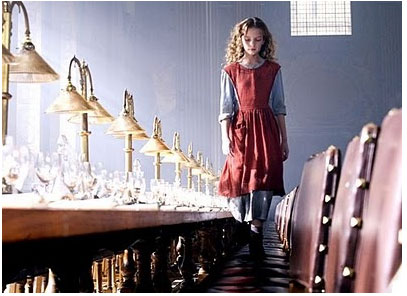
What is Steampunk Style? (Turns out I adore it.) Here’s an example from the movie The Golden Compass:
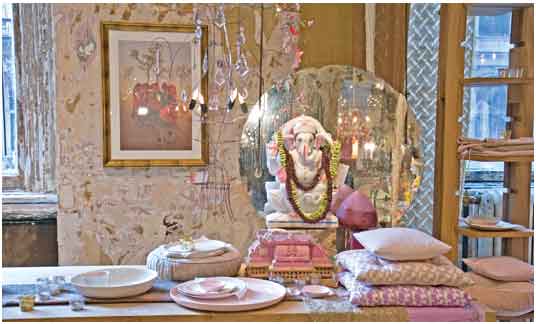
 How do you create a space that has texture? I took three conference calls while I was wandering through ABC Home. I thought that if I spent time there, I would somehow learn from being surrounded by examples, like this one:
Some of you will ask what these questions have to do with career change. But a career is not a history of how you make money. A career is a learning path. It’s what direction you take in your personal learning.
4. Asking good questions takes work – that you have to do yourself.
This struck me during my New York trip as well, because one of my best friends is Lisa Nielsen, who leads New York City Public School technology initiatives and writes a blog about education reform. She is a big advocate of me homeschooling my kids. She says that kids don’t need to learn subjects. Kids need to learn how to ask questions about things they are passionate about. And that’s no small task: First, you have to learn how to find your passions. Then you have to learn how to ask questions. Most adults can’t do either thing well, which is a good argument for taking kids out of school, I have to admit.
5. Field other people’s questions to get better at asking questions.
Finally, the last thing I did in New York is visit Seth Godin’s office, to interview him for a webinar. The biggest criticism I received after the interview is that my commentary about people’s questions was obnoxious.
This is true. I am becoming increasingly impatient with questions that reflect poor self-knowledge. And with questions that reflect a penchant for finding roadblocks instead of finding ways to soar. Neither of these bad question types seem genuine, or useful. (Here are some examples of questions like that.)
No one complained about Seth during the webinar though, because he had a better approach to the questions. He tells people what they are really asking. So the webinar was really a webinar on, among other things, how to ask a good question.
The webinar also served as a good lesson for me. Instead of complaining about the question I get, I should answer the question by sharpening the question. People almost always know the answer to the real question but the real answer is often scary. So we conjure up an ancillary question to distract us from reality.
I also need to be more kind about people’s questions, by helping them figure out what their real question is. And the process helps me do it with my life, too. For example, I’m not sure my real question is “What is Steampunk Style?” My real question is how does style fit into my career right now?
I feel like I’m hallucinating. PT has a post which includes a photo of some kind of room decorated with some kinds of pink things? What has happened to the universe?
Excellent Post! Well done…this is coming from someone that asks questions for a living…more or less.
Kirk @EASTeam
This post makes me proud that the only quote I’ve ever used on my Brazen profile is the self-penned: “It’s not whether you have the answers, it’s whether you know the questions.”
Ironically, it’s also a reminder.
Thanks, Pen.
Asking questions is something I hate to do (and I never know what to ask). Thanks for your advice and ideas about it. Hopefully they’ll inspire my future question asking.
“When you’re lost, look for questions, not answers.” Perfect comment for me to hear today, thanks. I am dealing with an enormous problem and I never thought of finding new questions about it rather than berating myself for not having the answer. I will go around it and maybe it will become clearer.
Also, what has happened to the universe? Didn’t you know girly and pretty is “in”? I love it, so feminine after a long boring masculine stretch.
And you generate lots of questions!
Penelope,
This is one of your best!
For one thing, I absolutely love your statement that “A career is a learning path.”
And you are absolutely right about questions. When I taught 6th grade we spent an entire unit at the beginning of the year learning questioning (the Socratic method and other questioning strategies). You see, some public school teachers do know what’s going on.
Also, I think that steampunk style will look awesome in a farm house. It’s a perfect match.
–
I am a big proponent of homeschooling. I agree that homeschooling the boys on the farm would be the greatest educational adventure for all of you. Yes, I have books, curriculum and advice to share. Go for it!
Steampunk style is exactly what I imagine the inner workings of your brain to look like Pen. I think you found your style and will soon be living from the inside out! Fabulous post.
We are far more revealing by the questions we ask than the answers we give
– so (however you feel about someone)
when that person asks you a question, ponder:
why is this person
asking me
this question
right now?
In so doing you may glean an insight as to an underlying fear or interest and thus be able to answer to bolster rather than weaken the connection you have with that person.
Maybe you should consult with Virginia Postrel, author of “The Substance of Style”, about the glamour of Steampunk!
Thanks for the recommendation! I’m on my way to check it out right now…
-Penelope
Checking out her “Deep Glamour” blog only brings up a single reference to “steampunk” at http://www.deepglamour.net/deep_glamour/2008/09/glam-or-spam.html so I am not sure whether there is much to “check out” directly – the book is about style and its importance to modern life.
Ok, steampunk…Making mental note. Very cool.
I was homeschooled. I write about it a little in my blog. If you want to talk to someone who didn’t go to school until college and turned out very opinionated and also fairly capable of blending in, let me know. I love talking about it.
I am so glad you posted this. I’ve been a long-time reader of yours and a supporter. I spent quite a bit of time after the Webinar sharing links of your posts on asking good questions on Twitter.
Good to see someone else get schooled by Seth. Like running up against a hard, benevolent guard rail. Puts you back on track, sometimes stinging. But you can’t complain!
Yes good questions require creative thinking. Knowing how to ask questions and which questions to ask is a skill, and I noticed that some wise or smart people had a way to ask the right questions. They would lead for example to put some light on a complicated issue or make the other person realize a key point.
So if you are not redecorating the farmhouse, what are you doing to it?
I think she’s decorating it. To say she is redecorating it implies that it was decorated in the first place. : )
Seth makes such an important point:
"The Resistance is the voice of the lizard brain. The Resistance is very clever. It comes up with a hundred really good reasons not to take a risk, not to stand out, and not to do something remarkable. The Resistance is the voice that says, "No, I won't raise my hand at the end of this seminar." Think about it: some guy gives a talk, some woman gives a talk, there's forty people in the audience, they go, "any questions?" How come EVERYONE doesn't raise their hand? – . Why? Simple: because of the Resistance. The Resistance is eminently reasonable and rational, and it's scared to death. It doesn't want you to succeed at this kind of stuff."
One of the reasons the voice of the Resistance is so powerful in people's heads is because it is given so much credibility, so much support, and so much momentum in our culture. The voice of the Resistance is vocalized – out loud – throughout the culture, over and over, unceasingly. And you, Penelope, are one of the people vocalizing it:
"I am becoming increasingly impatient with questions that reflect poor self-knowledge. And with questions that reflect a penchant for finding roadblocks instead of finding ways to soar. Neither of these bad question types seem genuine, or useful."
You commit all of the worst sins here: you grade questions as being good and bad, genuine and not genuine, useful and useless; you tie a "poor" question to "poor self-knowledge;" you judge not only the questions but the people asking them (after all, a question that doesn't seem "genuine" – whatever that means – can only be asked by someone whose intention isn't genuine).
If I'm afraid that my question isn't genuine, that my question reflects poor self-knowledge, that my question is useless or seeks to find a roadblock, why on earth would I raise my hand and ask one? Seth wasn't just talking about the Resistance: he was talking about you.
Seth is a nice guy, and his equanimity in the face of your bullshit was better than you deserve. But, on the other hand, watching you talk about how people shouldn't be afraid of asking questions even as you were talking about all the questions you didn't think were any "good" was as valuable a demonstration of the mechanism at work as anything I've ever seen. For you, I have a special wish: the eyes to see your child's face the moment you tell him he's asking the wrong question.
I have to agree with a lot of what Kerry said. There is more to be gained by teaching someone how to ask the right question than by just grading their question as a failure. Being able to do the former is the difference between being a leader and a manager.
Hey, you guys, PT seems to realize what you are criticizing:
“The webinar also served as a good lesson for me. Instead of complaining about the questions I get, I should answer the question by sharpening the question. … I also need to be more kind about peoples' questions, by helping them figure out what their real question is.”
So maybe be a little more forgiving; eh? We all have things that we are working within ourselves that when we see them in other people, provoke the most vehemently vile responses. The mirrors in our lives help us grow but we have to be careful not to smash them.
People don’t come out of the womb knowing how to ask good questions; You have to ask a lot of bad questions to eventually be good at asking good questions. Early on in my career I often walked away from a bad question incident with embarrassment. But, each of those were a lesson in how NOT to ask a question and honed my abilities to ask the good, and even sometimes great, questions. It is pretty simple in my mind that having a talent for asking good questions is so different than the Olympic ice skater: Practice, learn, practice, learn more and so on.
Meant to say “…having a talent for asking good questions is NO different than the Olympic ice skater.”
You’ve covered a lot of ground in this post, P. I’d love to talk about interior design, but your observations about uninformed questions raises issues I’m dealing with in my own life: more specifically, my striving to move past intellectual snobbery. I’d like to say a few words about that.
Generally, I’m doing my best to “evolve.” I’m trying to be more tolerant of other people’s belief’s. I’m working on being more patient and empathetic, plus getting past my ego’s point-of-view. And I’ve sort of made some headway in that regard, the equivalent of the first three inches of a mile. I wish I could grow faster but I’ve hit a paradox: the more I inform myself about world dynamics and how fear grows out of ignorance, the more I observe people subconsciously choosing to live within this contaminated condition. The result? Perpetuated negativity and deconstruction. Everywhere. WHY people lapse into myopic focus, is the most complex question of all. But they do. And I can’t help WANTING TO BE separated from that majority because their confrontational reality is scary and potentially dangerous.
And here’s the point where I too fall into the trap. From where I stand, it doesn’t take much work to look for answers behind the answers, or to be generous and kind, or to be mature and see things from all sides. It just takes desire. (So I believe.) Consequently, when I observe infectious, “lazy” disinterest,(MY label), I tend to become prejudice against “prejudice” people! But are they really? Or are they just trying to survive using whatever mental tools they have, even the ones that don’t work?
I am so fortunate to have a loving wife who continually reminds me that I too need more “working” tools; ones that allow me to VALUE others who think differently than I do. Sometimes that’s very difficult!
That said, all the best, Penelope. You now have a Reminder Spouse. The best kind; a man of the Earth.
Irv
Hi, Irving. I think you need to remember that love and kindness are way more important than how smart you are. Actually,no one cares how smart you are because smart and snobby are so incredibly annoying and shallow. But you know that, right? Or else you wouldn’t have written this comment.
So try this: Everyone has a topic that they know way more about than you do. If you stick to topics you are an expert on, you are a bore. If you try to connect with people on topics you would like to learn about, you are interesting, engaged, and curious — all things that are likable. And you have no reason to be a snob because you are talking about topics where the other person knows more.
If you find yourself getting angry about other peoples’ ignorance, tell yourself to focus on yourself. The more you work on making yourself a better person, the less what other people do will matter.
Good luck, I often struggle with similar stuff that you struggle with, which is why I have so much to say on the topic :)
Penelope
There’s a shift in perspective that may help: from “why are THEY so stupid/ dangerous/ confrontational/ whatever?”, to “why are WE so stupid/ dangerous/ confrontational/ whatever?”.
It feels false to start with, but I found that after a couple of weeks, fear and fury began to mellow into sympathy and empathy. There’s something strangely comforting about a wry smile.
Penelope, Inspiring Post! I saw another post today “Taking Charge of your Career” by Vineet Nayar. He says “If your orientation moves towards convincing people on actions rather than ideas, I think you would be able to take charge of your career”. http://www.vineetnayar.com/taking-charge-of-your-career/
penelope, as usual you demonstrate an amazing insight of the human mind…
the theory of the “scary real questions” and the “ancillary” ones is so simple but oh so true….
i’m in the middle of a change of career and i’ve just started noticing how much of my biggest problem- what i believed being procrastination- is in fact due to my fear of confronting certain feelings/attitudes; i am/was submerging myself with “ancillary” tasks, because i did not want to confront myself with my real tasks, and real questions…
Great pix. Never heard of Steampunk before, but now I’m interested …
Computer game that touches on the Steampunk style:
http://en.wikipedia.org/wiki/Arcanum:_Of_Steamworks_and_Magick_Obscura
I think the reason most people beg for answers as opposed to questions is that answers are easy. Answers are what you get from As Seen On TV products, infomercials promising untold wealth for broke people in “3 Simple Steps!” and other snake oil sales pitches. Answers are for people who don’t want to think for themselves, and thus never seem to work out quite like they were supposed to.
Questions free the mind and spirit, whereas answers put them in a cage. Good post, P!
Pay attention to the answer. Make sure it answers the question.
Follow up with more questions if the answer isn’t clear.
One day the Hodja was visited by some of his young friends. They had been gathering and the discussion turned to the question of what was the most valuable thing in the world. They could not agree, but decided to consult his wisdom.
“If you think about it”, the Hodja replied, ” the most valuable thing in the world is sage advice.” The friends thought about this a while, nodded their heads, and agreed.
The next week, they visited the Hodja again…this time their discussion had turned to the LEAST valuable thing in the world.
“If you think about it”, the Hodja replied, ” the least valuable thing in the world is sage advice.”
The friends protested – how could the most valuable thing in the world be at the same time the least valuable?
“Ah, my friends, even the sagest of advice is utterly worthless if it is not heeded!”
My 32 month old granddaughter has recently started asking the question, “Why Nana?” She’ll stand there, cock her head, put her two little hands up, palms skyward, and say, dropping her hands emphatically an inch or two before settling them, fingers outstretched, “Why Nana?”
I look at her and wonder what’s she talking about. It’s not like I’m asking her to do something, or pointing something out – it just comes out of the clear blue.
“Why, Nana?”
I guess it’s a universal thing, tuned to our cores.
I wonder when it stops (in most of us)?
Children (and everyone) learn by asking questions. The smarter the child, the more questions they have. One of my daughters asked question after question. Every answer to a question brought her back with another question. And then after I thought I couldn’t stand to answer one more question on her topic du jour, she’d reach some kind of mental synthesis point, and summarize the whole subject and what she had concluded, puctuated by “Wight, Mommy?” every few sentences. I’d make a minor correction or comment, if needed, or just make affirmative noises to each “Wight, Mommy?” until she finished. The next day’s questions would at least start on a new topic.
I think many people have never learned to ask “good questions,” because they were not allowed to ask the questions they wanted answers to when they were little. Many busy, impatient parents, and most of our school systems discourage children from asking unending streams of questions, although that is how they learn. (Of course, smart kids do learn how to ask their teachers questions to distract them from assignments or quizzes that they don’t want to get, too.)
Excellent post! I want to re-read a dozen times when I have more time to reflect on it. However, it most quickly brings to mind why I am not asking myself the important questions, scary answers…oh you are so good Penelope! Thanks!!
+1 for homeschooling.
Learning how to learn is not taught at a school either – its taught in the home. Those things can be reinforced in school but the bulk of it is developed at home in my opinion.
This statement also couldn’t be an truer: “Kids need to learn how to ask questions about things that are passionate about.” Great post!
Penelope,
I understand your impatience for ‘good’ questions and how helpful they can be. However, as I watched your exchange with Seth, my impression was that you had not prepared well for the interview and were not asking questions that highlighted his ideas well for listeners. There was no clear organization structure to your queries, which is so helpful to audience understanding. Yes, it was a bit rude to cut down those who asked questions not up to your standards, but it seems that edginess is part of your brand, so it was not a dealbreaker. The silver lining is that no one who questions exactly as you do would be a customer of your business, so in a way, bad questions are a form of job security.
As a suggestion for the future: request that some questions be submitted in advance of your program. People often need time to formulate a question and presubmission allows this. In addition, have your staff/you brainstorm a handful of kickass questions to generate great answers at your desired level. These questions cover you in case you have a technical glitch, or in case your audience doesn’t ask good questions. You can just pull from your preferred question list and no one is the wiser. You don’t have to insult anybody and you can repeat the takeaways you think are most important.
Thanks and best,
Lisa
As a guest speaker, I am often asked questions that are somewhat clueless and off-topic. But, I am that person’s research tool at that moment in time. They aren’t goggling anything while listening to me. People aren’t in the habit of doing their homework before a lecture – even though that’s when it makes the most sense.
What I have to remind myself is that the person asking the question is in a different headspace than I am. If I asked them a question about their area of expertise I am sure I would sound like I hadn’t done my homework.
every question has answer,even difficult questions has difficult answer,but the main engine is who is the sincere person whom able to give right and clear answer !
Having been a teacher I realize my students weren’t always clear on how to ask the question they wanted answered. It was forming as they asked it or became more clear while they were forming it (out loud). I think it’s important to not make people feel bad or stupid when they ask questions – intimidation doesn’t motivate learning. It’s sometimes scary to ask a question – no one wants to look dumb, ill-prepared, etc. so helping someone reform it or clarify what they want to know is the way to go I think. It helps them learn both to model a question and to get an answer to what they want to know.
people asked Isaak newton how he discovered attraction of earth ,he answered them because apple failed down on his head from the tree,people asked penicillin innovator how he discovered penicillin he told them any one can see behind the perspective he could be innovator,either way world took too much time before discovered expression (hospitality industry),thus question and answer is important subjects because science depend on discover and discover depend on questions and answer,question and answer is the main subject of practice and progress
Have you seen calewrecks’ steampunk inspired post? http://bit.ly/Okygr
Hi P,
Oh how I miss your blog and thought I’d commend you on the great interview with Seth Godin (minus the technical issues).
I love this 1. Good questions require creative thinking.
This has always been true, I think. Good questions are fundamentally creative. But today, when all facts are available to all people, it's the questions that have become most important. To get to the answer, you have to ask the right question in a search bar. But also, to differentiate yourself in the workplace, you need to focus on questions, since answers are a commodity.
People could come up with good answers or try to give their best answers but only creative minds could come up with the right questions.
I’ve already referred a number of my graduate student friends/colleagues to this post. Thanks for it. Graduate students (cultural anthropologists in this particular context) may never come up with the “answer” but we spend years learning how to formulate questions, react to questions in seminars by asking more questions. We ask bad questions, humiliate ourselves, and learn. And most importantly, we learn how to ask the right questions in extremely diverse times and places. Finally it culminates in a dissertation which is, essentially, just another question with a learned perspective. I appreciate your question about the intersection of family, farm, and business — good questions are all about intersections. And good answers only come with a processual understanding of how questions and intersections change.
Yeah, you’re rapidly becoming my guru. Even though of late I’ve been asking this here question a lot: Why didn’t I write that? And were I to attempt an answer it might be: Perhaps I’m not in answering mode at this point in my life.
It’s great to read you for inspiration and for more scalp scratching questions.
It depends on what kind of and how much information you are looking for.
If you are looking for a simple ‘yes’ or ‘no’ answer then closed questions are ideal. However, if you are looking for a lot more detailed information then asking ‘open’ questions is much more appropriate and will usually provide you with greater information.
Also, learning and employing the Meta Model will help anybody improve their question asking.
Though all 5 points mentioned are great, I really enjoyed point 2. Great approach to problem solving.
@Sarah: I agree. =)
This was a great interview.
In the future, you may want to consider doing the screengrab of the full-sized Vokal video, though. At the current embedded video embed size, this might as well be just audio.
Thank you for posting, though. You two could be running mates:)
Good post! A thought process begins by asking the right question. Children are good examples of how we use the answers gathered to formulate or build our little world. Therefore, question is really curiosity of the mind. It's the reason and in most instances that I evaluate the questioner not the question.
Penelope,
I was already loving this blog….and voila, you included VocationVacations! Appreciate your advocacy of the work we do, Penelope.
And say a huge hello to my beloved homeland, WiscoDisco, for me.
All my best,
Brian Kurth
Asking better questions is the foundation of learning how to listen better. You made me think and I’ll use your question tips as I work to become a better listener to people. Thank you for a provoking bit of writing.
This post really is useful. We need to learn not only how to ask better questions, but also how to respond to those. It’d be great if there could be another article about giving out answers
We must have been listening to my thoughts. I was really struggling in my last blog with the questions that I was asking. I was thinking about how I can really fine tune those skills…and then I see your post!
Great post and great feedback. Thanks so much for sharing!
I didn’t know what it was called but I am pretty sure my brother-in-law has been doing Steampunk longer than the 10 years I’ve known him: from his collection of antique globes to, um, his own teeth. One night, he couldn’t sleep and drove out to pick up a road sign he had been passing for months. Now it’s the overhead light above his and my sister’s island in the kitchen. Wanna see pictures? Or just drive down to Athens, Ga. I’m housesitting. :)
Oh, and I went to sign up at BC and couldn’t do it. I don’t know if it’s my browser or what but when I click on the bit where you fill in your name and all that, no cursor appears to let me type. I have reloaded tabs and opened new windows, and nothing works.
I just drove to St. Louis and saw some hospital billboards on the way there and thought to myself, why doesn’t my company have billboards on the freeway, we have hospitals right off the freeway as well??? Good question.
Your job should always be something you are passionate about. If you’re working just for the money, you are going to earn every single penny of it. As for children asking questions, I think a big part of an education is learning how to answer those questions for yourself, and you don’t mention that at all. Early on, that involves looking up answers. But as you progress, it involves a lot of things that most people are comfortable with, like introspection. We’re so distracted by TV’s, cell phones, the internet, etc. that we don’t look into ourselves for answers any more.
I’ve been thinking of just questions until i read this post. Now need to think in a smarter. The Right Questions ..Yeah ! :)