
Everyone who works with your kid needs you to keep paying them
When I started doing research at Harvard, I noticed that almost every family study used poor families as subjects. I assumed the funding skewed that way, but it didn’t — even race-based grants used poor families.
When I asked my PI why, she explained that high-earning families almost never participate. That’s when I understood something about the research: it’s parents who are the problem in families, not children, and Institutional Review Boards don’t approve research that might destabilize a parent. So obvious parenting patterns are ignored in favor of centering solutions around the children – as if they are the problem.
High-earning parents don’t sign up for studies. They pay for “parent empowerment.” That’s the word practitioners use to sell to parents who are overwhelmed and have decided something is wrong with their kids. Parent empowerment promises “families centered on gratitude,” which parents hear as “my kids will do what I tell them”.
The actual work is structure and routine. Someone has to set expectations, enforce them, and repeat every day. That’s no fun, so rich people hire tutors, nannies and coaches to do it. Then the parents can work (so much more fun than parenting!) or focus on the fun, meaningful interactions (we are so close!) while someone else handles the heavy lifting.
This is one of the biggest differentiators among families but no one talks about it because the people who work with parents need those parents to keep paying them. Slow progress means more income. And schools don’t tell parents the truth because the rich parents get teachers fired. Research on this is clear: schools only raise problems with parents when the teacher is having a classroom management issue. Otherwise it’s not worth dealing with the parents.
I didn’t understand any of this until I tried to outsource it myself.
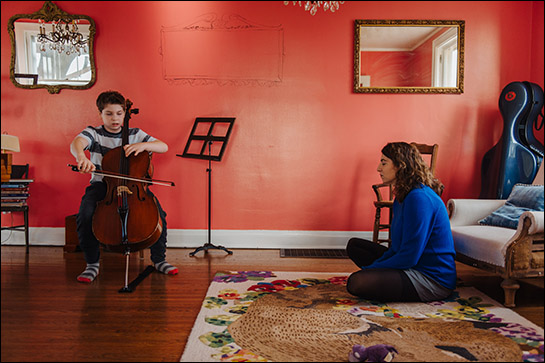
When my kids were four and six, I hired people to practice violin and cello with them. I had money, parenting was hard, the math seemed obvious. The cello teacher found out and screamed at me: “You are the parent! You learn how to practice! It’s your job!” I would not have understood it without her level of outrage.
What she was actually saying is that the job isn’t music. The job is setting high expectations and then working with the child to meet them: structure and routine.
She could say it because she was a famous cello teacher for little kids. There was always another student if I couldn’t handle it. Most people who work with parents are in the opposite position: no leverage.
My homeroom teacher once refused to let me back into school with bruises unless my parents produced a note from the police. My dad was a top Chicago lawyer — but the teacher found the loophole the police couldn’t ignore. It takes someone with nothing to lose to tell parents the real truth about their situation.
We don’t have reliable ways to change long-term outcomes by working only with children. Every time a parent sends a kid to get help, it’s a missed opportunity to take responsibility for the situation that created the problem. No one will tell you that. The researchers can’t. The schools won’t. The empowerment coaches are paid not to.
So I’m telling you: your kid is not the one who needs to change. You are.
Help the parents to help the chíldren.
Today my daughter went to physical therapy for the first appt. The therapist showed her how to clip the resistance band to a door so she can do it herself instead of me holding it. I had said I would help with the exercises, but exercise homework was still set up for independence. The PT was not trained to help me. Her expectations of me are low. Asking for help and showing up consistently is unexpected. I have hope that one day this will become normalized and pediatric professionals will be trained to help moms. Not to find Ways around them.
That’s such a great point! Most service providers have no idea how to help parents because they’re so used to parents being checked out.
Also, as an aside: Megan is, herself, a service provider for kids. I’ve watched her encourage parent involvement, and I’m stunned by how many times parents think it’s not their problem.
Thank you, but you know encouragement without real support doesn’t move the needle. Parents need more than just a push, they need practical ideas, resources, and help restructuring their lives so they can actually follow through.
I see that providers default to not including the parents at all, or it’s reduced to a quick conversation in the waiting room. That’s not real partnership. When they just handle things themselves, they may be helping in the moment, but they’re not building something sustainable for the child or the family.
Parents need accessible team support. The crucial moments are never during the scheduled appointment time.
Yes, let’s involve parents.
Speaking of physical therapy, one of my formative experiences was reading Sex, Love and the Physically Handicapped, which is guess is no longer in print. The title was in big read letters on the front cover, and when I tried to modestly put it upside down on the librarian’s desk I found the letters were equally large on the back page too! This was in the Bible Belt. I guess the publisher wanted readers to confront the fact that our children would one day want to give and receive love and affection.
This meant our kids had to be unspoiled and likeable. Hence the little trick of not responding right away if the child asked for help, to teach that the parent had a life too.
A spoiled child was shown as asking, “What will become of me?” when the mother was on her deathbed, instead of saying, “Oh no, poor mother.”
I know a handicapped wife who struggles to happily make greeting cards for birthdays.
Loving others can start with being as independent as possible.
When m mom was a nanny, she would often come home and talk about how poorly the rich parents treated their kids. They clearly loved them but they were both lawyers and not around the kids enough to know their kids very well, or for their kids to respect them. They respected my mother enough to listen to her. They did not listen to their parents. My mother couldn’t say anything, though. At best they wouldn’t listen; at worst, they’d get offended.
There’s always a price paid by the people taking care of other people’s kids, too, if it’s in a fulltime capacity. My mother saw how much more she did with and for the kids she nannied than she did for us and often said she regretted it. She also said it’s much easier to be nice and control your own frustration with other people’s kids than your own.
Though the difference, I think, is that if you’re cruel to your boss’s kids, you’ll get fired, but if you’re cruel to your own kids, usually nothing happens. Unless someone else steps in, like your teacher did. Like you said, the person has to have nothing to lose in order to be willing to intervene.
This makes me think about camouflaging. We are able to pick and choose where we camouflage and we give the people we love the worst version of ourselves. We think that people love us so they wouldn’t want us to camouflage. But actually camouflaging is a gift we give to people when we want to show respect and empathy. It exhausts us, so we can only do it for the most important people in our lives.
As Gen Z convinces us that giving our entire lives and identity to work is pathetic, we we embrace the idea that our camouflaging efforts should be at home, for people we love.
my life was probably saved after a doctor finally called the cops on my family. i’d been to the emergency room three times in a year for nasty, bloody dog bites that left scars all over my face and body. i’m sure the doctor was acting out of disgust for what he saw though, not some savior mentality. my family was disgusting. they finally hid the dog away from the house only to avoid being jailed. at this point, decades later, i have to admit i’m really on the fence about whether i should have just been left for dead. i grew up never having family who cared about anything. i never had real friends, i was the weird kid. i never got married or had a family of my own, never found a profession or a job i was good at. i’ve struggled every year of my adult life. it’s hard to describe how lost a person can be from having a horrible foundation and living life perpetually on the outside of everything. you trudge through life, barely getting through things, living on a shred of hope that somehow something will work out the next time. but you keep learning the same lessons about humans and what you can expect from them. (i don’t think i need to elaborate on that part.) if you are reading this, please never have a kid you don’t want. life is long.