
Women we pay to raise our children
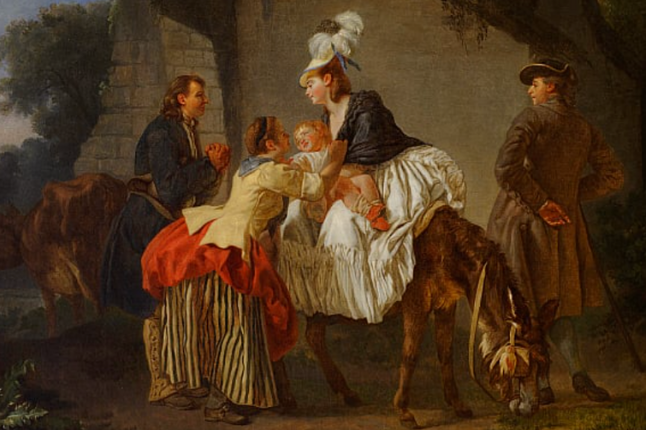
Farewell to the Wet Nurse by Etienne Aubry (1776)
For hundreds of years, middle-class women have maintained their social position by making childcare into dirty work that only desperate women do. The wet nurse was the original outsourcing: a poor woman feeding another woman’s child while the middle-class mother kept for herself the clean, socially acceptable parts of motherhood.
Wet nurses ran their own show when it came to emotional bonding and infant nourishment. You can’t regulate someone else’s food intake or emotional output. No one talked about this, because admitting it would have meant admitting that the woman doing the real work of mothering mattered more than the woman writing the checks.
Once machines stripped housework of its dirtiness, middle-class white women had to find another way to separate themselves. The answer was a college degree.
And now women show class position by getting high-paying jobs and outsourcing childcare. If you don’t take care of children all day, you’re smart and special. You deserve respect from men because you hold the same roles they do. The woman changing your child’s diaper for $20 an hour wasn’t “smart enough” to get a real job.
I know because I did this myself. I told myself I was running my family like a company: each kid could be with a nanny while I earned money. I even rode in the car with the nanny, because when I tried to work and drive, I totaled three cars. Of course she should drive. Of course her kids would be home alone after school. I had the money. That was my logic.
There were years when childcare cost six figures—though it was “my work” paying, not me. That distinction made me careless. Once I left for live TV in another state without telling the nanny. She had to call that night to ask if I wanted her to feed my kids dinner. I thought the paycheck was respect enough.
And this wasn’t new. I grew up with a laundress named Sula. She started with my grandmother in the late 1930s, when they were both teenagers. She stayed through my father’s childhood. My dad sat in the basement after school with her, because there was no one else to care for him.
Later, when I was a child, Sula came to my parents’ house too. If I stayed home sick, I was alone—except on laundry day. Sula would make me chicken soup and put new sheets on my bed while they were still warm. On days I wasn’t sick, I went to the basement just to sit with her, the way my dad had, though I didn’t know that at the time.
I didn’t know she was my grandmother’s oldest friend. I didn’t know every kid in my family learned to iron by pestering Sula while she worked. We never thought about who was taking care of Sula’s children while she was taking care of us.
Kurt Vonnegut remembered his 1930s childhood the same way: White women calling housework “n-word work”. That was the open secret. Childcare was degrading labor, fit only for women with no other options.
The language has softened, but the logic hasn’t. Today we say “quality daycare” or “empowering careers,” but the message is the same: respectable women don’t do the dirty work of raising children.
I recently published a post detailing what women in high-paying jobs actually do for childcare. Some stayed home. Some had a stay-at-home spouse. Some paid for full-time care. The last group did not have good outcomes.
I mentioned the President of Cloudflare who speaks openly about her children, and I noted that she appeared to have a stay-at-home husband. Her PR firm contacted me to say I needed to fact-check better: her husband, they said, is the CEO of a startup. When I didn’t revise the piece, they badgered me.
I wrote back: “The post I wrote is about taking care of children. I’d be happy to update the post. Can you tell me, if both parents have full-time jobs, who is taking care of the children?”
There was no reply.
That silence is the point. Childcare has to remain invisible. When it starts to make successful women look bad—when it exposes the trade-offs rather than the empowerment—we pretend it doesn’t exist.
This explains why we lie about childcare options. Admitting that group daycare is warehousing would mean admitting we’ve built professional identities on harming children. Admitting that most nannies are underpaid and overworked would mean recognizing that we exploit other women’s desperation.
We’re told this is about women’s empowerment, but empowerment for who? Not for the working-class women we pay poverty wages to raise our children. Not for the children who spend their earliest years with stressed, underpaid strangers. Not even for the middle-class mothers, who discover the price of professional success is giving everything you have to work.
We could design a society where raising children is valued and supported. Instead, we built a system where good mothering is what we pay someone else to do while we chase status.
The updated version of this seems to be outsourcing of wombs to women of poorer status, and purchasing eggs from women of poorer status. And this by the people who are so afraid of others re-creating the Handmaid’s Tale.
Agree. It seems that each time we have reproductive innovations we use them as a way to reinforce inequality… although as I think about that I guess we could argue that every innovation can reinforce inequality if we let it. And then we’d have to define what, actually, is an innovation.
I think a certain amount of this started with agriculture. When we became tied to a place. There was probably still some help because of multiple generations living together or neighbours helping eachother to farm. I think it got devalued more wih moves to towns anf more capitalism. If you read about hunter gatherers mothers have comparable free time to non mothers because they are working together and the olders kids take the younger ones from about age 4 for awhile most days. I read about them sending babies to wet nurses and often dying on the way or because of the filthy conditions . The Mom was more valued by working in the family in Paris. Lots of stories of high child abandonment too. Are our nervous system screwed from years of versiond of this?
Dr Stacey Patton has theoriesof European children been brutalised and then reenacted this through Colonisation.
I will nevrr have a career. I don’t know woild I have even if I didn’t have a child. And yes we are outsourcing more and more to other countries re surogacy etc.We want a child but not necessarily to put our bodies through the hassle. Ive read of Hollywood actresses in the past adopting indtead of stalling their careers and risking their bodies changing. Boarding school from age 7 sèms to have been popular in the past with the wealthy
Thanks for mentioning Stacey Patton. I like her writing because connects so many dots by starting with the parent-child relationship and extending it out to society.
Most people don’t like drudgery. Feminism has sent a loud and clear message that women should want more than drudgery.
It isn’t just that they are smart and capable of great things and a “seat at the table”. You shouldn’t feel obligated to live a life of drudgery.
There are people who embrace the drudgery because nurturing your family is beautiful and a blessing. If you say that you want that blessing, now you are condemned because you can somehow afford to do that and others have no choice but to use daycare..
The art of making a home and nurturing your family is highly controversial. Ask yourself why.
I think we might be able to redefine what drudgery is. As a startup founder I was admired and celebrated every time I raised another round of funding. But it was hell to run a startup. The only thing that made if bearable was the accolades from society. So I’m not sure our ideas of drudgery is intrinsic to the job.
Possibly drudgery that needs to be done simply for the well being of your family vs. drudgery that has the potential to take in some dough.
We are all too smart to keep the kitchens and bathrooms clean as a way of life. And yet….
I learned something at the deathbed of my very tough cookie Ukrainian grandmother (refugee) who worked in a factory job that people now would consider below her education level and she took care of everything in the house. At 96 years old, her strength leaving her quickly, she lamented sincerely,”I can’t work! I can’t get up and do anything.”. I had to reassure her that it was ok not to work…and she meant cooking and cleaning and keeping things going. For some people, there is dignity in doing all you can in all spheres of your life to make life good for those you love, family and friends, regardless of the nature of the work.
Thanks for sharing this – she just wanted to love on her people. In life there are givers and takers and blessed are the givers!
Such a nice story. When I was younger I was always hoping my kids would leave me alone. As I grow older I always want my kids to ask me to do something – it’s such a pleasure to be needed for something meaningful.
The great GK Chesterton had some amusing thoughts on this topic- “To put the matter shortly, woman is generally shut up in a house with a human being at the time when he asks all the questions that there are, and some that there aren’t. It would be odd if she retained any of the narrowness of a specialist. Now if anyone says that this duty of general enlightenment (even when freed from modern rules and hours, and exercised more spontaneously by a more protected person) is in itself too exacting and oppressive, I can understand the view. I can only answer that our race has thought it worth while to cast this burden on women in order to keep common-sense in the world. But when people begin to talk about this domestic duty as not merely difficult but trivial and dreary, I simply give up the question. For I cannot with the utmost energy of imagination conceive what they mean. When domesticity, for instance, is called drudgery, all the difficulty arises from a double meaning in the word. If drudgery only means dreadfully hard work, I admit the woman drudges in the home, as a man might drudge at the Cathedral of Amiens or drudge behind a gun at Trafalgar. But if it means that the hard work is more heavy because it is trifling, colorless and of small import to the soul, then as I say, I give it up; I do not know what the words mean. To be Queen Elizabeth within a definite area, deciding sales, banquets, labors and holidays; to be Whiteley within a certain area, providing toys, boots, sheets cakes. and books, to be Aristotle within a certain area, teaching morals, manners, theology, and hygiene; I can understand how this might exhaust the mind, but I cannot imagine how it could narrow it. How can it be a large career to tell other people’s children about the Rule of Three, and a small career to tell one’s own children about the universe? How can it be broad to be the same thing to everyone, and narrow to be everything to someone? No; a woman’s function is laborious, but because it is gigantic, not because it is minute I will pity Mrs. Jones for the hugeness of her task; I will never pity her for its smallness.”
A pleasure to read.
Yes, people who believe in hierarchy don’t have a default of respect for people they meet. I’m lucky that my mum and dad figuratively said, “Even the president puts on his pants one leg at a time.”
There was a Hollywood movie (perhaps Who’s Life Is It, Anyways?) where the hero has a disability. When his main carer, a husky man, is introduced, they have to take some precious camera time to have him be recognized by hero, for the sake of the viewers, as a respected former football player. This when the game, and sports, is never mentioned again.
And people who believe the world is a matrix of the “oppressed and oppressor” cannot live their lives by their own definitions. They have to balance which side of the equation they are on and evaluate (read: judge) others to figure out where they are in the matrix. Very complex navigation skills required. Then there are those who don’t care what anyone thinks of their life choices because all the people with the most vehement opinions have absolutely zero to do with anyone else’s actual well being. The most vociferous demonstrators like the sound of their own voices. People who quietly help others without sounding a trumpet, who don’t fit into the equation….they *are* the equation.
Ah but Penelope…I would much rather be at home raising my son than out working at my job. Except that, as a solo parent, I have no way to keep a roof over our heads if I do choose to raise my kid instead of doing my job (and this shiny pre-child career of mine means that we’d get no help from the state if I said screw it and raised my kid anyway…I’d have to sell our home, spend every penny of that money, and then scrimp and scratch to survive on what’s deemed “enough”, all because I was crazy enough to create a future taxpayer to take my share of the burden of the next generation.) So instead I choose to support another single mother (this one with a deadbeat ex) as my childcare. I pay her a good wage, well above the legal minimum, to include my child as she raises her own. It was the closest I could manage to giving my son a stay at home parent, and it means that two other little ones will also get to have a stay at home parent.
But I’d also like to set the record straight about donor eggs – very clearly none of the people commenting here have either donated or received eggs. Sure, there are a few high-paid women giving egg donation a bad name (one might say the same about reckless women getting themselves knocked up during a drunken night out), but no one who has gone through the emotional and physical trauma of egg retrieval and failed IVF (because almost no one opts immediately for donor eggs – usually this is a last resort after many failed rounds of treatment) chooses this route to motherhood lightly. They are not outsourcing a messy bit of motherhood, they are using science to try desperately to retrieve the dream of parenthood that capitalism has dangled endlessly out of reach as they did “the right thing” and postponed parenthood for their careers. You can tell her that egg donation (one of the bravest and most selfless things a woman can do for another woman, and for which she *should* be compensated richly) is outsourcing when you’ve suffered through six weeks of injecting yourself multiple times a day, retrieved two dozen eggs and spent a week on tenterhooks while the embryologist counts down the viable blastocysts and eventually implants the last surviving one which turns out to be incompatible with life, but not until she is 19 weeks pregnant, so her miscarriage is not just bleeding but actual labour. When you’ve lived through that and found the courage to not only try again but to try again with another woman’s eggs (meaning that the baby you’ll nurture in your womb, if you are lucky, is not biologically yours), then you get to be the one to tell her how it’s morally wrong to use donated eggs.
Thanks for sharing. I have adopted cousins and family members who couldn’t have children ,others didn’t have them. I don’t know whether any tried fertility treatments etc.
If someone is considering egg donars or surogates they have given it alot of thought.
Neither of my children were planned. I don’t regret either of them. I do regret some of the circumstances when they were born. One is 20 and in college. The other is 4.
I have a very close family member who did buy eggs. I witnessed her experience the emotions you named, and I love her little guy with all my heart. But a situation can have an upside and a downside at the same time. Penelope is pointing out a problematic side we might not recognize or really talk about. And to my thinking, it wasn’t capitalism so much as feminism that dangled children out of reach. Babies and capitalism can work together, and do so just fine in many conservative families I know.
Ah! Such a timely post. I’ve spent the last 23 years grinding, saving and working – and it’s been rewarding, I’ve gotten to do and see incredible things that I never dreamed of as a kid. And now, I think I’m done. I have a 3 year old and I’m realizing that I’d rather be home with him more than anything. I can’t even believe I’m typing this – I NEVER thought I’d be a SAHM. I’m in the middle of the decision process of stepping away and I’m so, so scared. But, I’m more scared of missing my only child’s childhood because I thought work (status, money, security) was more important. Our finances will take a hit (and I’m sure the stock market will plunge the day after I quit) but it seems worth it. I think I’m actually posting this here so I follow through. If anyone’s reading this, would love to know more about your decision to make the leap. XO
I want everyone to know that I’ve known Abby for almost two decades. I’ve watched her career go up up up. I’ve watched her decide to get married and refocus her energy toward that. And I’ve watched her relocate to family in a lower-cost of living location. It’s so great to see her life unfold because she’s made hard choices – each step she’s giving up something that was, for a time, important to her.
Congratulations, Abby. I’m looking forward to seeing what staying at home brings to you.
Heart emoji
Penelope
I love this post – it has a lot of empathy for women of a background the writer is not from, which most people can’t or don’t pull off.
Maybe I feel this way because my mother was both a single mother AND a nanny throughout my older childhood and teen years. When she came home late at night she often lamented that “I do so much more with these kids than I did for mine.” The demands of the job: playing with the kids, teaching them and helping with with homework, giving them nutritious meals, etc. – she hadn’t had the time, energy, or resources to do much of that for us when we were little. It wasn’t really her fault, but it ate at her nonetheless. Her employers were really nice and treated her well, but the class distinctions were always clear.
That’s usually the reality of women who do caregiving for other people’s kids.
Thank you for sharing your perspective! I did so much research for this post – dozens of books – but it’s really hard to find writing from the perspective of the nanny’s child.
I recently read “Why Love Matters” by Sue Gerhardt and reading this post really called it back to mind, so I thought I’d just quickly comment to recommend the book to you.