
Bad parenting is a constitutional right
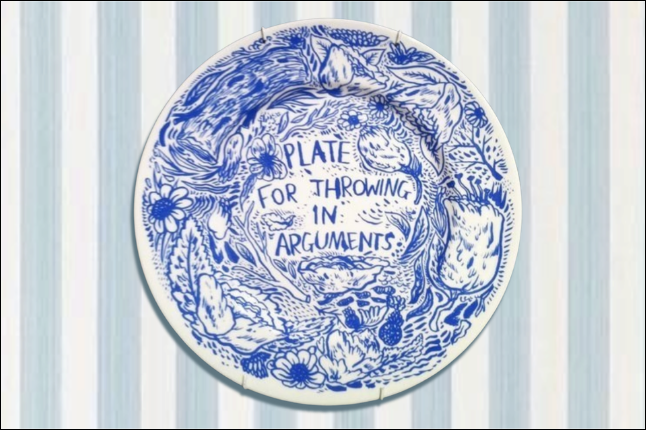
Ceramic plate by Keaton Henson
In the past few days hundreds of you have given me feedback on my post about Rob Reiner. I’ve learned a lot from the comments section. This post organizes ideas that have come up in discussion.
The day after Rob Reiner was killed by his son, Nick Reiner, a New York Times podcast revisited Rob’s relationship with his own father. Rob had said that even as a young child, he felt his father hated him. When Rob’s brother died, Rob believed his father wished Rob had died instead. Years later, Rob admitted he had not bonded with his own son, Nick, when Nick was young.
Failure to bond with a child is abuse
When there’s shocking gun violence, the media takes an opportunity to debate the balance between the right to bear arms and the right to feel safe. But when there’s shocking family violence, we refuse to talk about the balance between the rights of parents and the rights of children.
We avoid talking about children’s rights because psychological abuse is often more damaging than physical abuse, and acknowledging that would implicate many of us who think of ourselves as good parents.
Bad parenting distorts your baseline
People with psychiatric vulnerabilities partner with people who have similar vulnerabilities, because it feels familiar. Their children then inherit both the genetic predisposition and the relational environment shaped by those traits.
This month, groundbreaking data published in Nature mapped the genetic overlap across psychiatric disorders. Schizophrenia and bipolar disorder are genetically almost the same. Depression, PTSD, and anxiety strongly overlap. Many of the same genes influence all psychiatric disorders. Autism and ADHD form a distinct neurodevelopmental cluster, separate from mood disorders and psychosis—but people in the neurodevelopmental cluster often activate mood disorders under stress.
This creates a symmetry that parents rarely recognize. Adults with neurodevelopmental differences are parenting children with similar differences. Some children are, in fact, harder to parent. But when faced with a difficult child, parents without neurological differences tend to make decisions that reduce harm. Parents with neurological differences are more likely—through rigidity, overconfidence, or emotional blindness—to make decisions that worsen the situation.
Parents lose the child before the drugs
Many children have bad childhoods. Very few kill their parents. When a child does, it signals that something went catastrophically wrong early on. We should scrutinize that parenting.
I watched more than 50 videos on a documentary channel where parents, hoping to help other families, tell their story about losing a child to addiction. In every video, it’s clear the parent lost their emotional bond with their child first, then the bad choices followed. Sometimes the parent sees it, often they don’t.
For these videos to help anyone we have to acknowledge that failure to maintain connection is itself a form of abuse. Naming the problem is how help becomes possible.
Money insulates bad parenting
Parents have near-absolute rights over their children, so unless they are on public assistance, we cannot force them to get help. Wealthy parents in particular use their resources to resist criticism. And most parents do not believe they need help until it is too late.
Rob Reiner and his wife discuss this openly. When Nick was addicted to heroin and cocaine at age fifteen, they sought expert help. But when the experts challenged their permissive approach, Rob and his wife decided the experts were stupid. Rob and his wife rejected oversight. Nick was hiring prostitutes in Los Angeles before he could drive.
Bad parenting takes two main forms: being too controlling or too permissive. Both neglect a child’s need to feel emotionally valued. And both feel “just right” to the parent, because parents judge themselves against their own childhoods, not against healthy standards.
Children can’t compete with parent ambition
What children need more than anything is to feel special to their parents — to feel that they matter. No one else can give them that. Making a child feel special does not mean being entertained by them. Parenting is often boring. It’s easy to prioritize something more interesting.
But when parents prioritize self-expression, status, or public validation over presence, children internalize the belief that they do not matter. Or that they need to make their parents look good in order to matter. Those children spend adulthood trying to prove their worth instead of giving their children a sense of worth.
This is what failure looks like
Judge parents by how they respond to a broken bond. When Nick was a middle-school addict, Rob was traveling the country campaigning. When Nick tried to tell his own story, Rob directed the film, rather than finding a way to connect with his son outside Rob’s professional identity. Rob did not hide these choices. He believed they were reasonable. That’s the pattern.
Wanting to be a good parent is irrelevant
When we try hard at work and fail, someone tells us. Parenting is the only domain where there is no mechanism to tell educated, financially secure people they are doing harm and must get help.
In the United States, parenting is a fundamental constitutional right. Children do not hold independent rights; they are treated as property of their parents. State intervention requires extreme physical abuse. We have a good understanding of psychological abuse, but we don’t address it in law or public discourse.
We need to treat bad parenting the way we treat irresponsible gun ownership. Leaving a gun unlocked does not cause death by itself, but it is illegal because it is dangerously predictive. Psychological neglect should be treated the same way.
Bad parenting is not one thing. It shows up as emotional unavailability, excessive control, excessive permissiveness, chronic criticism, unpredictability, or prioritizing adult needs over the child’s emotional reality. The outcomes are predictable: addiction, aggression, anxiety, emotional collapse.
We have the vocabulary to describe bad parenting. Refusing to describe it is why bad parenting is everywhere.
Rob Reiner’s death is a personal tragedy. But the lack of honest discussion about parenting is a societal tragedy. We will not stop these stories by talking about children like they’re the problem. We’ll stop these stories by holding parents to societal standards that center on the child’s needs rather than the parent’s intentions.
I agree that parents can be “in denial” and I can understand that “Rob and his wife decided the experts were stupid.”
As for my own parents, I remember saying to a friend that if on Monday bartenders got training in counselling, and if on Tuesday this was in the newspapers, then on Wednesday my parents would be saying, “Bartenders are all stupid.” Why? As an escape . They were already saying that everyone who might advise, and I do mean everyone, from an expensive psychoanalyst to a cheap garden-variety pastor, was “stupid.”
I laughed. I think a lot of us have parents like that.
Alot is to do with Nuclear families,capitalism and individualism. The narritive of clothing,feeding anf sheltering a child being enough. Neurodivergence not being accomodated or critiscised/ punished does comorbind with trauma, like atracting like does perpetuate the odds of inheriting mental illness.All is mitagated if you have extended family to care about you or domething that makes you aware enough to treat yourself or try break the cycle .
I don’t know shat the answer is.With money or percieved high staus mental and physical abuse is ignored,in poverty may be ignored for a time but the odds are higher that children will be removed.
It’s so difficult- I think I emotionally neglected my eldest but she had more outsude support,my youngest I’m more aware but think I isolate him more
This is the article you should have written the first time.
Yah. I know. But I needed to go through 300 comments and reply to a bunch in order to clarify how I was thinking. I like to think this post was a collaborative effort.
So, you believe that you inability to bond with your child means you abuse them? And that means your children being they cannot bond naturally will abuse any child they have just as you have done?
Remember you naturally cannot bond with your children. Your children cannot bond with anyone naturally.
Using your foundation here, you believe you are a child abused and have been abusing yours children since you had then and they will only grow up to abuse children.
Penelope, you didn’t sit with this long enough.
You need to really think what you are saying as someone who cannot bond and who has children who cannot bond. I know it is your deep fear. I know you are scared of doing what Nick did and scared your children will as well. It is why you focus on the subject matter. Look how you behaved at the airport. Like how Nick behaved at that party. I see why you are so scared. But I really hope you can give yourself some grace. I know this is just more of an attack on yourself since you fail every day with bonding.
To add, you say you want an honest discussion on parenting. I agree. I think you need to be honest with yourself.
Personal ambition? How much did you put your kids to the side for all those moves and marriages and Harvard and this blog? How about homeschooling? How much was for them verse your ambition?
Socioeconomic status? We know child abuse occurs in every income bracket.
This was written to make you feel good that the likely hood of it happening to you does not seem as likely. And that makes others feel good and then they can say they are “good parenting”.
But the only end measure you use for good parenting is getting into Duke. When we know that is more than parenting and some really bad kids also get in there. Your metric doesn’t work. And worse, it only highlights that you are a bad parent. And that means… why would any one take parenting advice from you, a bad parent.
A bad parent who cannot bond with their children, who puts their personal ambitions over their own, etc. but at least you admit your intentions, all this work in bonding, won’t make you a good parent.
You are so close to admitting it all to yourself.
If I thought I was a good parent I wouldn’t be writing all these posts. It’s only interesting to write about what I grapple with. I don’t actually know what it would even take for me to decide I was a good parent let alone deciding anyone else was. I’m working it out. And, when there are hundreds of comments like in the past few days I get to work it out with all of you. It’s more efficient that way, and more interesting. Thank you.
It’s really an attachment issue. Rob didn’t attach to his father, he was attracted to a wife with attachment issues. Neither attached to Nick. Classic. What you’re saying is there should be a way to teach parents how to attach to their kids so we stop raising broken people.
This is a perfect summary of it all. Thank you, Sarah. Everything else is me trying to untangle my own trauma from the situation in the Reiner household. And me trying to make sense of how to go forward. PS For the record, I don’t think I know anyone who has done more work around learning to bond with kids than Sarah.
Relaxing in the bar after a Toastmaster meeting, a working mother, who was a survivor of abuse, asked me, “How can I know if I am being abusive?” Because she was worried that she couldn’t tell, and might abuse her kids by accident.
I said I didn’t know, then added that it might be useful to act as if there is no middle ground: Anything that is not nurturing is abusive.
We both liked that idea.
This analysis made me stop and think. We all wonder if we’ve really done the best for our kids, I tried. But will they call me abusive in future for homeschooling and trying to give them the best possible life – in my eyes? Their view of a best life may be different. But at a time when a fellow travel blogger lost a very young child by her own hand, I count myself very lucky to be where I am today with my kids.
You can be certain that your kids will figure out the ways that you put your own needs and fears ahead of theirs. We don’t see it when we’re doing it. Because we’re imperfect. But when your kids point it out later it’s clear that the kids are right. I have not found an exception to this rule.
That’s a very interesting way to put it. Food for thought. That just might inspire a blog post.