
Women who had it all had a stay-at-home husband
TechCrunch published a list of 30 women disrupting tech in 2011, and I was on the list. Since then I’ve tracked how the women manage kids. Almost all the women were childless at the time, but enough years have passed that we can see what happened next.
The women fall into four categories:
1. Women who kept working, never had kids
Ginni Rommety: Board Member JP Morgan
Lucy Peng: Board Member Lazada (Alibaba group)
Polina Raygorodskaya: Board Member Wanderu
Julia Hu: CEO of Lark.
Anda Gansca: CEO Knotch
Alicia Morga: CEO No. 8 Media
Mary Meeker: Investor
Gina Bianchini: CEO Mighty Networks
Heather Harde: Investor
Jenny Lee: Investor
Kathryn Minshew: Investor
Christy Liu: Various startups
Zoe Barry: Various startups
Kegan Schouwenburg: Various startups
2. Women who quit working when they had kids, husband is an investor
Patricia Calfee: Two kids.
Jessica Livingston: Two kids.
Leah Culver: One kid.
Alexa von Tobel: Three kids.
Alisa Matsanyuk: One kid.
Sheryl Sandberg: Two kids.
Note: Sheryl Sandberg was COO of Facebook when she wrote Lean In telling women not to quit work to take care of kids. Then she quit work to take care of her kids.
3. Women who kept working, had kids with a stay-at-home husband
Amy Hood: CFO of Microsoft; two kids
Michelle Zatlyn: CEO of Cloudflare; two kids
Alex Cavoulacos: COO of Hug; two kids
Marissa Mayer: Board member Walmart, AT&T, Starbucks; three kids
Ursula Burns: Board member Uber, Exxon, Nestle and others, two kids
Ruth Porat: President and CIO of Alphabet, Google’s parent company); three kids
Angela Ahrendts: Board member Airbnb, Ralph Lauren; two kids
Padmasree Warrior: Board Member Spotify; one kid
Safra Catz: Board member Oracle; two kids
4. Women who kept working, had kids without a stay-at-home husband. It didn’t go well.
Me: Writer. Divorced. Two kids. Significant instability documented in real time.
Caterina Fake: Angel investor. Divorced. One kid who ran away from home as a teen and a state-wide search ensued.
Weili Dai: CEO FLC Technology Group. Cofounded with husband. Two kids. When asked about the husband/wife team making time for family she said, “Those hours are pretty short.”
Julia Hertz: CEO of Eventbrite. Cofounded with husband. Four kids. When asked about making time for children, she said, “During labor I just kept answering customer service emails. I’ve always felt like the kids are getting on my train. I’m not stopping the train…I don’t do playgrounds.”
Arianna Huffington: CEO Thrive Global. Divorced. Two kids. One wrote about being addicted to cocaine in high school as a result of her parents’ career choices.
Meg Whitman: Board member Nature Conservancy. Husband is a surgeon. Son took a voluntary leave of absence from college after being accused of sexual assault.
Susan Wojcicki: (Deceased) Husband is a director of product at Google. Five kids. One died in college from an overdose.
The best case was divorce. The worst cases resulted in harm to the kids.
What I learned:
Some women never had children and continued working without interruption. Their careers progressed steadily into executive, board, or investor roles. This group doesn’t tell us how to combine career and family. It tells us what happens when the problem never arises.
But the women who did have children while maintaining their careers actively suppressed information about how they made it work.
After Michelle Zatlyn had her first child in 2013, her peers encouraged her to talk publicly about being a mother and a co-founder at a high-growth tech firm. She chose not to. “I didn’t want people to label me as a woman,” Zatlyn told INC Magazine. “I was a founder, I was Michelle, and I happened to be a woman. But I wanted to be known as an entrepreneur.” Meanwhile, her stay-at-home husband was raising two kids.
Marissa Mayer became CEO of Yahoo and immediately ended work-from-home options for all employees. Then she commandeered the office next door to hers for a private nursery for her new baby and nanny. When she eliminated remote work, the New York Times quoted Ruth Rosen, a professor emerita of women’s history: “The irony is that she has broken the glass ceiling, but seems unwilling for other women to lead a balanced life in which they care for their families and still concentrate on developing their skills and career.”
Ruth Porat said she doesn’t like the term work-life balance because it’s sets people up for failure. She never mentioned that her stay-at-home husband was doing the balancing for her.
Rob Henderson describes this dynamic: “Women in corporate leadership create environments that make reproduction difficult for the women below them. They do it through culture and expectations. Long work hours become mandatory. The message is clear: serious women don’t let children slow them down.”
This helps explain why section three of this list is the longest. Women publicly insist that there’s no higher priority for young women than organizing their lives around a career, yet all those women have children—and stay-at-home husbands making it possible.
They don’t talk about how women who are married and have children report the highest levels of happiness. Instead, they emphasize the importance of career and the burden of children while hiding the support structure that enabled them to have both.
Individually, the women on this list “disrupted tech.” As a group, they provide a blueprint for college-age women to make decisions about their adult life:
If you want a family, make it a priority. This means making a conscious decision about whether you will stay home with the children or your partner will stay home. Don’t underestimate how early successful women set this up.
The data also shows that women with stay-at-home husbands married men whose careers were clearly smaller than theirs. Of the nine women in Section 3 all but Angela Ahrendts picked a husband specifically to be the stay-at-home parent. Women who married career equals—a surgeon, a Google director, a co-CEO—couldn’t ask those men to step back.
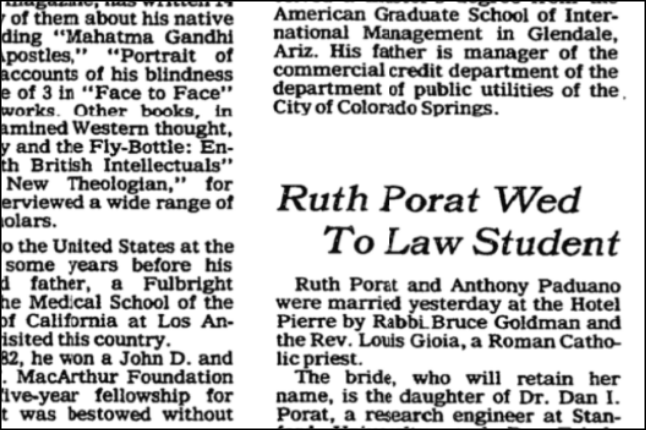
Porat’s marriage announcement in the New York Times said, “Ruth Porat Wed to Law Student.” They knew from the beginning she would have the outward-facing life.
Women who tried to keep working and have kids without a stay-at-home husband failed significantly in at least one aspect of their life. Most examples led to divorce. Disturbingly, I was one of those people. I also noticed that in all sections most women did not have a big exit. They sold their startup for a small amount and married investors, or just went to the next job. I’ve been feeling bad that I never had a big exit. But it was the wrong focus. I should have been feeling bad that each time I dated an investor I hated it.
What do you make of feminism, then? It seems like that’s the elephant in the room when I read your blog on this topic.
I think feminism is about choice. Women did not have choices for most of history. Today women have all the choices men do. Now we’re just talking about what women choose and how it works out. We have thirty years of data from a Nobel Prize winner to tell us what happens with various choices. That’s great for us. Women won. Hooray. Go make a good choice.
So you are happy that women have a choice. But you also speak of “bad parenting” and a desire for “children’s rights,” possibly protected Constitutionally. So is this the kind of choice that a thief has? Do the right thing or here comes the government? I’m not hostile, I’m just trying to think through this a bit.
I don’t see that this conflicts with choice. Having a standard for what ‘good’ parenting looks like wouldn’t take away the choice to be a parent or not… just set the stage for what you are signing up for should you CHOOSE to parent.
Yes, feminism was/is about choice.
People who are threatened by feminism may do the “flip flop” as in thinking that all gender roles will be reversed (a 1950’s time travel to-the-future story pictured a man with a beard and cotton dress with a mop and bucket, on his knees scrubbing a corridor)
Another flip-flop would be in the movie Norma Rae, where reactionaries thought giving Blacks union membership would mean all the leadership positions, such as shop stewards, being Black—or was it the entire union would go Black? I forget)
From fear of feminism, I remember a subtle flip-flop where people figured strident libbers wanted to use emotional coercion to deny every woman any choice to be a housewife.
Of course, just one can be a Jew and be an atheist, so too can one believe that women are equal and reasonable creatures and still be a Christian.
I love my “stay at home” partner. He allows me to be successful! I wish I was told this was an option growing up. It would have been nice if he knew it was an option too.
This is so important, Mara. Thank you for the comment.
Telling kids what’s possible. We’re stuck in a rut because there’s no way to motivate kids in school beyond telling them they have to do well in school to get a good job. it’s ironic that school is meant to open possibilities for kids, but at this point, it’s closing our minds to what’s possible in adult life.
someone said my life is really bougie after quitting my ft job and I get resources to still get massages and drive kids to therapies to get the support they need.
and I was like am i supposed to feel guilty about that? For a second I did. And then they clarified that they meant it as a compliment, to have enough money to support the kids, to do a little bit of what you like and being paid peanuts for it, and have hot showers and food on the table.
I suppose being very competitive like tech competitive ultimately was not in the cards for me. My childhood starter pack was way too low. It was the kind where everyone has daily blackouts due to energy issues. Lol. I guess my kids will have the better starter pack that they can reach for “all” – whatever that will mean to them in the future.
“Childhood starter pack” I love that.
I think you are being too hard on yourself, Penelope. I feel a tone I get from your writing is that you believe that if you had chosen to stay home, or chosen a different life partner, things would have worked out and a divorce and resultant hardships would have been avoided.
I was never a CEO, but I was the lead therapist at a 250 bed facility when I left to be a stay at home mom when my child was two years old. So, not a soft “mom job,” to be certain. At the time, I felt like I either needed to choose my family or choose my job, because one was going to fall apart. I remember my assistant would bring me lunch every day at work because I literally had no support or time at home to take care of myself or nourish my own body. My assistant told me one day, “I dreamed last night I forgot to bring you lunch and you starved to death,” a funny story, but also completely illustrative of how things were for me.
Anyway, two years after I left to be a stay at home mom, my investment banker husband left me and we divorced. One of the myriad reasons he gave for leaving was that I seemed very unhappy. So a lot of good choosing my family over career did for me.
Now I have a small private therapy practice and I do very well for myself. My daughter is well adjusted, though to be determined how she ultimately grows up in the end. She spends 50 percent of her time with me, and the other half of the time she’s with her dad. The break up of our marriage forced him to step up as a parent, something I had been asking him to do since our child was born.
I should add, I am probably autistic (I have two sisters who are autistic, much more obviously than I am). I would perhaps frame the situation as thus: as a neurodivergent woman, I am not likely to be able to fulfill the heteronormative role of wife and stay at home mother very well. I am also not likely to be discerning when I pick a life partner because I miss the important signs. What I mean to say is, a nuclear family life was probably not ever going to work out for me. I am not going to fit society’s traditional roles, no matter how hard I try. I don’t think not ever having children is a reasonable answer either: I deserve to reproduce as much as anyone else. My life is just going to look different and that’s ok.
Decades ago, my research led me to conclude that a two-career family is less stable than a one-career family. I’m not saying incomes, but careers, greedy jobs. There are plenty of non-greedy jobs that you can have two of in a family, where somehow you balance who takes of what time for kids’ needs. But if you have two high-paying careers in a family, you have poor odds of success. Failure looks like job stagnation, it looks like overwhelming stress, alienation from children, and divorce. Meanwhile, the pay differential between an okay job and a great career is immense, much more than making up for the cost of a parent staying home.
That meant that my conversations with my wife included the idea that, once we had kids, one of us would entirely quit their career. Eventually, it turned out to be me, and we ended up in category three.
I believe either one of my children (I have a boy and a girl) could have a great career. I believe either one of them could be a stay-at-home parent. But neither of them can do both. And I think they both know it.
I had this conversation with a group of friends from high-school a couple of weeks ago. We all went out of town to do a little bit of shopping and just to get away and have some girl time. I am the only SAHM. I’ve been a SAHM for the last 20 years and a homeschool mom for half of that time. All I heard during our time away was how exhausted everyone is and how much they loathe their jobs. One of them stated that they believe they had failed their kids. I was glad that they felt they could share how they felt and just get it out without feeling judged.
I have none of those feelings. I feel like we did a good job with our kids and our kids tell us quite often that they are glad that I stayed at home with them. I have to mention that we are a Black family and black SAHMs in the south are like unicorns. Every now and then you will discover one of us. 😆 The culture really doesn’t support us being home with our kids. I even had one of my friends during the trip ask me why did I choose to not work. She said, you’ve been to college and grad school and became educated, why would you give all that hard work up just to be at home? I’m glad she asked because that is how most people feel. They devalue women who choose to be homemakers. My oldest daughter has decided to go to college but she hopes to marry a man who will support her decision to stay at home if they have children. I felt proud! ☺️
So beautifully stated and so important for people to hear!
Perhaps, by going to college, your oldest daughter will improve her chances of marrying a man who will support her decision to stay at home if they have children.
I do hope so. I mean I will support whatever decision she decides to make about it, but I will be happy that she even has the choice. So many women do not.
Any thoughts on women getting into medical school. Then having some sort of career while also having kids? Is it possible for doctors to take career breaks?
I wrote a blog post about this. Most women who get medical degrees are not likely to earn back the money from their medical school loans. This is because most women who get medical degrees stop working to take care of kids or they cut back so much that they are barely making money.
Here’s a link:
https://blog.penelopetrunk.com/2022/08/09/is-medical-school-worth-it-for-women/
I have families in my piano studio where Mom is a doctor. In one case Dad is a stay at home parent. In the other Mom works part time as a doctor. They actually decided to homeschool and Mom enjoys planning fun activities and big travel. I imagine it depends what you specialize in but I’ve seen it work.
I like your example of the mom who is a doctor working part-time. It’s very common — so common that people have studied female doctors working part-time and it turns out it’s impossible to pay off medical school loans working part-time when kids come. So then a medical degree turns out to be less of a career and more of a signal that someone is smart and educated.
Here’s a post I wrote about that:
https://blog.penelopetrunk.com/2022/08/09/is-medical-school-worth-it-for-women/
That “Careless People” book suggests that Sheryl Sandberg was forced out of Facebook and didn’t simply quit. There is a lot more going on behind closed doors in every category (emotional neglect, generational trauma). I am proud of my daughter for realizing that college is a racket once she recognized she didn’t wish to live/work in the liberal elite enclaves despite having a Harvard-educated Grandma and a Stanford/U Chicago/Swarthmore mom. She is getting an AI-proof degree in 3 years at a nearby rural SUNY college with a lot of trade students, plans to marry right after graduation to her construction manager degree fiancé, be a stay home mother while her husband supports them in rural upstate NY, and can go on to have a career in environmental science and sustainability after the kids are grown, if she chooses to. Modest goals, traditional values, community/church focused, no FOMO. Just being a mom was way more rewarding than my corporate or creative work was and living in a tight-knit, low-key village is more nourishing than my academic or C-suite friends (with all that striving and schadenfreude) ever was. Intelligent women with successful parents are conditioned to strive for “the best” schools and careers, alas. Just being “regular” is another great option too…less f’ed up kids, I’ve observed.
Pre-kids I remember being very angry about this “parent or have a big career, you can’t do both” conversation and now that I have a kid, a hungry career, and no partner, my perspective has shifted. It’s not that you can’t have both a hungry career and a family, it’s that you can’t give 100% effort to both and sometimes (some careers, some kids) those can’t get by with less than 100% effort. I absolutely recognise that life would be a hell of a lot simpler if I had a “wife” at home full time (or even part time!), and I resent the compromises my career forces on my family. But, like many hungry careers, mine can’t be done part time and so we cope – we outsource the house management (to a cleaner/housekeeper and a meal prep service) and some of the parenting (to a wonderful nanny who my kid adores), and sometimes a ball gets dropped at the hungry career and the job has to live with that because my family needs me, but that’s a luxury I have because I was well established in my career path and company/partnership when I had my baby (and that delay means that there is one fewer child in our family than I’d like there to have been). But absolutely there are unpleasant compromises – my kid is the only one in his kindergarten class who is never picked up from school by his mom, and my career is one layer sub-c-suite right now even though my (childless female) c-suite boss is only five years older than I am.
There are wonderful careers that aren’t all consuming and are fulfilling. I homeschooled and taught piano for15 years. When I divorced unexpectedly, I dusted off my 22 year old Masters degree and started working at the school 3 days a week as a speech-language pathologist (enough to get full benefits). I’ve been lucky too have two jobs I love and now that I’m an empty nester it’s much easier.
I always wanted to follow in the family’s footsteps and be a lawyer but my heart was in teaching and I love the flexibility of two part time jobs.
I really worried about sacrificing my career in the beginning and I think every woman needs a plan B because marriages don’t always work out. But grateful I could find a niche that worked for me.
I really appreciate you shedding a light on what traders actually are and how women actually do the high pressure jobs. I often felt lazy for not taking that path. I hope we can all be more honest about traders so our choices can be made with real information.