
Next phase of your career: design
The future of the Internet is design: from fine art galleries to the size of the box you type in name. So start figuring out how to rejigger things to make your career relevant.
Here’s how I know what’s coming:
First, a flurry of emails arrive in my in-box each day touting “free infographics.” After sniffing around, I discovered that infographics garner so many clicks that SEO mavens publish quick, cheesy infographics to hand out for free in exchange for links back to publisher sites. The infographics suck so much that I’m not even going to show you one, but there’s a lesson here: people love pictures.
This means that you will be more valuable and more relevant if you can think in terms of visuals. This makes sense. It’s clear that in the last twenty years, as emails became the norm, if you were great at communicating via text, you had an advantage.
Not that everything can be reduced to an infographic, but what can be reduced is made more interesting. Short is good, and concise is fun, and in a world where we have too many facts, we appreciate a quick picture that synthesizes facts into something meaningful rather than a summary of disjointed facts.
In the design world there is a sense that design is not so much about product or endpoint but rather the interaction one has with another person. Davin Stowell, of Smart Design says, “Companies used to come to us asking for products. More recently they have been asking us to help them understand their customers. It’s almost as if our role has transcended from design experts to relationship consultants.”
I just received the book Microstyle: The Art of Writing Little. I did not read it. I skimmed it. Because, as the author, Christopher Johnson writes, “We have a collective obsession with brevity in all media.” I’m not going to argue here if this is good or bad (although I think it’s good). I’m going to tell you that if you don’t get on the brevity bandwagon, no one will listen. And presenting information visually is one of the most reliable ways to present it with brevity.
A list does that as well, by the way. It’s sort of the stepping stone between text and infographic. Which is why lists are so popular online—you can skim them. So, here’s a list of things you can do to start thinking more visually:
1. Read Tufte. He’s the king of information design. Every big thinker you admire has read Edward Tufte, trust me. The last time I read Tufte was in Seth Godin’s bathroom. No kidding. He keeps a Tufte book there.
2. Think short. Short writing already rules the Internet. You get noticed with short big-ideas, 140-character quips, and a 20 minute summary of a career’s worth of research. Infographics take bunches of very short ideas, and create a single, consise idea on top of them. A good infographic is like a poem that ends at just the right time.
3. Demand more meaning. It’s not enough to stack pictures of missiles to show an arms race. The information you put together needs to amount to something new. Statistics should not surprise people so much as the conclusion the infographic draws from the statistics. Check out the arms race infographic in the book Diagrams: Innovative Solutions for Graphic Designers. It blew my mind how quickly it allowed me to synthesize tons of arms race data and feel smart about it. And then I realized that a good infographic is the visual of a good blog post with lots of links — a fresh and solid argument on the surface, and lots of small pieces of evidence underneath.
4. Consider not only text-to-visual but also verbal-to-visual. Alexis Finch creates graphic renditions of speeches. She is able to go beyond a speaker’s outline to capture the most interesting ideas and how they relate to each other. Finch creates, in effect, her own version of the topic. Here is a sketch she did of a speech I gave at Tech Week.

5. Market yourself visually. The limitations of a text-based resume are clear. Solutions are not so clear. But Vizualize.me has a good start on solutions with their chart-based resume service. For example, text is too linear to describe today’s non-linear careers. But a chart-based resume shows time in a more useful way to an employer:

6. Steer your career visually. If you have a text-based resume, you need to always think in terms of bullets — is your project leading to a bullet on your resume, and if not, why are you doing it? With resumes going visual, you will need to think in terms of visual accomplishments. Brazen Careerist (my company) just launched a visual self-assessment tool that combines thousands of details about your activity on Facebook and LinkedIn to show a simple graphic of your strengths and weaknesses as a job candidate.

7. Use photos with more intention. The number of photos we take is incredible. And I’m starting to think that the next generation will laugh at how many photos we have taken. What is the point? Who will look at them all?
At some point, when we are just clicking to click—with no visual intention—then the photo serves to put a wall between us and the experience rather than a window.
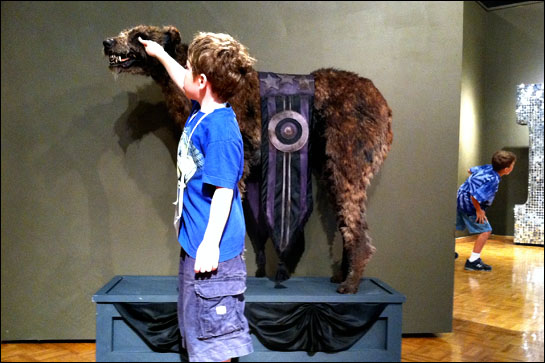
What are you doing behind the lens all the time? Raise the bar for yourself; allow only good photos. Melissa forced me to learn about good photos when she started taking them for my blog. Her photos are fantastic. Which served to show me how bad my own were. So she gave me lessons, and she edited. She rejects 90% of the photos I send her. But I learn a lot that way. See the photo at the top? I took 20 photos in the art gallery to get one good one.
But for most of us, photos are a good entry point to the next version of the Internet. Because if you force yourself to publish only good photos, you force yourself to think more about images and what they communicate to the viewer. It’s the first step in transitioning your career to the visual Internet.

Great post!
But I can’t help but wish you had given us more visuals of yourself!
creepy! that’s pretty much all you say to Pen’s smart posts. Unless you’re the Farmer passing as Bill this is weird.
Er, that isn’t the real Bill.
I am. That guy’s an imposter!
This all started, in the automated non-IRL non-whiteboard world, with Powerpoint. The prevalence of email delayed full impact. I have been saying for 10 years that a killer app would be an email tool that offered PPT-like visual tools.
This all started, in the automated non-IRL non-whiteboard world, with Powerpoint. The prevalence of email delayed full impact. I have been saying for 10 years that a killer app would be an email tool that offered PPT-like visual tools.
Just tweeted about this article on Twitter – it took a bit of reworking but I was able to fit it this concepts into 140 characters! Talk about being brief!
Plus, love the visual resume idea. Do I dare try to use it?
@marybudge:twitter
I don’t know. Will a visual resume pass muster with all the keyword focused computers used by companies? The HR tech has to change to accommodate the visual.
M
Michelle, many services will allow you to include keywords or tags in your work experience. For example check out my professional profile on Path.To http://path.to/joeymarchy
Michelle, many services will allow you to include keywords or tags in your work experience. For example check out my professional profile on Path.To http://path.to/joeymarchy
Mary, I would consider both: stick with your text-based resume, but paste the link to the visual resume right at the top with your contact info.
reminds be of Burroughs: “Word begets image, and image is virus”
reminds be of Burroughs: “Word begets image, and image is virus”
http://www.youtube.com/watch?v=-iwaqPBWOBQ I just absolutely love this! I felt kinda lost last night because I couldn’t explain some of my own conclusions. Now I can draw pictures!
The video will be interesting to you penelope. If you haven’t already watched it! it’s called Changing Education Paradigms.
Great post Penelope! Thanks for posting the link Karelys. I watched another TED video recently on the value of doodling: http://www.ted.com/talks/sunni_brown.html. We are moving towards the age of visual literacy. So even though we always hear about the importance of reading and writing, maybe it’s time to sign up for a drawing/animation class.
I couldn’t agree more with what you’re saying about how it is possible to increase meaning through being very minimalistic and strict about what you write.
sort of like a haiku but without being annoying I guess
sort of like a haiku but without being annoying I guess
sort of like a haiku but without being annoying I guess
Does the gallery encourage touching the pieces on display? I sort of cringed at the picture…
Does the gallery encourage touching the pieces on display? I sort of cringed at the picture…
Does the gallery encourage touching the pieces on display? I sort of cringed at the picture…
This is a funny comment to me. You have a point. I was so concentrating on getting a photo that I was having a hard time telling him the rules of the gallery. It was open for kids, so there were probably 100 gallery rules being broken right at that minute. I guess that’s what I ended up documenting :)
Penelope
the photo made me want to open a gallery/museum where kids can touch. Or anyone can touch. I think we learn better this way.
the photo made me want to open a gallery/museum where kids can touch. Or anyone can touch. I think we learn better this way.
I think this is so true! Style is becoming a major factor in communications these days. Sites like Pinterest.com and instagram are great ways to start working with images and curating your style if you’re not sure where to start.
Yep, visualization is the wave of the future.
Those interested in learning more should check out my book, Designing Data Visualizations, released this week. It’s an actual how-to-get-started with visualization design. Very practical for exactly this sort of thinking. Check it out. http://shop.oreilly.com/product/0636920022060.do-Noah
Yep, visualization is the wave of the future.
Those interested in learning more should check out my book, Designing Data Visualizations, released this week. It’s an actual how-to-get-started with visualization design. Very practical for exactly this sort of thinking. Check it out. http://shop.oreilly.com/product/0636920022060.do-Noah
penelope the link to the visual self assessment is broken :(
I think the visualization of the resume is a great approach that would set so many job-seekers apart! It continues to amaze me how I can see a project such as resume-writing in one viewpoint and then another view like this article sets me looking at the resume at a whole new angle. Great!
I think the visualization of the resume is a great approach that would set so many job-seekers apart! It continues to amaze me how I can see a project such as resume-writing in one viewpoint and then another view like this article sets me looking at the resume at a whole new angle. Great!
One of the most informative, right-to-the-point, hand-outs of how-to-get-a-job, I’ve read coming through YOU! I’m passing this on!
One additional point I’d like to make:
Many times job interviews are verbal, and initial set-up and intros are done over the phone through gate keepers. I make cold calls all the time in hopes of getting the top person who hires.
I have discovers that the conversations are not so dependent on WHAT is said, but HOW it is said. By that I mean, beyond the basic info I’m trying to convey, I do my best to make that phone call a PLEASANT EXPERIENCE, and actually ENTERTAINING. The idea is to leave a personable and positive impression so the next call is more”friendly” and I’m remembered.
Finally, I sincerely try to make the people I’m talking to know that I CARE ABOUT THEM AS WELL. They are not simply messengers. They are PEOPLE with needs and wants and hopes just like me. And so are their bosses!
Irv
It’s called visual literacy Penelope. Intent/ Content.
Thanks. Whenever I think I learned something new, I always find I’m just at the open door. Your comment makes me see that. I’m googling visual literacy now…
Penelope
“Multimodal” writing is the norm in first year composition classrooms with writing programs directors who go to current conferences. Composition now means composing, not writing.
Other search terms: digital literacy, visual rhetoric.
http://www.sciencedirect.com/science/article/pii/S8755461507000230
good girl
good girl
Also google ‘visual thinking’ and ‘visual learning’ for even more information because the information is scattered all over the Internet under various search terms.
The brevity comment brings to mind:
I am sorry to write such a long letter. I didn’t have time to write a short one.
(variously attributed to Johnson, Twain, Pascal, Voltaire)
Thanks for this timely post. I have a project due on Wednesday and now have a new direction . . .
So how does this jibe with your assertion that most blogs suck because people write what they think other people want to read instead of what they themselves want to read?
I do think design and visual appeal are important, but I hate reading lists and bullet points — they usually oversimplify things and make me feel talked down to. I like literary prose and complex arguments. Insanely long paragraphs and sentences are difficult to read, yes, but it’s also easy to tell when the writer is artificially shortening them out of fear that readers can’t read.
Yeah, I’m sure you’re right that the majority of the populations would rather see a page covered with lists and charts than one covered with traditionally-written text, but on the other hand, if every page on the Internet is all chart-y and list-y, and you are not a chart-y, list-y person, and you can write well, then I think you might be able to attract a niche of people who get seasick when they see yet another list and just want to read a well-written post. Especially if, as you say, you have a few judiciously chosen high-quality, relevant images thrown into the mix. And good design.
Do I agree or disagree with you? Yes, I guess.
I am one of those who will skim over a chart in favour of real sentences! Not everyone is a visual learner. In fact, I process auditory information much better, and my son has inherited this (he is 15). He had an educational assessment done not long ago, and we discovered that he has very poor visual memory (yes he can thank his mom for that). So this is not a generational thing, but has much more to do with the way you learn and process the information. Though, I agree that brevity is definitely key these days..
1). love the photo (always do).
2). love the visual resume. makes so much sense!
3). Brevity has been around– being a tech writer in the 90s in northern CA, if you couldn’t do brevity you were out of the game. Pictures were better, but we didnt have the tools then to make it work ROI-wise.
Brevity is a snack. Pictures are dessert. Sometimes I want a meal.
Well, these days people want snacks, so much so its an epidemic (yours truly included).
But if you want something that sells well, well, snack it is!
‘Want’ and ‘Need’ are two different things. When you need something, you can’t rely on a snack (not that you were implying this, I’m just making mention of it).
—————————————-
http://www.firefoldblog.com/
If you like PowerPoint, you will love Prezi:
http://prezi.com/
tufte’s contribution to the understanding of visual language is phenomenal. my husband studied with him at yale, and now passes his teachings (as well as those of paul rand and other masters) onto his own graphic design students. these people were committed to cutting through artifice/mere decoration to create visual communication that transcends language.
people can still study with tufte. he has, for some years, done a traveling show to many major cities, consisting of a day of lectures about presenting data. for the price of admission, students also receive four of his books. it represents a real educational value. see info about it on tufte’s own site: http://www.edwardtufte.com/tufte/
http://www.youtube.com/watch?v=MiAh3lYo6k4&feature=youtu.be
I like the photos you post on your blog. However the majority of them don’t have attribution so I don’t know if you or someone else took them. I can’t tell if you’re making progress or not on your photo skills and if I’m going to comment about a photo, I’d like to know who took it.
Read the posts. She always tells if Melissa or someone else took the picture in her blog.
I read ALL the posts and yes, she does tell if Melissa or someone else took the picture in her blog … in the comments. The attribution for the photos in her posts should be in the post itself … right next to the photo.
Hi
I want to elevate my site www.medikalurunler.org original content that article I want to climb in and help, but I do not know exactlywhat to do olabilirmisiniz.
thanks
Hi
I want to elevate my site www.medikalurunler.org original content that article I want to climb in and help, but I do not know exactlywhat to do olabilirmisiniz.
thanks
GREAT article, one of my favorites! I am designed challenged so needed this kick in the pants.
I love the visual resume – great post.
I love the graphic rendition of your speech! i really admire artistic talent like this.
I will have to grab a copy of Tufte.
I love the graphic rendition of your speech! i really admire artistic talent like this.
I will have to grab a copy of Tufte.
Look! I think this is hilarious. After reading the post where I say all infographic advertising emails I get just completely suck, someone actually sent me one. So I am posting it for your reading pleasure:
———- Forwarded message ———-From: Neil Spencer Date: Mon, Sep 26, 2011 at 5:50 PMSubject: Infographic post ideaTo: penelope@penelopetrunk.comHi Penelope,I enjoyed your infographic post, http://blog.penelopetrunk.com/2011/09/26/next-phase-of-your-career-design/, and thought you may be interested in using one of these new infographics we created here at Column Five in a future article post:
MDG Advertising Infographic: The ROI of Social Media
http://www.mdgadvertising.com/blog/infographic-the-roi-of-social-media-2/
Hunch Infographic: Stick vs Automatic
http://blog.hunch.com/?p=52234
Mindflash Infographic: Surprising and Strange – State-Sponsored Online Training Programs You Never Thought Existed
http://www.mindflash.com/blog/2011/09/surprising-strange-state-sponsored-online-training-programs-you-never-thought-existed/
Best,– Neil SpencerLead Content StrategistColumn Five MediaNewport Beach, CAwww.columnfivemedia.com
columnfive.tumblr.comskype: neil.spencer8twitter: @columnfiveInfographics App: http://itunes.apple.com/app/id449338596?mt=8
Infographics Newsletter: http://eepurl.com/etMLs
Hi Penelope,
Sorry for the oversight on our end. We appreciate your perspective on your blog here, and didn’t mean to waste your time.
Jason Lankow
CEO/Column Five Media
Hi Penelope,
Sorry for the oversight on our end. We appreciate your perspective on your blog here, and didn’t mean to waste your time.
Jason Lankow
CEO/Column Five Media
The visual self-assessment tool looks like girl scout badges.
This is a first-class entry, thanks for sharing the tips. It’s unfortunate that you highlight the hotdog on a stick flavor of infographic resume. I suggest for a professional touch using http://re.vu/
GREAT POST. I love it when you tell me what to do. BUT you buried the best part…please tell us more about Seth Godin’s bathroom.
You're doing well if you get one good photo for every twenty. The one of your son touching the dog’s eye is more about curiosity than about just one sculpture.
I also love to take photos in art galleries of the people looking and interacting with art. After I see the pictures I understand the artist's work in a whole new way.
Two sites I find interesting that utilize what you speak about above (and they might be Tufte disciples, I’m not sure – but I’m checking out Tufte next based on this post) are:
http://flowingdata.com/ he really has seemed to make a huge amount of data easy for anyone to understand and utilize. I loved the text messaging graph
http://fathom.info/ a company in CT who is primarily utilized by GE has done some cool stuff to explain a lot of information.
I spend the majority of my life explaining financial statistics to very creative people – you are very spot on as this is the next major communication roadblock that technology has allowed us to target. As someone who took way too many statistics classes in college though, I will always find this fascinating. And hopeful that all this will finally lead us to understand each other correctly the first time.
I for one mourn the death of the lyrical aesthetic that writing used to contain.
I for one mourn the death of the lyrical aesthetic that writing used to contain.
What is the aestheticism in older writing that is not present there anymore? The awkward, sort of antiquated organization of your words and the inflated diction say to me that you feel at home with romantic poets. Our definition of aesthetics is changing–that’s what this post is all about. By lyrical, I assume you’re referring to language’s inherent musicality, its cadence. If you don’t believe that is present in writing anymore, I don’t think you’re reading enough. Writing is a craft, and writers’ habits, tendencies, and influences in writing are widely disparate, so it is unfair to assume that a lack of lyricism is bad. Especially coming from someone who stopped listening at the chapter on commas.
What is the aestheticism in older writing that is not present there anymore? The awkward, sort of antiquated organization of your words and the inflated diction say to me that you feel at home with romantic poets. Our definition of aesthetics is changing–that’s what this post is all about. By lyrical, I assume you’re referring to language’s inherent musicality, its cadence. If you don’t believe that is present in writing anymore, I don’t think you’re reading enough. Writing is a craft, and writers’ habits, tendencies, and influences in writing are widely disparate, so it is unfair to assume that a lack of lyricism is bad. Especially coming from someone who stopped listening at the chapter on commas.
Romantic poets can suck it. Your preconcieved generalities (and arguably your opinions) are moot. I acknowledge and fully anticipate the cultural shift of aesthetics, but what I’m really saying is I’ll always miss the smell of a paperback over a Kindle. SAN DIMAS HIGH SCHOOL FOOTBALL RULES
The Kindle is not killing the book. I wish people would stop saying that.
Makes sense that I guess your personal mantra is the refrain of a single-line character in a nearly obsolete comedy from twenty years ago. Since pretty much everything else you’ve said is also irrelevant.
The Kindle is not killing the book. I wish people would stop saying that.
Makes sense that I guess your personal mantra is the refrain of a single-line character in a nearly obsolete comedy from twenty years ago. Since pretty much everything else you’ve said is also irrelevant.
U MAD?
Nah
Just giving you a hard time. I wanted to challenge your opinion that the lyrical aesthetic in words is dead, because I don’t think it’s true. Defend it if it’s true! (But it’s not.)
Also I like your blog.
:-) just giving ya a hard time as well. got me off guard but I appreciate the fine art of conversation! (that I definitely just failed at)
what?
Could we please have an infographic of just how dry and hairy your pussy is??? I’m thinking an image of a tuna would go well just to give readers an idea of how smelly it is.
Thank you for the hints and info. I still believe in the power of words, but will keep these trends in mind.
Loved this post. Why? You did what you talked about and it included a lot of what I like in blog posts. Good pictures, relevant hyper-links and lists, and turned me on to a new person/topic/thing I did not know about before. Thanks so much.
Wonderful post. The paper resume will never die – and for most industries – it will always be mostly text based. I wish I believed otherwise, but I don’t.
If you are searching an essay encyclopedia, visit Essaypedia.Com =)
Would love you to take a look at Path.To. It’s a professional network designed to showcase talented professionals. http://path.to/ -> my profile is http://path.to/dbounds
3,200 words and counting in the comments on this 1,000 + word (not including inforgraphics text) post. Brevity – right.
Great tip about using info-graphics, something that I will definitely take on board!
I used to draw verbal to visual doodles when I was in high school. Teachers would think I was not paying attention, but I was. I just found that I was able to review my notes faster when they were displayed visually. Which of course brings us to brevity; we all want fast and to the point, no matter what we are reading. Visuals definitely help with that!
However, I am kind of curious about the visual resumes. I have never heard of visualize.me, or seen a mapped out resume. Is that really more effective than the standard resume formats? I would venture to say that while visuals/images definitely enable brevity, but they should be used appropriately. A charted resume just seems like a cop out to me. Great post, and great photo!