Here’s an interview of me in Inc. magazine. John Warrilow did the interview. The topic was how to know if you’re an entrepreneur. I basically said that you know you’re an entrepreneur if you are crazy, in a manic way, and you are willing to risk the health of your family and have no chance of a stable income, ever.
Then John sent his book to me. It’s called Built to Sell. It turns out that John did a startup and he sold it, and his book is, basically, how to be so smart about doing a startup that you are aiming for a reasonable, not-pie-in-the-sky exit from day one.
I spend a lot of time talking about how startup life is completely crazy, and the founders are crazy for choosing it. But in fact, the lower-stakes, lower-risk entrepreneurship, where, instead of having investors, you use your own time and energy to make money on the side while you are doing other things – that’s a great way to structure a life.
Ramit Sethi has great advice on how to do this. Its called Earn $1K On the Side. And now I bet a ton of you are going to sign up for his program, and I should have negotiated beforehand to get a cut of whatever he earns from this post. But I am stuck thinking about insanely risky businesses with high reward and so I forget to do things like earn $300 when it’s just sitting there. Read more
I get my haircuts in Los Angeles because my best friend Sharon cuts my hair for free, which means the cost of the plane ticket to LA is cheaper than paying for cut and color in Chicago.
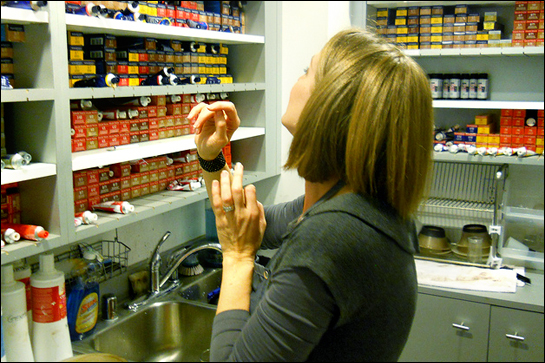
Sharon is a color specialist. This is Sharon picking color for a client who Sharon is trying to focus on while I disrupt her.
She started out just being a hairdresser. That's how I met her. I had a boyfriend who had a terrible haircut and I walked into a salon that looked expensive because he was paying, and I asked for anyone. We got Sharon because she had just learned to cut hair and we didn't request anyone who had experience.
Now I know better. Now, twenty years later, Sharon is my best friend. At some point, I don't remember when, Sharon started cutting my hair for free. I asked, like a jealous boyfriend, which other friends she cuts for free. She said no one else. That's how I feel okay telling you she's my best friend. Read more
Interview adage: If you can’t get hired being your true self, you don’t want to work there.
Life adage: If you’re not comfortable showing your true self then you probably have a disconnect between who you are and who you want to be. You really need to address that before it derails not only your career but also your relationships.
Here are three ways to make sure you stick to who you are when you interview:
1. Recognize that who you are is a moving target.
I find that showing my true self stems from knowing my true self. I am always learning about who I am, and then I always have to how I convey myself to other people—the two need to match, and I have found that it’s not so easy.
For example, we had guys come to put new roofs on old barn buildings.

The farmer told me that most of the buildings we are re-roofing are buildings people around here would tear down. People build new, shiny metal buildings now. Our yard full of old, wooden sheds, is something between a historic monument and an abandoned farm. Read more
I just got waxed. Everything off. Here’s a picture of Stephanie in action:
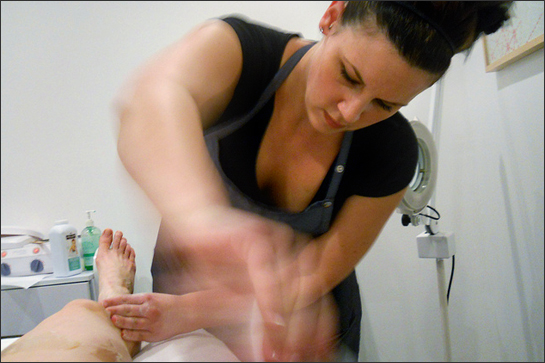
I love Stephanie because she is fun to talk to if I feel like talking and she leaves me alone if I feel like sending emails on my iPhone while she waxes. Or taking pictures.
I love the feeling of being neat and tidy after waxing. Because I feel like if my body is neat and tidy then my life is neat and tidy. Which is, of course, not true. I’m not sure anyone’s life is neat and tidy. But I like the idea that I can buy the illusion that I have things pulled together.
The problem is that waxing is expensive, and it’s a recurring expense. And I’m working on keeping my expenses very low so that I can start another company. Because a startup is really difficult to keep funded, and if you are supporting a family on a startup salary, it’s very scary.
But I keep feeling I’ve already cut as much as spending as I can. Does everyone feel that way?
But look, I moved from NYC to a farm. There are no stores here so I have to go to eBay at 2am for something to qualify as an impulse buy. There are no avenues for splurging on spoiled children beyond buying an extra dog or donkey. But still I find avenues to extravagances that I hate giving up. Read more
Why are almost all the bloggers in the Life at Work section at BNET women? I’m worried, because it’s never good for one’s career to be in a room full of women unless you’re a model or a stripper. Because where there are women there are lower salaries. Read more
My kids are Generation Z, born between 1995 and 2010. And I wonder: what can we see in those kids now that can tell us what they’ll be like later, at work?

As a history student in college (history of political thought, for all you fans of the Republic) and still an obsessive researcher of generational demographic trends (everyone should start with Strauss & Howe) I understand that to study history (contemporary or ancient), you must study generational shifts in thinking, because the way the generation thinks helps us to understand and explain historical action. And maybe predict future action.
So I think a lot about what Generation Z will be like. I have written before about what Generation Z will be like at work , but I’ve been thinking, recently, that the way Gen Z is educated will change the workplace when they enter it.
Baby boomers changed politics, Gen X changed family, Gen Y changed work, and Gen Z will change education. Here’s how the education of Gen Z will affect us at work. Read more
I just spent the last two weeks selling my self-published book. I published a book a few years ago with Time Warner, but I wanted to see what it would be like to self-publish. I decided against an ebook format because I really like holding the book of an author I love to read. I like living with that book in my house because it’s like living with a friend.
So I went with a print book. And I did a lot of unconventional things – beginning with the announcement — and they paid off. So, here’s my advice on the new rules for self-publishing.
1. Mainstream publishers help very few people. And probably not you.
Authors sell books, not publishers. For writers without a big name, publishers give them credibility. The problem is that publishers aren’t set up to be able to make money from authors who haven’t already made a name for themselves. This arrangement used to be fine before social media, before almost every author needed a channel to an audience. But now authors have the ready-made sales channel that is social media, so the publishers are no longer the gatekeepers to customers.
Amanda Hocking is reportedly making a million dollars a year self-publishing ebooks. And very rich author Joe Konrath, who has written about the math behind publishing, recently he turned down a half-a-million-dollar book deal so that he could self-publish. Read more
If you’re here because you read the Tim Ferriss article in the New York Times today, you will probably want to read the blog post I wrote about my experiences with Tim Ferriss:
5 Time management tips I learned from years of hating Tim Ferriss Read more
I didn't notice how much Yiddish I use until I moved to Wisconsin and people had not heard any Yiddish. I keep using it, though because it’s a great supplement to English; almost all Yiddish words we use with English are actually extremely nuanced ways to express negative feelings about something or someone.

Take, for example, tsotcke, chazzerai, and schmate. In this photo, the candlesticks are tsotchkes—they are stuff I don't need but I have in the house because I like them. In general, if it's your stuff, it's valuable or sentimental, but to other people, it's just tsotchkes.
The stuff in front of my candlesticks is chazzerai—junky toys. The kids still play with them, but only in so far as they are weapons to catapult into each others' heads under the guise of a missed toss. Chazzerai is more negative than tsotchke. If it's a tsotchke, everyone wants to throw it out except for the owner. If it's chazzerai, even the owner will not rescue it from the garbage.
Using Yiddish is a way to feel a sense of belonging through a common language. There are lots of ways to feel like you belong. When I work at a company I belong through a common goal.
Last week I flew to Washington DC for a Brazen Careerist meeting, with Ryan Paugh. When he saw what I was wearing and he said, “Nu? What’s with this schmate around your waist?”
He didn't actually say that. He might have if he were Jewish. Instead, he said, “That sweater is pretty dirty.” I put another schmate over my schmate because if you have one schmate it's just a rag—which is the literal translation of the word. But two schmates, I was hoping, is more Mary-Kate Olsen. Read more
 My son made this card for me, after I bought him Pokemon Cards. So it seems appropriate that after you guys bought so many copies of my new book last week, I give the card to you. Read more