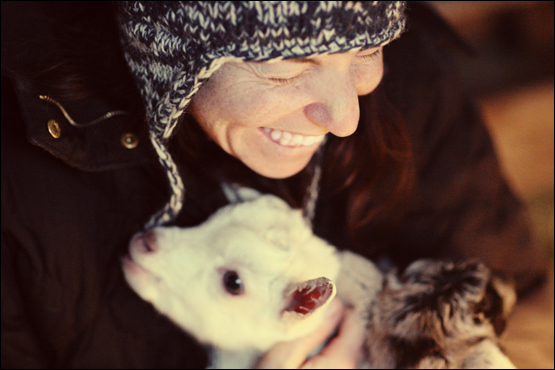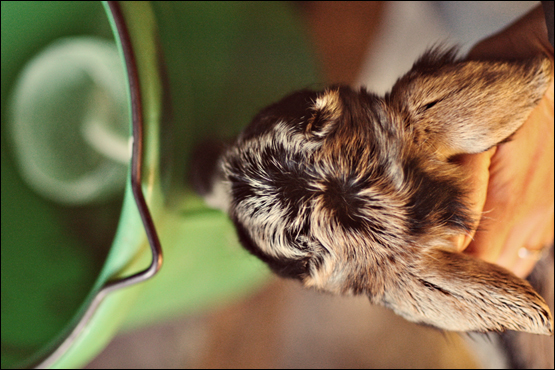
I have two new goats.

In a nod to Tom Sawyer and his fence, I told my sons the goats are for me only, and I want to take care of them. When my sons thought of 100 names for each goat, I told them that the person who takes care of the goats gets to name the goats.
So the goats are named Samuel and Snowflake. And I am supervising feeding instead of feeding.
I know you're not supposed to name farm animals you are planning to eat. But last summer my son bottle fed a calf that did not have a mom to take care of it, and now my son seems to be fine with the idea of killing the calf.
The farmer made the idea more palatable to my son by telling him that my son will get money for taking care of the calf. My son asked for $10,000. The farmer pointed out that we cannot sell a calf for $10,000 and when all was said and done with the financial lesson, it became clear that if you add labor, and milk replacer, and the small size of the orphaned calf, it costs more money to keep the calf alive and slaughter it for meat than it would have cost to kill the calf when it was born.
"We don't kill our animals here unless they are in pain," said the farmer to my son.
So it was easy to explain to my son why our goats were free. "The dairy goat farmer doesn't want them," I said. "It costs too much in labor and feed to keep the goat alive. That farmer would lose money."
I didn't tell my sons that farmers all over the cheese belt of America are banging goat babies on the head to kill them as soon as they are born.
If this were a PETA blog, there would be really gross pictures. But my kids go to school with tons of dairy farm kids, so I have to be careful.
But here's the problem with the milk industry. To get milk from animals they have to give birth. And their milk slows down if they don't give birth a lot. If the dairy cow gives birth to a girl, there's hope that the girl cow will give milk when she grows up, so it's not a total waste of money to keep the calf alive.
If the dairy cow gives birth to a boy, there's not really anything to make it economically sensible to keep it alive.You have probably never had a dairy cow steak in your life—they're just not that good. But dairy cow meat can go into low-cost food like McDonald's hamburgers. So McDonald's is saving the lives of tons of boy dairy cows by creating a market for them.
The dairy goats are not so lucky. Just like the cow business, there are meat goats and dairy goats. But there is not enough money is the goat meat market for people to pay a decent price to kill dairy goats for meat. There's not enough meat on the dairy goat to make it worth raising the dairy goat.
So farmers that provide goat milk to the cheese industry kill the boy baby goats.
You can get angry at the farmers if you want, but what can they do? They could raise the prices of goat milk, but someone would undersell them. And people who are great at raising goats can't switch their farm over to something else. They don't know how and they don't have enough money for a capital investment.
We have seen this business problem before. We see it in corporate life all the time. It's much easier to make money without the burden of a moral compass. Until you go to jail. But also, most of us have our own moral compass and we are always trying to balance ethical problems: feeding ourselves and our families and being the good person we envision ourselves to be. Making real world business decisions requires a constant recalibration of the right and wrong of our own perspective against what's at stake.
The type of business makes a huge difference. Take Bernie Madoff, for instance. It's hard for me to understand the laws he violated and the numbers he faked. So who knows what I would have done with the opportunity to make decisions for him? But when I first met the farmer, I could look in his pig pen (technically called a "farrowing pen") and see that I really don't like how he's birthing pigs. He has the moms immobilized so they don't roll over onto babies.
My perspective: It's inhumane to tie down an animal during birth and if pigs would roll over onto babies in natural childbirth then probably that's why there are such big litters—because some would die naturally.
The farmer's perspective: His whole system is set up this way and it's too much to change right now and it's just balancing the pain of a birthing mother versus the pain of a baby being squashed, and who am I to guess which is more painful? (This is what most animal arguments with the farmer come down to: "Don't anthropomorphize the animals!")
So it's never absolutely clear to me what is right and what is wrong on a family farm. And most of these goat milk farms are family farms.
What is clear to me, though, is that goat cheese is like veal: If you had any idea what animals are going through to get you this meal, you would be horrified.
The great thing about awareness, though, is that once people understood the horrors of the veal industry, the veal industry tanked. And now a new industry of veal cows with a high quality of life has emerged.
So, I got two boy goats from a woman whose specialty is taking boy goats from milk farmers who don't want them. Here's a photo of Samuel today. Four days old.
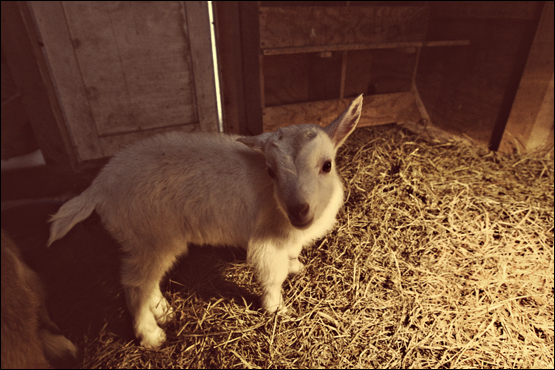
The farmers control the births so they get an optimum price for milk. Milk prices are high now. So babies are being born in the coldest part of winter. They are not in heated barns because it's too costly to heat a barn for animals that make so little money at slaughter. Of the boy baby goats that are not intentionally killed at birth, a large percentage of them die from frostbite. And even more die because when you take them away from their mother, they have no will to eat.
Because I make money from something other than goat milk, and I can afford to turn my boy goats into sort-of house pets, we have two in a small heated shed. I am having to force-feed them to teach them how to eat. It reminds me a little of feeding my own boy babies that hadn't learned to latch onto the nipple.

Here's my idea. I'm going to learn about how to take care of boy baby goats, and then I'm going to figure out how to change the goat cheese industry so that people understand that the moral cost of goat cheese is very high right now. But it doesn't have to be. Somehow I want to try to figure out how to make morally responsible goat cheese.
Does anyone have ideas? Also, if you want to know what it looks like to figure out a new idea for a company, here's what looks like: Going down seemingly insane paths, learning skills that may or may not be useful in life, meeting a wide range of people who may or may not help you, and then telling everyone your idea in order to get feedback.


Ok, Ok, I'll take a goat. Fedex overnight box with holes in it?
Posted by Alan Wilensky on January 25, 2011 at 4:00 pm | permalink |
Add them to chickens and bees as the next step in urban farming. Though goats are "browsers" not "grazers" and can't really be used as lawnmowers (sorry Google ), maybe you could rent them out to <a href: http://www.grist.org/article/getting/) clear brush.
Posted by Chris on January 25, 2011 at 4:03 pm | permalink |
Forgot my closing tag. Meant to say:
<<a href: http://www.grist.org/article/getting/) clear brush .
Posted by Chris on January 25, 2011 at 4:04 pm | permalink |
but they do eat poison ivy rent them out for that?
Posted by carol on January 25, 2011 at 6:39 pm | permalink |
Do goats eat kudzu?
Posted by Eowyn on April 4, 2011 at 11:07 am | permalink |
Off topic:
Your new camera is really making a difference!
Congratulations on them!
Lucas
Posted by Lucas Reis on January 25, 2011 at 4:09 pm | permalink |
*Congratulations on the pictures…!
Posted by Lucas Reis on January 25, 2011 at 4:10 pm | permalink |
Why not start a company that sells Goat Meat which would come from mature free range goats? people would pay for that.
Posted by Steve on January 25, 2011 at 4:10 pm | permalink |
This is absolutely sad. I hate thinking of animals dying for no reason. I do love goat cheese.
What is a goat's original purpose on a farm? Milk? What do the male goats do?
I like the clear brush idea.
Posted by Natalie on January 25, 2011 at 4:20 pm | permalink |
A well-written piece. The Penelope Sweet Spot — combining the intimate and personal with a relevant business insight.
Posted by Joe Fusco on January 25, 2011 at 4:23 pm | permalink |
Yes, I was impressed too. Penelope has a wonderful woman's brain (yes, what else would she have ) that freely encompasses all that is around here- kids and farmers and goats- with an entrepreneurial brain vs. the typical male brain that is more narrowly focused and maybe more hemmed in by perceived realities.
Posted by Stu Langley on January 25, 2011 at 4:46 pm | permalink |
I like the pet food idea. I work for a pet business magazine, and pet food is doing all sorts of odd things right now. People want to believe they are feeding their pets the best they can…and if that meat is cheap, but still 100% "real meat" people will pay to feed it to their pets.
Posted by Melissa Breau on January 25, 2011 at 8:28 pm | permalink |
Perhaps goat meat could be used for a more naturally produced pet food? and… agreed. Urban farming could adopt the use of goats on small scales. If you're creating a sustainable farm on your tiny acre and a half or less, managing a goat to manage brush, etc. and perhaps its waste as added fertilizer combined with vermiculture, bees, etc. could work?
Posted by Julie on January 25, 2011 at 4:26 pm | permalink |
Lots of people (us included) do not bang our male baby goats on the head. In fact, most goat raisers that I know actually will wether male goats (castrate) and try to sell them first as pets and brush-clearers. Goats are incredibly efficient at that.
I think the answer is not in banning goat milk entirely but rather, finding out what the practices at the farm that provides YOUR products are, whether that be milk from a cow, chicken from a…well…chicken or beef, or pigs or any of the other animals that we use for food in any way shape or form.
Just for reference, my family is mostly strictly vegetarian (no factory farmed meats, eggs, or milk), but we will eat cheese made from the milk of our own goats, eat eggs from our own free-range chickens and will support local farmers that promote sustainable and humane animal husbandry on the rare occasion where my husband and children do decide to eat meat.
Posted by Bevin on January 25, 2011 at 4:26 pm | permalink |
Thanks. We have to stop the bastards.
Posted by David on January 25, 2011 at 4:30 pm | permalink |
Meant to add, but hit post too fast…
We also don't take them away at birth (unless the mother rejects them, which is why we're raising a little boy in our laundry room right now), separate them early (our goats are dam-raised, and only separated at night starting at two weeks), and are currently snuggled up under special heating lamps designed for our goats that birth in these cold winter months.
We're not the only producer to operate this way, but because we operate in a humane fashion, we can't get the throughput that others can, and our prices will be higher. If that's worth it to you, pay the prices.
That's what will change the industry. Be willing to do some work for your food.
Posted by Bevin on January 25, 2011 at 4:32 pm | permalink |
Exactly! I think the answer lies with the consumers. Be informed. Be concerned. Be willing to accept that ethics and higher quality come at a higher price, and be willing to pay it. Only then will things change.
Posted by Elle on January 25, 2011 at 4:51 pm | permalink |
Bevin, where is your farm? I bet some of us would love to be customers!
Posted by brooklynchick on January 25, 2011 at 5:59 pm | permalink |
We're small right now, and in Pennsylvania. If you're in PA, please check out: http://www.fruittartcaprines.webs.com/
You're welcome to visit the farm!
Posted by Bevin on January 26, 2011 at 7:36 am | permalink |
Bevin, your stories of "this is why our prices are higher" needs to be part of the marketing and packaging of every unit of goat-anything that you sell, anywhere. A big read headline ala (but better than): "this is why this costs more" and printing out your (well-crafted) story — giving the consumer the info that most of us (me) had no idea went into the whole deal — this is educating the buyer and letting them make the decision. But it would be really hard to reach for the cheaper stuff after reading your "be aware" packaging… at least without thinking of your story.
Kudos to Penelope for wrapping a global business lesson inside a new biz brainstorm process around an intimate life experience. Rock on.
Posted by @TheGirlPie on January 25, 2011 at 6:39 pm | permalink |
Good thoughts, and maybe that ought to be a part of any local food packaging, eh? Because in every single local food there is a story, and that's why they are more expensive in general. From not using pesticides that damage the earth, to humane rearing methods to hand-crafted care…every single locally produced item has a story.
Thanks for the thought!
Posted by Bevin on January 26, 2011 at 7:34 am | permalink |
Excellent comment string – I think that the cost factor is critical. People who care simply have to make this choice – either eat randomly and don't care or eat less meat/dairy, but when you do, buy the better, local, humane stuff (unless money is no object, then please buy vigorously from local sources). We have a sheep farm an hour from our house (that you can visit, with good conditions) with extraordinary lamb – I don't eat it all the time, but it is totally worth the extra money when we can get it. I'd rather have that once a month than random factory meat once a week.
Posted by MJ on January 26, 2011 at 8:52 am | permalink |
Thank you for your informed response to this very inaccurate story.
We have raised hundreds of goats over the course of the past 18 years and never once killed our bucks (boys) at birth. They are often castrated and a few get to remain "intact" to be used for quality breedings. We love our boys as much as our does (girls) and always give them the same attention and healthcare that the does receive. Every attempt has been made to see them go to good homes, usually as pets. Only on a couple of occasions have they been eaten. AND dairy goat bucks ARE very good for eating purposes, usually around 4 months of age.
I've been involved with the dairy goat world — locally, regionally and nationally — and the majority of goat owners do not kill their bucks at birth because there is a market for them. There still are a few dairies that use this practice but if you know the source of your favorite goat cheese and look into their practices, you can avoid those folks.
Posted by Lisa on February 10, 2011 at 1:11 pm | permalink |
Thank you, Bevin! After I read Penelope's article I swore off goat cheese until I could do enough research into local farms that do not kill off their male goats. Thank you for all that you do to treat these gentle animals right – at the end of the day, a goat, a cow, a dog, a cat – they are all animals like humans, and they deserve their life just as much as we do.
Posted by Alyssa on March 12, 2011 at 7:56 am | permalink |
The best thing any concerned person can do is buy from a local family farm, then visit the place and ask questions. Many goat farms sell the boys as bottle babies for meat, which is at least better than clubbing or drowning them. You can find one near you on localharvest.org producing any number of products, very often in a more responsible and ethical way. Big agribusiness is usually not hard to beat in the quality and ethics departments, after all.
Posted by Elle on January 25, 2011 at 4:33 pm | permalink |
Actually steak from a dairy cow is just as good as from Angus cows. We have a few acres and have taken calves from a dairy farmer nearby to raise for their meat, and everyone who has had them loves the steaks from them. The issue is that it is a bit more economical to raise beef cows to sell for meat than to raise dairy cows for the meat.
Posted by David on January 25, 2011 at 4:36 pm | permalink |
Well damn…I was just starting to love goat cheese. I'd love to hear if you cone up with a solution.
Posted by Alaina on January 25, 2011 at 4:46 pm | permalink |
I googled "Kosher goat meat" and didn't come up with much, except people complaining that they can't find any.
Maybe this is a calling?
Posted by Nancy on January 25, 2011 at 4:49 pm | permalink |
Nancy, try "Halal Goat Meat." Halal food practices are similar to kosher. And Halal is more practiced in geographic areas where they appreciate the tastiness of goat, it seems!
Posted by Wulfwen on January 27, 2011 at 2:53 pm | permalink |
Ok, so I always wanted a house pig. Pigs are smart, and clean. And everyone always asks you if you're a dog or a cat person, but what if you're a pig person, and you never even knew? And Byron had a bear at Cambridge because there was a rule against having dogs, so maybe that's inspiration for having a pet to surprise people. No, of course that's not a good reason to bring an animal home. I know because I once brought home a ferret that I named Francisco Pizarro and it didn't go over that well. But sometimes putting animals in places you don't expect does work (with a lot of thought). Can you herd goats, like sheep? I heard on NPR that some people are renting flocks of sheep to keep their border collies busy. I have an Aussie. In the city. I would rent her a flock of sheep. Or goats, whatever.
Posted by Harriet May on January 25, 2011 at 4:50 pm | permalink |
I'm living in a little village in southern France where goat cheese is a primary food. I don't know the goat cheese practices here, but food ecology and ethics on the whole seem to be approached from a position of respect. Might be worth researching?
Posted by RJ on January 25, 2011 at 5:01 pm | permalink |
Oh, my gosh this is awful. I had no idea my brie was encouraging the death of boy goats! I eat meat, and I love a good steak, but I won't eat veal, and I don't even eat in restaurants that serve foie gras. I don't know if I'm a hypocrite, but either way, I can't be consuming goat milk products if boy goats ar being treated like baby Chinese girls.
I, too, am perhaps guilty of anthropomorphizing the animals, but I don't particularly care. This is just awful. I hope there is an industry, at least, for sending the boy goats out to stud, but probably not much of one. *sigh*
No more feta or other goat milk cheeses for me. Though I did hear that goats are doing well with eating debris for landscapers. Maybe they could only use male goats? Oh, forget it. I'll just stay away from the goat milk. Feh.
Posted by Tara on January 25, 2011 at 5:01 pm | permalink |
Most feta is cow's milk, nowadays. Traditional feta is made with sheep's milk… not sure if there is any goat cheese feta. I only know because my boyfriend is lactose intolerant. Goat cheese has almost no lactose and sheep's milk has none. Cheese he can eat =
Posted by K00kyKelly on January 27, 2011 at 3:50 pm | permalink |
Penelope: I do not doubt that you will have a positive influence on the goat industry. I want to say I will officially sign off on goat cheese as a result of this post…but I also don't want the farmers to lose their livelihoods. And there in lies the dilemma that you've described….
Unfortunately I have nothing of greater value to contribute… except to say I support your efforts.
Amy Parmenter
The ParmFarm (not dairy… :0))
Posted by Amy Parmenter on January 25, 2011 at 5:02 pm | permalink |
There's a technique, Microsort, that is said to do a pretty good job (90%) at separating male and female sperm. So if you did that and used artificial insemination, you'd drastically reduce the male offspring population. It would add to the cost, though. Do we think goat life quality includes mating? Now there's a conundrum.
Posted by Chris McLaughlin on January 25, 2011 at 5:07 pm | permalink |
I don't understand. If it is okay to kill adult animals why is it not okay to kill the babies? Just because they're babies? If you don't have a problem killing animals to eat them, why would it matter how old the animal was? If anything, killing the babies before they lived long enough to suffer is the greater kindness.
Some have also argued that it doesn't matter how well you care for an animal you intend to kill because, well, you intend to kill it. Anything else you do to care for the animal amounts to mitigating your guilt OR optimizing the product to maximize its value to the intended consumer (who wants to assuage their guilt).
I do thank you for the info on goat cheese which I've only bought from local producers, safely adding that to the list of things I don't eat. Meat obviously being one of them.
The youngest subculture of vegans have always annoyed me for being so holier than thou, irrational and judgmental. I'm starting to understand how and why they get that way.
Posted by Anonymous Coward on January 25, 2011 at 5:09 pm | permalink |
Penelope,
I am so happy that you are using your brilliance and business acumen to help animals, which is really assisting for the better good. I hope that the energy you put into this project makes you feel good about yourself and gives purpose to your life on the farm. I have no doubt that the goat cheese industry, as well as you, will be all the better for it.
Posted by Suzy McQ on January 25, 2011 at 5:28 pm | permalink |
where's my goat?
Posted by Alan Wilensky on January 25, 2011 at 5:31 pm | permalink |
Fascinating. But I'll take a break from goat cheese. I'm a carnivore, but not a kill babies so we can use their mom's milk kinda person.
Posted by Lisa on January 25, 2011 at 5:53 pm | permalink |
I found this farm (they sell at whole foods), but I don't know the details about "humane certification" and what it really means:
http://www.redwoodhill.com/our-farm/certified-humane
Posted by brooklynchick on January 25, 2011 at 6:06 pm | permalink |
@Brooklynchick, Redwood is very well known in the dairy goat community and highly respected both for their animal care and their products. But "Humane Certification" is a dubious accreditation given by filling out a form and mailing it to HSUS. There is no inspection. One of the worst farms I've personally seen was "humane certified".
Posted by goatlady on January 29, 2011 at 10:26 pm | permalink |
Really helpful (if depressing), thanks. My favorite east coast cheese is from Shelburne, which is humane certified. Sigh.
Posted by brooklynchick on February 5, 2011 at 11:14 am | permalink |
So I live in Pasadena. How do I find out which farmers are baby goat killers, which ones are baby goat castrators, and which ones raise baby goats under heat lamps? I don't think that info's printed on the label. I'm so confused! I could certainly give up eating goat cheese. But how do I give up Wall Street? These guys are killers too. Even when the heats on.
Irv
Posted by Irving Podolsky on January 25, 2011 at 6:27 pm | permalink |
And … you officially have won me over, and I'm thinking about a solution so you revamp the dairy goat industry. Thank you for raising my awareness and for wanting to find a solution.
Posted by Micaela on January 25, 2011 at 6:40 pm | permalink |
I wonder if the by goats can be used as mobile lawnmowers, or brush clearers, when they're grown? That would recoup some of the cost of their raising.
Posted by Tzipporah on January 25, 2011 at 6:40 pm | permalink |
"…goats can be used as mobile lawnmowers,"
Replacing static lawnmowers?
Posted by Dobharchu on January 26, 2011 at 5:23 am | permalink |
I love your articles, Pentelope! I especially love the photo of you at the top cuddling the baby goats. I think you should keep that one in the happy folder. You look filled with "joy".
When I was 10, my family moved from suburban life in Northern CA to a farm. We did get a few goats, who had babies and one even tripplets. We named them Winkin, Blinkin, and Knod. Baby goats are just so much joy to watch leap and bounce about.
When we first went to the farm we adopted 10 baby sheep from a meat packing company. We got them home in the back of my mom's Cadillac all safely packed into hollowed out cigarette cases from the local supermarket. Thus, they all became named after cirgarette brands: Camel, Winston, Benson, Lucky Strike, etc.
At some point, we did have the talk about 'you live on a farm now and we will be eating what we raise.' Of course that only came after my father told us that a nice man we knew was going to swap his two sheep for our two sheep – and we werent really eating "our pets." Great, but I was a smart child: "Daddy, Mr. Barker lives in a house without a farm. Where does he keep his goats? And, when they take the coats off the sheep, how will they know which ones are Waffles (my sheep) and Daisy (my sheep)?"
Your story tickled me. Keep up with the great photos, too!
PS: Mom switched us to a goat make only diet, and eventually started making soft goat cheese at home for the family. Goats are wonderful weed eaters as well. Around here in Northern CA people rent their goats out to farms who need their weeds eaten down in a pasture or along the roadside.
Posted by Lynny Young on January 25, 2011 at 7:03 pm | permalink |
Oops "Penelope" .. sorry, I spelled your name incorrectly.
Posted by Lynny Young on January 25, 2011 at 7:05 pm | permalink |
Someone from the city came up with the idea that you can't name animals that you intend to eat. I have been naming animals all my life and they always have tasted good too!! (Of course it's always been cows and chickens…not sure if they were to like live in my house with me or something…that maybe would be wrong! LOL)
Posted by Elisabeth on January 25, 2011 at 7:10 pm | permalink |
Okay, I just read your whole article. I just have to say that goats aren't that great. Someday when you get a call from the local school district complaining that the children on the school bus saw the goat humping the dog right out in the open will be the day that you realize that these male goats may be more trouble than they are worth! (And this is a true story). P.S. I live in WI too.
Posted by Elisabeth on January 25, 2011 at 7:20 pm | permalink |
Gosh, I would have paid good money to see that!
Posted by Kay on January 26, 2011 at 3:19 am | permalink |
Well that's why most of the male goats are castrated. LOL That would have been hilarious. Life on the farm…and all that!!
Posted by Izzy on January 26, 2011 at 7:31 am | permalink |
Penelope:
I have a feeling you and I would get along really well in person. The reason is, the whole time I'm reading this, I'm thinking, I would have named the goat Earl instead of Snowflake. And I have a feeling that you would think, "that makes sense" (not necessarily naming the goat Earl, but getting stuck on naming the goats.)
Good luck with the goats.
Posted by GenerationXpert on January 25, 2011 at 7:24 pm | permalink |
sheep go to heaven goats go to hell…
Posted by Miss SJ Albany on January 25, 2011 at 7:25 pm | permalink |
Penelope you have hit a very big nerve! Take for example, the slaughter of horses, 10,000 a MONTH will die a horrible and cruel death to be used as food, and the major population in the U.S. has NO clue.
I say, "Save All Animals, No Killing" .
Posted by lynne whiteside on January 25, 2011 at 7:36 pm | permalink |
I write an occasional blog on food issues. Dairy (and its associated birth requirement) is one of the big reasons vegetarians are usually fooling themselves about the pain their food occasions. All those boy animals. However, goat cheese and meat are still probably better from a cruelty perspective than cow's milk (as are sheep cheese and lamb): goats are rarely raised in confinement, they are usually fed a diet that does not make them painfully ill (unlike cattle), killing baby goats right away avoids the terrible suffering of veal calves, and anyway the farmers I've visited raise all the kids under heat lamps and sell the boys for slaughter or occasionally brush-clearing later on. In any case, no kind of dairy approaches the brutality of pig or chicken agriculture.
One thing that would change the economic calculations you describe is reviving dual-purpose breeds, which provide enough meat and milk to be used for both. To do this, you also need to expand the market for goat meat so it's worth raising any goats for meat. Finally, keeping a billy on the premises changes the flavor of the milk, because they are stinky stinky creatures. Thus, the most likely scenario is something where new farmers start meat-goat farms, getting the babies for free from dairy goat farms.
Posted by TheVoiceoftheLobster on January 25, 2011 at 7:42 pm | permalink |
I had no idea boy goats were so "useless"… I guess I never really thought about it though. Thanks so much for sharing! I can't wait to add this to the list of reasons why my parents should have gotten me a goat growing up in the country. I've always wanted one and as soon as I have the means there will be a baby boy goat on my little "farm". I wonder what the dog will think…
Thanks again, good luck and keep us posted!
Posted by Amanda G on January 25, 2011 at 8:09 pm | permalink |
Good post Penelope
We raise goats humanely, and struggle with the idea of having to breed them to get the milk that we use for drinking and making cheese and yogurt. We always try to find pet homes for the babies – it is not easy. We end up keeping most of them – I would never ever kill them. They get to be with their mothers until they are weaned, then we take over and milk the mom's for about 9 months or so. If you want more information on feeding and caring for your baby wethers please contact me at the above email address. It is extremely easy to kill babies with milk replacer and overfeeding. Please do not use milk replacer – it causes scours – you should really use goat milk or cow milk instead.
Posted by Gina Marcell on January 25, 2011 at 8:11 pm | permalink |
Maybe this varies from state to state, but the demand for goat meat is very strong here, so all the bucklings are raised to 50-70 lbs. I know of several Grade B (cheese grade) goat milk producers that keep milk cows to feed their kids. There are also a lot of goat owners who can't sell surplus raw milk that buy bucklings from commercial dairies to raise for meat.
Some goats will milk for two years or more, reducing the need to rebreed every year and increasing the total milk per doe.
Posted by goatlady on January 25, 2011 at 8:39 pm | permalink |
An article in Rolling Stone got me to stop eating pork years ago, eventually leading to becoming a vegetarian. After this article I am definitely quitting goat cheese, and seriously debating quitting cheese altogether. Thanks for the information. As far as purposes for the boy goats, there is some charity, and I cannot recall their name, whose entire purpose is to provide goats to poor families in Africa. Maybe they could be a part of resolving the goat issue?
Posted by Deena McClusky on January 25, 2011 at 8:43 pm | permalink |
I'm pretty sure you're thinking of http://www.heifer.org. They do what you're talking about.
Posted by Michael Carwile on January 26, 2011 at 12:29 am | permalink |
Heifer (formerly Heifer International) would not be a placing organization for these animals. Heifer purchases local breed animals (already adapted to the climate and diet) for their programs – this has the added benefit of supporting local farmers with excess animals to sell.
The idea of 'dual purpose' breeds may have some merit, but my experience with 'dual purpose' breeds is that, regardless of species, they don't suck at producing milk (or eggs) as the meat breeds, and they don't suck at producing meat as much as the milk/egg breeds, but they're not really good at either.
Posted by Kerani on February 4, 2011 at 9:34 pm | permalink |
Goats make engaging, intelligent and loving pets. Castrated males can be taught to pack like a mule or trained to harness and pull a cart. They are much quicker learners than horses. My 180 lb wether is taller than some ponies and is also broke to ride.
Posted by goatlady on January 25, 2011 at 8:44 pm | permalink |
The male goat problem is classic.
Fact: If you can monetize the system you can revolutionize it.
Opinions/Queries: How do you monetize the value of life. Guilt? It worked on brooklynchick.
But unlike Elle, I do not believe the answer is in end-user markets. Consumers are reactive and not proactive.
So then.
How do you turn the cost of keeping unwanted farm animals alive? Grow exotic mushrooms on the male goat poop? Wean suburbia off of lawn mowers and onto goats? Turn droppings into a lower-cost-than-the-grain-it-takes-to-feed-them, low-polluting biofuel?
Clearly, I've thought about this before. I dashed it all and moved on to sheep. May you come up with something better.
Posted by Zom G. on January 25, 2011 at 9:02 pm | permalink |
I like this direction you're going. A lot of people care about animal rights, eating well and gourmet food. You have some options here. Plus it sounds like goats are a joy to watch. Make some videos while you're on this path of a new business venture. And props to Melissa Sconyers on the beautiful photos!
Posted by Elizabeth on January 25, 2011 at 9:36 pm | permalink |
raise them for fiber. Cashmere comes from goats… along with a bunch of other types of fiber used for knitting and knit clothing…
Posted by Katie on January 25, 2011 at 9:39 pm | permalink |
There are actually three types of goats, not two: meat goats, dairy goats, ands wool producers (think of the Angora breed). The wool producers don't produce as much milk as the dairy ones do, and so on.
Ever wonder why lamb is available at a reasonable price and suckling pig isn't? It makes no economic sense to slaughter a piglet when, for a small additional investment, you have a big hog to send to slaughter. (See, you have already spent a lot feeding the sow, getting her bred, etc.)
On the other hand, sheep are raised for wool, not meat. But ewes average two lambs a year. (They mostly have twins, and a ewe will have triplets about as often as a single lamb.) Unless the producer is trying to grow the herd quickly, the lambs will go to slaughter when they are a few weeks old.
The same principle also holds for dairy animals. Kids are a byproduct of the dairy goat industry. It is pure economics.
Veal used to be a byproduct of keeping dairy cows, but with recombinant bovine somatotropin, dairy cows produce more milk and have fewer calves, so veal isn't available any more. But don't feel good about that. Instead of veal calves, you get cows with swollen udders, mastitis, and other ailments. (I won't buy milk or butter from cows treated with rBST.)
Posted by Jim C. on January 26, 2011 at 4:58 pm | permalink |
Wow Penelope ! Thank you for wanting to change the system and inspiring us to think of a sustainable solution. I support the mission and will spread the word so please keep us posted.
Posted by adventurose on January 25, 2011 at 9:41 pm | permalink |
You and Obama… my heart is swelling with innovation.
Posted by Laura on January 25, 2011 at 10:29 pm | permalink |
That last photo is such a gorgeous composition – Brava!
I love the way your mind works, Penelope. Gorgeous post.
Posted by Jennifer P on January 25, 2011 at 10:32 pm | permalink |
Deena, you would be foolish to stop buying goat cheese and only goat cheese to avoid supporting potentially cruel animal husbandry practices. All dairy is the same basic plan: separate a mother animal from her infant and steal its milk. The male infants are always a problem in this scheme. You could be vegan, although that has its own set of issues.
I eat dairy, myself, but I'm particular about where it comes from and I don't kid myself about being morally pure.
Posted by TheVoiceoftheLobster on January 25, 2011 at 10:37 pm | permalink |
This is a v well written post. Business lessons encapsulated in a story telling format. The photos also look great
Posted by Prime on January 25, 2011 at 10:49 pm | permalink |
Goats can be helpful in maintaining cattle pasture – they prefer broadleaf weeds and browse plants, leaving grasses behind. You can add 1-2 goats per cow without changing stocking on good pasture – more if the brush level is higher. Fiber is also an option – while angora is a breed, all goats produce cashmere in their undercoat.
Posted by HeyCarl on January 25, 2011 at 11:28 pm | permalink |
They make great companions for hiking and backpacking. Are able to carry a great amount of weight with little impact on trails, unlike other pack animals. There are companies in Oregon which rent them for this purpose. I see others have mentioned what a great job they do of clearing yard debris.
Posted by tracy on January 26, 2011 at 12:19 am | permalink |
I think I won't eat goat cheese. The use of male goats for keeping tall, dry grass from causing extreme fire danger in the summer seems like a very good idea. I have seen them on roadsides and they seem to be grazing–at least that's what their keepers/herders are being paid for them to do.
Posted by Betty on January 26, 2011 at 12:44 am | permalink |
Penelope, the real feat would be figuring out an economical way to leverage the goat farmers' skills into a new business that doesn't involve harming animals. (This would pretty much remove goat milking as an option.)
Posted by ADoodle on January 26, 2011 at 2:21 am | permalink |
It was a similar experience of learning from a farmer about the details of cow milk production, in particular the practice of killing of male calves – incentivised by hefty government subsidy, that motivated me to spend 2 years obsessively developing dairy free chocolate truffles 13 years ago leading to the creation of The Booja Booja Company. I did not want to develop a chocolate business based on dairy as a main ingredient. The amazing thing is that the obsessive research led to the discovery that you dont even need dairy to make delicious chocolates and 'ice cream'. By virtually all accounts, our dairy free chocolate truffles and 'ice cream' contain more deliciously sensuous enjoyment than their dairy equivalents.
Dairy is used as an ingredient in such a wide range of products from ready meals to desserts, biscuits, confectionery. Who actually drinks a glass of milk anymore? There is therefore huge scope to reduce the pervasive use of dairy as a food manufacturing ingredient. This would reduce a lot of the dilemmas that you identify Penelope about how we produce milk.
Your post helped me because goats cheese does appear in our house from time to time and in an omission of joined up thinking I had vaguely thought that somehow the production of goats milk was somehow more benign. They probably get to roam a bit more than cows and are less subject to routine chemicals but those baby boys are still getting bonked because they cant make milk. So, thank you.
Posted by colin mace on January 26, 2011 at 4:08 am | permalink |
Did you really write "Who actually drinks a glass of milk anymore?"?? Seriously? Children do, people who eat cereal do, people who eat cookies do. People who like milk do. What's the most crowded isle in the supermarket? The one with the milk.
Posted by HER on January 26, 2011 at 7:48 am | permalink |
I agree…my husband & I go thru a gallon of milk of week. No, we do not bathe in it….we DRINK it.
Posted by Kathy B. on January 26, 2011 at 8:20 am | permalink |
Who drinks a glass of milk? The better question is who doesn't? Most of the world drinks milk! Our family of five limits ourselves to 4 gallon a week when we have to buy it from the store. During the nine months when our goats are providing us with milk, we can easily do a gallon a day!
Posted by Vicki on February 10, 2011 at 8:39 am | permalink |
um, for starters, people in china do not drink milk. so that's 20% of the world's population right there.
Posted by kristin on February 2, 2012 at 5:39 pm | permalink |
"people in china do not drink milk." Posted by kristin on February 2, 2012 at 5:39
Kristin, people in China drink milk. Maybe not as much as me, but people in China DO drink milk. Perhaps you should do some fact checking next time.
Posted by Vicki on February 2, 2012 at 10:39 pm | permalink |
There has to be a way to keep these goat ladies fresh (a term for lactating). When I was nursing my son and my milk supply started to dwindle, I tried fenugreek, an herb, and it did indeed work. There are several plants that contain milk-stimulating hormones, but someone needs to figure out their efficacy on female goats. There are also some heavy duty drugs for people to stimulate lactation (Reglan aka domperidone), they are so strong they can make an adoptive mother who has not been pregnant produce milk, but I wonder if that drug winds up IN the milk, which would affect its sell-ability.
OK, I just looked up and found the following: Try natural galactagogues, also called lactation herbs. Many natural supplements are shown to stimulate lactation. Some herbs include: blessed thistle, fenegreek, fennel, shatavari, anise seed, cumin seed, goat's rue, caraway and hops.
Read more: How to Stimulate Lactation | eHow.com http://www.ehow.com/how_4455091_stimulate-lactation.html#ixzz1C92vTDRt
What is goat's rue? Is this an ancient herb for keeping goats fresh?
Posted by Micaela on January 26, 2011 at 6:45 am | permalink |
Rue means to regret bitterly so I highly doubt "goat's rue" would be safe for goats. To keep dairy animals lactating enough for cheese, synthetic hormones are used which does end up in the end product which is why they now sell cow milk without rBGH (and I assume kill the baby boy cows to do it).
Posted by Chickybeth on January 26, 2011 at 7:40 am | permalink |
rBST does not show up in milk products. There is no way to tell, outside of certification by the producer, that the cow that produced the milk had rBST administered to it or not.
Using rBST costs the farmer money in reduced milk output per cow, and increases the total amount of feed required to produce a gallon of milk. Udder infections rates for cattle administered rBST are similar to those of cattle who are producing at an increased rate due to better feed, better housing, etc. The total time of lactation (roughly 10 months a year) remains about the same, with some increased retention of cows under rBST use (ie – they keep producing more and longer, so the farmer is more hesitant to send them to market.)
If people don't want milk from rBST treated cows, fine. But they aren't doing their pocketbook, the farmer, or the cows a favor with their choice.
Posted by Kerani on February 4, 2011 at 9:43 pm | permalink |
Nice pictures.
I don't have the attention span to read the whole post, but the last paragraph was insightful.
Thanks for sharing
Posted by Celia on January 26, 2011 at 7:21 am | permalink |
My pet ferrets would happily eat free-range goat meat, and as long as it were relatively cheap I'd happily buy it for them. I suspect a lot of pet owners would also think the same..
Posted by Melanie on January 26, 2011 at 7:26 am | permalink |
We had goats for pets when I was a kid and they were great! Taking care of them taught me responsibility and they were always doing funny things. I'm really sad to hear about the farmers killing the babies, but I don't blame them. America needs to truly look at how what they think is "fashionable" in food is causing suffering for both animals and humans (what true farmer takes joy in killing a baby? Probably not a single one.)
Enjoy your new pets because they will bring lots of laughter (and great pictures) into your life.
Posted by Chickybeth on January 26, 2011 at 7:35 am | permalink |
Thank you Penelope for bringing this to my attention. Thank you Bevin also for your response, it is very important to know that not all goat milk farmers operate in the way that Penelope has described. My question then: how do I know which goat's cheese has been produced on a farm with the level of ethics I would expect, and which have not? I'm sure it's not simply a matter of 'the small farmers are good'.
Posted by Lois on January 26, 2011 at 7:50 am | permalink |
You need to go to your local farmer's market and talk to the farmers. Not just for cheese, but for everything. The American food system is completely broken and the only way to fix it is through consumer awareness. And with the total failure of so many blogs (ahem) to deliver accurate information about food, it is more important than ever.
Posted by christian seger on February 10, 2011 at 6:58 pm | permalink |
Hi, everyone. Thanks so much for the great ideas! Hearing how people think about these issues gives me lots of ideas about marketing. I think I'll always be a better thinker about marketing than farming, but the ideas in this string help me blend the two.
For anyone who is afraid of telling their business ideas to other people, this is a great example of why it's so valuable to get input. People always tell me they don't want their ideas "stolen". But people don't steal each others' ideas. They make them better.
Penelope
Posted by Penelope Trunk on January 26, 2011 at 7:53 am | permalink |
"So it's never absolutely clear to me what is right and what is wrong on a family farm. And most of these goat milk farms are family farms."
I think the real problem (myself included) is that we are too far removed from our food supply and are not aware of general procedures or procedures specific to a given farm. When I buy a given item from a large brand and learn they don't adhere to practices that I believe in, then I can take my business elsewhere. They have a brand to protect and are therefore usually responsive to their customer's concerns. Not so much with a family farm. They send their product "up the line" to be processed, marketed, and sold somewhere else.
I think, at least initially, the best course of action is to keep a separate journal on the goats and monitor all aspects (economic costs, emotional benefits as a pet, trials and tribulations of various experiments to find their 'usefulness') of their upbringing. Then write an electronic publication and sell it. The objective could be focused on the practical awareness of the problem or it could be the joys of raising a farm animal as a pet (as a children's book or adult how-to).
Posted by Mark W. on January 26, 2011 at 8:03 am | permalink |
You mirror my very thoughts Penelope. My neighbour used to raise meat goats. When she and her husband had serious health issues I started going over to help with the chores, feeding little ones using the bottle, etc. I fell in love with those little creatures. There aren't many baby creatures that aren't adorable though are there?? I haven't found one yet. It appalled me (hypocrite that I am, being a meat eater, but NO veal…haha) that she could raise them and sell them to be eaten, as well as eat them herself. Her last babies were three adorable males, and they were so entertaining. Bottle fed babies definitely bond with the human who feeds them and these guys were hilarious in their antics. I was so driven to stop their deaths that, I did the research and found out you could castrate them (wethers) and they were terrific farm animals, without the odour that an 'entire male' carries about him. I went so far as to offer to purchase all three at market price, which she turned down, telling me I couldn't save them all. I'm a total "save the animals" type of person but I also recognize we all don't eat tofu and beans. Where do we draw the line? Ethical treatment, good farming practices, check out your local farmer and how they do their business, etc. I think that is the best we can do and have folks like you with a larger contact base to spread the word of change. We as humans do some really nasty things to 'lesser' creatures on this planet to satisfy our desires and needs. We need to re-think those practices (look at Temple Grandin's affect on the beef industry!!) There will always be those who are what I see in my rural location, the typical old-timer farmers who farm in the old methods, but hopefully with a new crop of young farmers and the effects that consumer power can bring, we can change these methods to enable all creatures to have a better life, as well as allow our farming neighbours to make a good living.
Posted by Izzy on January 26, 2011 at 8:04 am | permalink |
it is funny that you call them the "old methods" because a generation ago they were the "new methods"
Posted by K00kyKelly on January 27, 2011 at 4:08 pm | permalink |
Give 'em hell.
Posted by Anne on January 26, 2011 at 9:31 am | permalink |
I've been hard on you in the past. This is a terrific blog entry. I hope you follow this thread up.
Posted by Mimsey on January 26, 2011 at 10:04 am | permalink |
Hey Penelope,
Greets again from Germany!
I'm a huge fan of goat cheese–Feta, Chavre, Ziegenkaeserolle….all of it….but I didn't realize that the Billy boys got axed at birth to save resources. Such great pix of the little guys, thanks for your latest blog.
Anyway–you've probably already seen this story http://abcnews.go.com/Nightline/video/living-lawn-mowers-goats-rent-12157420 about the woman who has started a lawn-care / landscaping biz with her goat herd……I hope this catches on in a big way, both here in Europe and there in the USA. So hope THAT's the biz idea you're looking for to keep humans and male goats employed up there in (?) Wisconsin!
I'm a fan of people naturescaping their yards in lieu of horrible green lawns (which aren't sustainable in huge swathes of the USA anyway!), but if you've just gotta have the lawn, then get goats to keep it taken care of.
Posted by EricaG on January 26, 2011 at 10:51 am | permalink |
Check out Dee Harley's operations at Harley Farms in Pescadero CA. She raises goats humanely and makes goat cheeses that are the best.
http://www.harleyfarms.com
Posted by Laura McHugh on January 26, 2011 at 10:59 am | permalink |
I love goat cheese and had no idea it was a cruel business. I am behind you improving it 100%. I'll be looking forward to hearing what you come up with and I hope you'll post requests for help for random people across the country like me who'd like to get involved!
Posted by Erin on January 26, 2011 at 11:12 am | permalink |
People have pretty well covered the goat issue, but there's more to the pig issue too…
I read a lot of farming blogs, and I don't think farrowing crates for otherwise free-range pigs are as evil as they seem. A lot of small scale and backyard pig farmers have tried it both ways, and farrowing crates really do cut down on mortality. A LOT. A sow can easily squish 90% or more of her piglets in that first couple of days. No matter how you market it, you can't make a living if your pigs only raise one piglet each farrowing. The better pork producers only use the crates for the first couple of days, until the piglets get more mobile and smarter and are able to evade the sow when she flops down. Far better to lock mom in a cage for three days than to have squashed babies
And you're right, the solution to the economically unviable males thing is marketing. People have to stop buying the cheapest food.
Posted by funder on January 26, 2011 at 11:57 am | permalink |
Farrowing crates are not as torturous as they look.
I worked with pig farming in Denmark for about 5-6 years when I was young, about 3 years of this time with sows, both indoor in farrowing crates and outdoor (farrowing in huts on a field).
Farrowing crates do save the lives of a lot of piglets, and indoor sows are generally more stressed than outdoor saws and more prone to lying on their piglets.
The crates are variable and is usually made to sit closely around the sow's body for the first few days, and then gradually loosened more and more. The piglets are drawn into a covered corner with a cosy heat lamp. But yes, not much fun in life for the sow.
Outdoor, a proportion of piglets do get crushed in the farrowing huts, no doubt about that. However, the rate of accidents varies greatly between sows. There are sow who never crush a single piglet in their "career" and others who crush every single one they make (usually they get max. 2 chances).
Posted by Anne on January 27, 2011 at 10:46 pm | permalink |
Yep, I really don't get all the hate for farrowing crates. Wild pigs, like warthogs, WANT a narrow, confined tunnel to raise a family. It is easily defended and holds heat. I work at a 3200 sow farm and the pregnant sows run down the hall from the pens to the crates. They know they are close to having babies and want a safe place, away from other sows and with food and water, to give birth and raise their pigs.
Posted by goatlady on January 29, 2011 at 10:36 pm | permalink |
This is crazy timely. A friend just rescued an unwanted boy goat. Explaining the boy goat dilemma to me, I wondered why we couldn't just keep the boy goats separate (due to their 'rapey' behavior). My friend explained we would eventually end up with a huge barn akin to the environment of a male prison. Don't have the answers yet, but am happy to see the discussion, and will definitely share any bright ideas (and look forward to seeing others).
Posted by Nick on January 26, 2011 at 12:08 pm | permalink |
No, you castrate the billies when they are young. A pen full of wethers is no worse than a pen of steers, for the same reason.
Besides brush clearing, a wether makes a good bellwether for a herd of sheep. Goats are a lot brighter than sheep but they get along well with them, and that wether (yes, commonly it wears a bell) can guide the sheep to the water trough and manger and generally keep them out of trouble.
Posted by Jim C. on January 26, 2011 at 5:10 pm | permalink |
That is interesting. I remember puzzle images with a goat with a big bell around its neck… so is that why? Supervising sheep.
Posted by Anna on January 27, 2011 at 10:51 pm | permalink |
Penelope, here in Northern California it is a common practice for sustainable/organic vineyards to employ a herd of babydoll sheep to control the weeds in the vineyard. Less commonly used are goats, which can do the exact same thing. You could have a goat rental service to eat the weeds in vineyards, not only increasing the sustainability of the vineyards but also lowering pesticide costs. I'd love to investigate this with you!
Posted by Victoria on January 26, 2011 at 1:10 pm | permalink |
Here is an example of a company that uses goats for fire prevention:
http://www.elmgoats.com/
These are not the local company our town hired to clear brush, but just what I found when I did a quick search on this. I have no idea if this works with all male (or even formerly male) goats.
Posted by Michele on January 26, 2011 at 8:45 pm | permalink |
If you are willing to eventually eat the bucks, I recommend raising them for halal processors who happily pay more recognizing the time and labor that goes into the full process. There is a growing Muslim population in the Midwest that should offer processors and a potential market.
I also liked the light bulb going off on telling the story – that's a big part of marketing humane and ethical products is explaining why people should care. Some won't, but you don't need 100% of a market to make a good business out of it.
Posted by Sue on January 26, 2011 at 1:11 pm | permalink |
I am puzzled why it is wrong to slaughter a baby goat but not an adult goat. Why?
Posted by Katherine on January 26, 2011 at 1:26 pm | permalink |
The idea is that adult animals are slaughtered humanely after they live a full life (or what looks to us like a full life).
But, sure, it's also that babies are cuter.
A big issue with animal rights these days is their quality of life before they die, as opposed to the mere idea that they get slaughtered (people are more accepting of that fact). Veal still seems a bit more harsh to me- those calves are not just killed at birth, they are tortured from birth until they are ready to be killed, in order to get that nice soft meat. I suppose I'm a bit less bothered by the fact that baby goats are killed immediately or are left to die, but I am still, at the very least, going to eat a whole lot less goat cheese.
Posted by Benny on January 26, 2011 at 1:57 pm | permalink |
Pasture-raised veal is delightful.
Posted by Peter on January 26, 2011 at 5:44 pm | permalink |
I grew up in South Spain, where kid (young goat, about 2-6 months old) meat is greatly appreciated. Its price goes pretty high around Christmas season, as it is pretty popular for certain meals. I have to say I find it the most delicious meat around. And here comes my point. Why is it wrong to eat younger animals? The economic and environmental costs are lower than if the animals are raised to full size (and the meat is tastier). I can understand if you're against meat eating in general, but I don't get the distinction. It is possible to raise farm animals in a humane way for a reasonable profit. I know because members of my family have been doing it for generations. Perhaps the problem here is the narrow American take on what meat is edible (pork, beef, chicken, turkey) and what is only good for pet food, as someone suggested above. That view is not only harming the environment and wasting the lives of animals, but also robbing the experience of tasting the most sublime meat I have had in my life.
Posted by Pablo on January 26, 2011 at 2:05 pm | permalink |
I agree with the people who question why you think it is better to kill an adult goat than a baby goat. Try to save every goat and every kitten and every piglet (they're cute too!) – you will just end up with a farm full of pets that cost a lot of money to raise and produce nothing useful. A farm is an artificial ecosystem where you are the top predator. They may be picturesque but farms are about raising things and killing them. You want to avoid cruelty but whether the animal lives a day or a year, you created it to kill it and there is nothing sweet or inherently moral about that. I get the impression that you think farmers are not very smart and that you could create something better if you applied your big city smarts to the problem. Try it. I strongly suspect that you and most of the business people you most admire would not be able to farm well enough to feed yourself, much less make any profit.
Posted by kelly on January 26, 2011 at 2:31 pm | permalink |
I suppose I have a broad (philosophical?) view, working for years in the animal products industry: people in our culture (and other cultures) are GOING to consume animal products. Food, apparel, things we don't even know about. Unless we stop eating meat worldwide – even cheese and egg consumption will create some discomfort and loss of animal life – there's no real way around it. We don't like to see pictures of the peaceful animals or their babies. But it's the "Law of the Jungle", customized a bit for humans. In nature, death by predators or the elements is generally more cruel than farming. Just a couple thoughts.
Posted by New Normal on January 26, 2011 at 2:37 pm | permalink |
I'm a not-quite vegetarian consumer in NC, wondering what the difference is between killing goats as babies and killing them as adults…they still end up dead. More important to me, would be how they are treated while they are alive.
Posted by legacylife on January 26, 2011 at 4:30 pm | permalink |
Awful. I can give up my goat cheese, no worries. Gee, maybe we can send the boy goats to China in exchange for girl babies; it makes just about as much sense. You're on the right track,this needs to be broadcast. I'll be posting this. Hey, I grew up on a large pig farm, and yes, we had farrowing houses. Although, to be fair, the sows were let out to get exercise before, during and after their litters were born. Sad to see that other practices aren't so humane.
Posted by Jo on January 26, 2011 at 8:12 pm | permalink |
Cheese 101: "rennet"
http://www.google.com/search?q=rennet&ie=UTF-8&oe=UTF-8&hl=en&client=safari
Cow cheese, goat cheese and sheep cheese all = death of baby cows/goats/sheep. Hello!!! I'm a vegan w/ Aspergers and it has always puzzled me why more Aspies are not vegans, especially Temple Grandin who "thinks [enough] like a cow" to better facilitate their slaughter, but not enough to consider that perhaps animals should be allowed to live for their own purpose.
Mine will not be a popular statement here, but consumption of animal products is *not* necessary for human survival. Also see http://humanemyth.org
Posted by Christina M. on January 26, 2011 at 11:12 pm | permalink |
Not to be argumentive, but I am curious: Do vegans where anything leather, such as shoes, gloves, belts? I know it's off-subject, but I remain curious.
Posted by Betty on January 26, 2011 at 11:55 pm | permalink |
Penelope: How about another side business for you? That is, train the male goats (this will probably involve castration to make them more manageable) to forage in California where the grass and brush create fire hazards during fire season. I know this has been tried and it has some challenges but I think outside-the-box entrepreneurs (who don't give up easily)like you should give it a try. BTW – although I live in southern California now, I grew up on a family farm in Indiana. I love seeing how your kids are enjoying the farm, it's a great way to grow up.
Posted by Stan on January 27, 2011 at 12:35 am | permalink |
Penelope,
Thanks for the great word "anthropomorphize".
-Dave
Posted by Dave on January 27, 2011 at 12:56 am | permalink |
Vegans do not eat or wear any animal products.
Posted by Christina M. on January 27, 2011 at 1:12 am | permalink |
Do goats eat Kudzu?
Organically raised goats might make better goat curry. We don't have (except maybe in NYC) a fast food chain for curry and Indian food: that could make a market.
Posted by Cathy on January 27, 2011 at 1:21 am | permalink |
One last thing – for those even mildly disturbed by what Penelope has brought to light re: baby goats & cheese… This is only a fraction of the business-as-usual cruelty necessitated by the consumption of animal products. Items as innocuous as jell-o, marshmallows, even cosmetics are all part of the same cycle of unnecessary cruelty (fret not, though – as there are many animal-free versions of all of these products). Please be aware of the realities of even "humanely raised, free range" products: http://humanemyth.org. Then comes steering clear of companies which engage in animal testing (ie, Procter & Gamble).
Be kind, not a wee bit less cruel.
Posted by Christina M. on January 27, 2011 at 1:38 am | permalink |
It breaks my heart to know of the suffering that these animals go through. I became a vegetarian a few months ago and I'm seriously about to become a vegan.
Posted by Steve Gordon on January 27, 2011 at 1:43 pm | permalink |
Penelope,
You're most recent post prompted me to want to share a photo of my own goat. His name is Dug and he came from a Dairy farm as well. This photo is one of my favorites. You'll notice the diaper, it was too cold for him outside in the barn the first week so he spent about a week in the house and this was my solution. It didn't work to well and trying to figure out his size at the store was highly entertaining. Today Dug is about a year old and a great addition to my small ranch. He's basically like a dog but more mischievous and I'm grateful for my day job so I can have him as a pet of sorts.
Keep up the great work on your farm!
Kristi
Posted by Kristi Hubbard on January 27, 2011 at 7:57 pm | permalink |
Ideas to goat-ethical business:
1. A brand of goat meat from boy goats, marketed as natural, gourmet, animal welfare-correct, and telling the story (without pissing the industry off).
1a. Product development, develop delicatesse food products from boy goats and create a brand.
(Doesn't need to be meat, necessarily. Goat hides?)
2. A certification for goat cheese where the production lives up to certain ethical standards. Here under that the off springs are taken proper care off, get to spend x weeks with their mom, or maybe even raised to x age. If the "ethical" products are reasonable priced and take hold, it can completely dampen the industry of the "unethical" practices, as has happened for battery hen production in many countries.
3. Promote baby goats as pets – make it trendy. Not sure how viable that is though. How long do they live?
4. Some people mention they are good at brush-cleaning. Find other things they are good at and establish a hype little business, renting them to people who would find it entertaining to rent a goat to do something for them.
Posted by Anna on January 27, 2011 at 11:05 pm | permalink |
By the way, excellent post! Great balance between personal angle with the 2 pet goats, explaining the problem well (understanding the farmers' side as well) and "crowd sourcing" a solution!
Posted by Anna on January 27, 2011 at 11:10 pm | permalink |
It's possible (though hardly cost-effective) to fertilize an egg using only female DNA. For instance, that is how they make clones. This makes it impossible to produce a male.
So your solution is genetic engineering.
Posted by Genetics on January 28, 2011 at 1:25 am | permalink |
Just saw this article about production of Bobby Veal in Australia
Bobby veal is the slaughter of very young calves, down to 5 days of age. I worked with export of this product in the past. I knew it was from young animals but I didn't really consider the animal welfare issues with handling & transport. Terrible.
Posted by Anna on January 29, 2011 at 12:09 am | permalink |
My husband and I just recently rescued two goats… beautiful and intelligent animals. Reading this article, I can't help but wonder how in the world we have come to a place where life is commodified to such an extent that stewardship and a respect for natural processes is completely overlooked, in the name of paying the mortgage. There is a flow in nature that we, as humans, seem to think we are privy to altering for our monetary gain. Anyways, it occurred to me that there in fact IS a great market for living male goats… goats are amazing for land management in fire-prone areas. Herds are rented out to land owners and cities for this reason all over the country. My male goat seems to love the gnarly kinds of growth, whereas my female shows very little interest. Worth a try..?
Posted by Shama on January 29, 2011 at 4:12 pm | permalink |
To everyone who thinks the answer is to give up goat cheese or to quit eating meat: what happens then to the *female* goats? Do you think the farmer could afford to keep and feed his Angus cattle only for pets or decoration if there were no market for them? It's great to promote good treatment, but if everyone went vegan tomorrow, farm animals would be extinct in months.
Posted by Marizel on January 30, 2011 at 9:17 am | permalink |
Extinct eventually, though not in months. First there would be generations of severe overpopulation of farmed animals everywhere, on highways being run over, in cities damaging property, and everywhere.. you get the idea… until natural AND human forces could reduce the populations. It could take years. And at the end of this difficult transition, you would have many displaced farmers who have farmed for generations themselves looking for another line of work. Just extending your *hypothetical* a bit!
Posted by New Normal on January 30, 2011 at 1:12 pm | permalink |
Do you know if this type of farming is used with organic products?
Posted by Charmaine on February 1, 2011 at 2:38 pm | permalink |
Farm animal extinction is a weak argument against veganism…. Statistically speaking, everyone going vegan overnight is highly unlikely. This kind of widespread dietary change would be gradual, and there would be a sizable section of the population who would never, ever, ever change their diet. Gradual shifts in the market allow time for businesses (ie, farmers) to re-think their business models. Also, the farmed animals we have today are hardly "natural" after centuries of selective breeding, not to mention the indigenous animals that have are / have been displaced to make way for non-indigenous livestock.
Market factors aside, how can there even be an argument against the elimination of unnecessary suffering?
Posted by Christina on February 1, 2011 at 3:49 pm | permalink |
Dairy goat procreation could be done exclusively via IVF in conjunction with DNA testing of the embryos prior to transfer to ensure that males are weeded out and thus never born. Embryos can be tested with results received in time to transfer them at the blasocyst stage (day 5 or 6). The male embryos can be destroyed. Yes, some folks will argue that this, too, is murder, but it is done at a cellular level and thus wouldn't be cruel to the fully grown animal.
Posted by Christine E on February 8, 2011 at 8:43 am | permalink |
People all around the world make morally responsible goat cheese everyday! Why reinvent the wheel?
I'm not sure if I should comment on this, or let many of you live happily in your somewhat warped world.
Of course, I'm going to comment! As you've pointed out, the dairy goat industry is not that big. There are big players, but the majority of dairy goat farmers are backyard hobbyists. We don't do it for the money. Therefore, we sell our bucklings (buck kids) for meat, breeding, and pets. I don't have statistics, but I'd guess a majority of dairy goat farmers do not kill bucklings as you've described. Don't get me wrong, I know that some in the dairy goat industry do. So, here's how you make morally responsible goat cheese. Go get your milk and cheese from a small local farmer who raises his animals the way you like. Quit supporting the mega-corps by buying their products. Oh, and work on your legislators to pass laws that allow farmers to sell their products directly to you. Did you know many states do not allow a dairy farmer to sell milk directly to you?
Babies are born in the coldest part of winter because that's when goats NATURALLY give birth! We don't really have a choice of when babies are born. Unlike humans, our goats don't cycle every month. If you don't cycle, you can't get pregnant. Most of our dairy does only start cycling in August. My educated guess is that if you kept bucks and does together all year long, a majority of the kids would be born from December to March. That's NATURAL. It's not our choice. Goat gestation is five months. Five months after August is January.
As for heating barns: Even if you offered to pay for it, I wouldn't keep my goats in a heated barn. Goats are NATURALLY better at surviving cold than they are at dealing with heat. (If you offered to pay for AC in my barn, I'd probably take it!) Our goats put on a thick winter coat of hair each year that helps keep them warm. Heat breeds bacteria and encourages parasites and insects. Bacteria, parasites, and insects cause sickness and disease. Not only is heating a barn not feasible, it's also not a smart thing to do if you care for the welfare of your animals. Goats are herd animals. That means they like being with other goats. They sleep together to conserve heat and keep warm in winter. If you only have one or two young kids, I would advise you provide a heat source for them, but that doesn't mean you should heat the whole barn. A heat lamp will do. A herd of goats, provided with adequate shelter (draft-free) do not need an artificial heat source.
The two following quoted sentences are wrong and ludicrous and not worth my time to address. If you want to convince us that your ideas are credible, use statements that have a basis in fact. "Of the boy baby goats that are not intentionally killed at birth, a large percentage of them die from frostbite. And even more die because when you take them away from their mother, they have no will to eat."
Yes, just like human babies, you have to teach baby goats how to drink from an artificial nipple. From your picture, it looks like you're using a bucket where the goat has to suck the milk UP. That's not the best way to teach a newborn to drink. (Try getting a human newborn to suck on a straw! Same idea. Not going to happen.) Use a bottle where the milk flows DOWN into the nipple.
Hope this helps get many of you out of the warp and closer to reality.
Posted by Vicki on February 10, 2011 at 8:09 am | permalink |
"So farmers that provide goat milk to the cheese industry kill the boy baby goats."
Blanket statements are rarely correct.
Yes, some do.
Most do not.
Baby boy (and girl) goats also go to provide brush control, make great pets (once made into a 'wether' or neutered male), are used for breeding stock and (contrary to your assertion) do provide meat.
Did you likewise tell your son that the same dynamic is possible regarding the milk on their breakfast cereal or icecream? If you did not then you were being disingenuous in that that "cheap" meat you referred to at McDonalds comes with a high ethical price as well–none of the male goats born at our goat dairy have ever ended up at a feed lot. I am glad that you chose not to include gory pictures–but your erroneous and only minimally informed comments are not much of an improvement. Good thing for you that the dairy goat farmers and cheesemakers that I know are too busy (and do not have pockets deep enough) to sue for libel!
Posted by LeeAnne Carlson on February 10, 2011 at 11:23 am | permalink |
From one dairy goat breeder to another – thank you Vicki for your post. You sure can tell when one knows not of which they speak!
Posted by Nancy on February 10, 2011 at 11:24 am | permalink |
I came over here from NGIP and boy, what an education. I haven't eaten veal in decades, and now it looks like I can live without goat cheese, as well.
Best of luck on your quest to make a more humane life for boy dairy goats and a more humane product.
Posted by injaynesworld on February 10, 2011 at 11:31 am | permalink |
Penelope,
You seem pretty intelligent. Do you think it's a good idea to post something that you know you readers will take as gospel, when, in fact, it is anything but..?
Perhaps you should do a follow up blog entry about what good people who are new to farming and animals,erroneously post about subjects that they are clueless about.
I've been a dairy goat owner and breeder for close to 30 years. Not one..repeat.. not one breeder that I've known killed buck kids at birth. Yes, Penelope, that's what the proper and correct name is for male goats.
We can't afford to kill buck kids because they are an important revenue stream for most producers. This time of year, they will be Easter kids, which bring welcome money at the end of the winter. Which makes me wonder how someone can give two kids away …
Do your research, too, on Redwood Hill, and the Bice family. Go to their website, and the facebook page. And then apologize to them. I'll vouch for their integrity, as many others will. And I'm forwarding them the link that showed up on many dairy goat breeders' facebook pages.
What I shake my head at , is how all these people believed you, a person whose expertise is what? Career planning? People, do some basic research. I'm just horrified at the bashing you people are dishing out on breeders who work a lot harder than most of you, for a lot less money, and love their animals more than life itself.
Posted by Terri Coleman on February 10, 2011 at 11:32 am | permalink |
I have a very small dairy farm. My buck has been very good at throwing bucks on my does. In fact out of the the last nine animals born here 8 were bucks. I did not "bang" a single one of them on the head. 7 of them were wethered which I will admit is not the most favorite thing for me or my husband to do but it is healthier for the kid if he is not going to grow up to erm, do his duty. The last one is still here growing up to erm, do his duty.
We placed 6 of the wethers in good homes. The last one had behavioral issues so I did send him to the butcher. Our butcher is excellent and very humane. I would not have it any other way. If one is a meat eater one accepts that one is eating something that once lived. I know that that goat lived a good life and was put down easily.
It is fact that to get milk the does have to give birth. At least here I do not take those kids away from their nannies until they are ready to be weaned. I time my births so that I am not without milk. It can be done. I have only had one birth "in the cold of winter" and that was because one of my does in heat decided to jump the fence to get to the buck. That kid had a heat lamp and at goat coat until he was old enough to handle the cold. Not every goat farmer is heartless. I know you did not indicate as such but I want you to know that there are those of us out here that do care for our animals and think hard about the choices that have to be made.
Posted by Patty on February 10, 2011 at 11:54 am | permalink |
So, you're enslaving some cows you can't see, in some faraway industrial CAFO, dry lot dairy, who's babies became the veal you so detest, so you can feed the bucklings you "saved" from the evil family farmer. What a joke.
And further, after seeing a single goat farm, and speaking with one goat farmer, you have condemned every goat farm everywhere with "So farmers that provide goat milk to the cheese industry kill the boy baby goats."
I hope your regular readers are taking note, that you have lost all credibility with this statement.
Posted by christian seger on February 10, 2011 at 12:59 pm | permalink |
Christian,
Breath of fresh air. Thanks.
Posted by Terri Coleman on February 10, 2011 at 1:05 pm | permalink |
Thanks Christian, we agree with your response.
It's so disheartening to see this broad generalization. I would suggest that the author seek out other dairy goat farmers for a much more enlightened and accurate picture.
Condemning all goat dairies is simply narrow-minded.
Posted by David Bice on February 10, 2011 at 5:48 pm | permalink |
Great post Vicki.
Posted by christian seger on February 10, 2011 at 1:01 pm | permalink |
You should watch this video. This is how the heartless owners of Blue Heron Farm (A goat dairy that makes cheese in Field Store, TX) treat their baby boy goats.
Please be warned, these baby boys did not get bonked on the head, but considering the way they are in danger of dying of frostbite… and worse… maybe they should have.
Graphic video. Don't say I didn't warn you.
http://www.youtube.com/watch?v=L7US3i7SeI0&feature=player_embedded
Posted by Lisa Seger on February 10, 2011 at 1:18 pm | permalink |
I do hope you have or are planning to have those two bucklings of yours wethered (castrated) or you'll be in for quite a surprise in several months when they become sexually active.
You have not done yourself or any of your readers a service by posting such negative and erroneous information on a public forum.
Posted by Caroline Lawson on February 10, 2011 at 2:27 pm | permalink |
Maybe you just don't know, but diary cattle are the leanest and most tender breed of cow that there is. So the veal comes from Dairy breeds. Also You can raise a cow responsibly and eco friendly. I make more off my cows than my neighbor who runs beef cattle. Becareful where you get your information because it is not totally accurate. have a wonderful day!
Posted by Cathy on February 10, 2011 at 4:35 pm | permalink |
The article makes a broad generalization about dairy animals, and it is a common misperception that males are killed. At our family farm, the goats are treated with respect, pampered even, as you would a favorite dog or cat.
As the first humane certified goat dairy in the U.S., Redwood Hill Farm is known to its' customers for the love we give each and every one of our goats. Each has a name and a unique personality. Additionally, dairy goats(not to be confused with Boer goats, meat goats), are very intelligent, social creatures. Our family began raising dairy goats in the late 1960's, since then our goats have been recognized by the American Dairy Goat Association judges as some of the finest in the country. Our does AND bucks are valuable dairy animals and herd sires, each year we have a waiting list of other dairy farms wanting to improve their dairy herd by acquiring does and bucks from our herd. I can't speak for other dairy farmers, but at Redwood Hill Farm & Creamery, our goats live an idyllic life and are not killed. Please expand your mind and don't categorize all dairy farms as factory farms, killing babies, that only perpetuates a cruel and untrue stereotype. Sustainably farmed & family owned since 1968, Redwood Hill Farm invites you to visit during one of our Open House Spring Farm Tours, and enjoy cuddling and playing with our baby goat kids, learn about our values, and you may be enlightened.
Sincerely,
David Bice
Posted by David Bice on February 10, 2011 at 4:40 pm | permalink |
If this were true, there would not be tractor trailer loads of "baby boy" goats from the mid west flooding the meat market here in Ny and Nj so the local producers could get a better price for their animals here. Nice try but not so true.
Posted by Doni DeVincent on February 10, 2011 at 5:21 pm | permalink |
I can't speak for the midwest, we are a family farm in Northern California. I'm quite sure that the dairy farms that acquire any doe & buck kids from us, are not paying us several hundred dollars, sometimes thousands, for a goat to wind up on the table.
Posted by David Bice on February 10, 2011 at 5:38 pm | permalink |
This is OUTRAGEOUS!!!! I have raised dairy goats for over 10 years now and have yet to kill a kid at birth. My does raise their kids (nurse them, love them, protect them, teach them, etc.)and I still have plenty of milk. To judge an entire industry by 1 farms' practices is WRONG!
Posted by Sharon Dz on February 10, 2011 at 9:31 pm | permalink |
I am exactly at that stage in my business that you're describing now. Figuratively speaking, I'm collecting my goats & talking about it a lot.
I'm terrified. It's kinda cool.
Posted by Chaely on February 10, 2011 at 9:49 pm | permalink |
Wow, I am shocked at the tone and misinformation in this post. Lumping all goat dairies into the factory farm category is both wrong and harmful. In general small boutique farms producing for local consumption are by far the most likely to provide superior care for their animals regardless of the end use or purpose. Of all the experience I have with livestock those who raise dairy goats and have working boutique dairies exemplify the term animal husbandry.
Personally after just having a recent bad experience with the diary cow industry (can you say mega factory farms) I believe that small dairy farms producing quality products is a genuine way to limit the kind of practices outlined in the OP.
Vicky, Chistian and Lisa have pointed out the problems with the OP so I really do not have much to say about it except I would hope the readers of this blog do actually go look at the farms that produce their food. Many of us believe in human treatment of all animals and sustainability.
Much of this goes back to the mentality that food should be a bargain and produced as cheaply as possible and consumed in massive quantities.
All food grown or produced commercially causes death, even those on a strictly vegan diet who buy commercially produced grains and vegetables are guilty of causing the collateral damage to other life. Untold animals are killed in the fields because of pesticides, chemicals, and harvesting of food stuffs. The real question here should be how we change the way we view, purchase and consume.
Instead of feigning outrage at anecdotal stories of abuse, we all should know our food and know how it is produced and the practices used by those who produce it. Purchasing products at the big box store in a carton or a plastic wrapped styrofoam tray while pretending that the animals producing these products were "happy cows" or that the products were mass produced in some pastoral setting is plain ignorance.
My animals all have a purpose, they all receive excellent care and their needs are taken care of by me. In return for a life of humane treatment those raised for a purpose return my investment in their own way. Goats, chickens, turkeys, pigs, cows, and all are humanely cared for and when the time comes are treated with respect as the produce food for me.
Excuse me I need to get of the soap box now and bottle feed one of my cows.
Posted by Kimon on February 11, 2011 at 8:52 am | permalink |
Solution.. GO VEGAN.
There is no justification for supporting the holocaust that is the meat, dairy, egg, skin and vivisection industries. We ignorantly and selfishly support and participate in this obscene and perverted treatment of our fellow earthlings for a selfish taste sensation, convenience and vanity.
There is nothing we require that is animal derived and in consuming meat, dairy, eggs, wearing animal skin, using products tested on animal, we behave as nazis towards them.
There are no reasons not to be vegan. Only selfish, ignorant excuses.
Posted by The Evolved on March 7, 2011 at 2:40 pm | permalink |
You heard it right people, GO VEGAN, if you have a heart and love animals, how can anyone for the sake of a dollar bash a baby goat in the head because it is not profitable! How dare you play the roll of God and artificially inseminate a girl goat to get pregnant! And to play the role of God and determine there death! But by a MURDERUS way! All for taste… Grrr.., you people make me sick, and I hope you all pay for treating animals as a commodity!
Posted by Dontusefur on November 2, 2011 at 10:30 pm | permalink |
Thank you for this wonderful post. I love goats.
I will be a morally responsible goat farmer. Just wait and see.. Just a few of us "CAN" change the world.
Sincerely,
April
Posted by April Herrett on April 6, 2011 at 9:08 pm | permalink |
Summer is Ecco season across the world!
Ecco shoes natural motion technology supports these natural systems encouraging muscles and ligaments to strengthen whist encouraging runners to develop a more natural.The Ecco collection is made of Yak leather, http://www.eccodress.com
has a water repellent coating called ion-mask, has removable insoles for added comfort, has an anatomical shank system which stabilizes the foot without limiting the natural torsion and many many more features.
Ecco shoes collection is broken down into ecco golf, ecco terra and ecco sandals Run- which has sub categories of ecco A, B, and C dependent on individual fitness. See http://www.eccodress.com for more details to our page.
Posted by Ecco Casual on April 12, 2011 at 8:43 am | permalink |
It has been a few months since this post was published, and I still look warily at the packages of goat cheese my husband purchases. Today, I was waiting for my dentist appointment, and I found the Jan/Feb issue of Audubon Magazine. In the Field Notes section, there was an article about hiring goats to clear invasive plants growing in wetlands in New York. The problematic plants are choking off bog turtles' habitats. Apparently, a healthy bog turtle population means a healthy wetland. You can view the article here: http://audubonmagazine.org/fieldnotes/fieldnotes1101-briefs.html#3
Posted by A. M. Notte on April 14, 2011 at 7:14 pm | permalink |
Hello, I know this is old, but just wanted to comment. I worked as a feed sales rep and nutritionist in the dairy industry in WI, and with some goat herds as well. Many farmers found a market for their billys (male goats) by selling them to the Hispanic and Asian populations. I had a coworker who transported the billys from the goat farm to a cattle farm where Hispanic laborers bought them for $5 each and raised them for meat in their backyard. Sales reps who visit farms have a pretty good connection with the farms in the area, so it wouldn't hurt to ask them to keep a look out for anyone interested in raising billys for meat.
Posted by Laurie Pilgram on April 25, 2011 at 1:37 pm | permalink |
Also wanted to add that none of the dairy goat herds I worked with killed the young males at birth. They either found a market like the one mentioned above, or took them to a sale barn. However, with their low market value, farmers loose money on the deal. So alternatives like linking up with people who want to raise them exists.
Posted by Laurie Pilgram on April 25, 2011 at 1:43 pm | permalink |
Had friends who got two male goats (Darryl and… Darryl) to clear their house lot. These fellows did an amazingly fast and very creditable job and had free range until they started to work on the front door of the new house.
Have read that power companies are using sheep to clear power-lines – after watching D&D, I think that male goats are the answer – and, the way brush grows in many parts of this country, they would be well-employed into their old age.
Posted by Kate on August 9, 2011 at 7:51 pm | permalink |
Adding to the first comment I saw following this blog post. You can get a male goat heard together to clear brush in cities on the sides of highways and streets. This is practiced in Boulder, CO. I bought and raised two baby male goats last year for the summer in the city – right in my backyard in Denver. We bought our male goats for $15 each. We bought them from a goat dairy in Norther Colorado. At this particular farm, most of her babies were born in the later spring and she keeps all of the male goats to try and sell them as pets or 4-h projects. She was a great lady and helped us along the way with any goat questions we had. Anyway, back to what you can do with male goats. We would take our goats on a walk each evening so they could get out of the backyard, and frankly, so they would stop eating our rose bushes. We would take them to a park down the street from our house and there they would literally graze for hours on the tall brush. We would tie them together with a leash and they were perfectly happy grazing there for hours. In Denver (not sure about other cities) it is now legal for residents to own 1 goat and up to 6 or more chickens. We are now going to get chickens.
We have a 6 yr old daughter, and we thought this would be a great way for her to learn how to raise and animal and learn about the cycle of life in a sense. We bottle fed the goats until they were over a month old. Every morning at about 6am, I would wake up to the sound of "Maaam", coming from my backyard. I loved the baby goats as much as I love my dogs. I highly recommend this pet to anyone looking for something a little out of the ordinary.
Additionally, I recommend that if you are looking for a way to help the goat industry thrive in a more humane manner; suggest goat herds for clearing brush along roads, etc… This is a double benefit because the cities would cut a significant portion of lawn care out of their budget.
Posted by Jennifer on August 11, 2011 at 11:03 am | permalink |
wow is that ever a huge amount of readers and comments on this! I was searching for info about pig leather… my Mom has raised goats for about a decade or more and we milk them but give them breaks as well. They are completely free range on over 100 acres and enjoy eating deciduous branches and nettles. Let me tell you about my experience with boy goats- they are slightly more violent during nursing than the females, but we always allow them to grow to at least a year old. We try to keep them seperate from the lactating females as they develop a strong odour ( from peeing on their own heads and natural secretions ) which can taint the milk. They are vocally quite loud and destructive to property (no respect lol) and do a lot of sucking and fornicating with their brothers and are generally gross and obnoxious. All that aside, some great djembe drums have been made from their hides and I still love em, espescially as babies.
Posted by anono on October 3, 2011 at 9:49 am | permalink |
The dairy cow steak may not be so tasty that is why they go into hamburger once they have lived their course in life. I will tell you a well fed holstein steer makes some of the best steak out there. This was even proven in blind taste tests across the USA.
Posted by Jcwholstein on October 7, 2011 at 2:08 pm | permalink |
Hi Penelope, Think Different! Different business model that is. Who says you need to make cheese? Or if you do, it has to be a high margin cheese product to offset the cost of keeping all the goats. As a new product consultant I can't help thinking (green) packaging innovation, single serving? Low fat/high protein single serve? Some dessert options? Innovative channel delivery?
And then, what to do with the goats? Petting zoo? Therapy goat program for children. (Kids caring for Kids?–gotta stop this until you sign a retainer, just kidding.) (Every other animal group–horses/dogs/llamas– seems to be on therapy bandwagon) OR tax deductible goat-saving foundation?
micro example: I met Cynthia Miller of Egg Mountain Farm at the Manchester Vt Farmers Mkt when my daughter was going to school in Vt and I visited. Cyndy has a small, goat milk-driven toiletries business sold via her website and farmer's markets in Vt and in New York where she is based. She got a goat to please her grandchild, then ended up with a lots of them and the same ethical dilemma about the price of milk.
Her higher margin toiletry business and direct selling method makes up for the lower margins the milk brings. Due to higher profits, she could keep the male goats, even the cute, blind one. She brought the little males to the farmers' markets and every mom got dragged to her booth by her children. I didn't expect her products to be so great(and to me living near NYC, pretty cheap) but she uses a higher percentage of natural oils to make lotions/soaps more luxurious than anything from Estee Lauder. That led to repeat purchases for gifts which are the norm for her. I find the packaging boring, but everyone I gifted loved them. She is not a personal friend and I get nothing out of commenting. My daughter was going to school in Vt at the time. http://www.eggmountainfarm.com/default.html
Posted by Mkozaczek on October 12, 2011 at 9:55 pm | permalink |
Why aren't soem "ethical" (are there any?) farmers hiring a genetics lab and doing selective births? I'm sure if enough farmers would go for it, the cost would be reduced. They should ONLY implant female embryos into the mom goat. Stop allowing male goat births…unless you want them.
Posted by Laurel in FL on January 23, 2012 at 8:00 am | permalink |